Module 1 · Post-Scarcity Domain Studies Foundational Research Framework
The AbundanceLab Manifest: "Abundance Moves the Bottleneck"
Understanding abundance before it arrives—the 12 Core Principles and 8-Question Domain Research Method across eight civilizational domains.
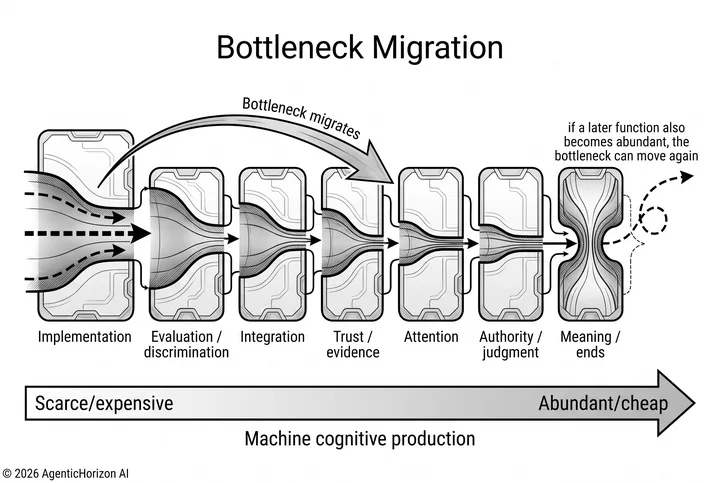
AbundanceLab is the foundational research arm of AgenticHorizon AI. Its central law is simple and unforgiving: when a foundational resource—computation, code generation, media synthesis, or formal derivation—crosses from scarcity into abundance, value and risk do not disappear; the bottleneck migrates to verification, meaning, governance, and human comprehension.
PLATE ABL-01A · +3 Figures Bottleneck Migration Under Cognitive Abundance As machine cognitive production becomes abundant, engineering scarcity migrates from implementation toward evaluation, integration, trust, authority, and judgment.
Module 2 · Engineering Beyond Comprehension (EBC) Post-Comprehension Architecture Spec
Engineering Beyond Comprehension (EBC): Post-Comprehension Software
How software engineering transforms when AI fabrication velocity exceeds human line-by-line code comprehension.
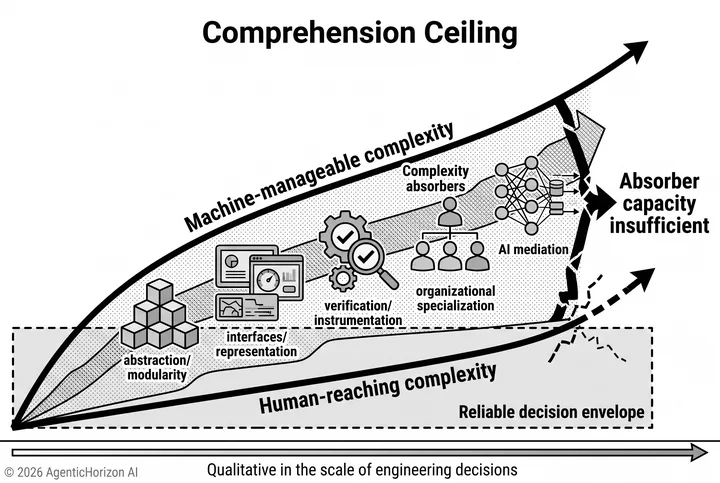
For eighty years, software engineering assumed that a human mind must comprehend every line of source code to guarantee system reliability. As autonomous cognitive fabrication loops generate millions of lines of interconnected logic, human comprehension becomes the hard physical bottleneck. Engineering Beyond Comprehension (EBC) establishes the scientific and architectural stack for post-comprehension systems.
PLATE ABL-02A · +5 Figures The Comprehension Ceiling & Reliable Human Decision Envelope Machine-manageable complexity grows far beyond direct human manipulation only when architectural absorbers keep decision-relevant complexity inside the reliable decision envelope.
Module 3 · Engineering Beyond Comprehension (EBC) 5-Level Semantic Zoom Specification
The Epistemic Telescope: 5-Level Semantic Zoom (L5–L1) & Blast-Radius Simulation
Inspecting, governing, and stress-testing million-line AI-fabricated systems across five formal abstraction levels without drowning in raw syntax.
When an autonomous fabrication loop synthesizes 50,000 lines of code overnight, presenting a human architect with a GitHub pull-request diff is cognitive theatre—humans rubber-stamp large diffs or get lost in trivial syntax. The Epistemic Telescope is the primary human-machine interface for Engineering Beyond Comprehension, enabling continuous semantic zoom from L5 Constitutional Intent down to L1 Runtime Execution Substrates.
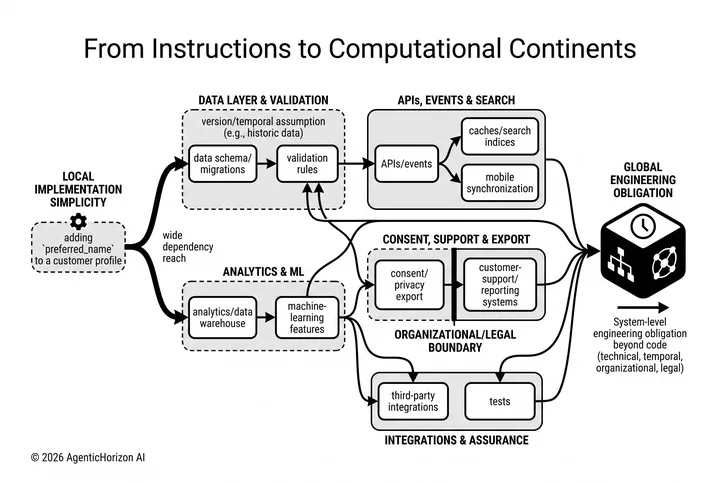
PLATE ABL-02G · +3 Figures Systemic Dependency Blast Radius of Local Schema Changes Across Distributed Stacks Visualizing how a seemingly trivial local field addition propagates across migrations, APIs, event schemas, caches, indexes, and ML pipelines.
Module 4 · Intent Compiler Compiler Architecture & Oracle Spec
The Intent Compiler & 8-Stage Cognitive Fabrication Loop
Compiling structured human intent and formal invariants into verified, self-healing software artifacts via independent verification harnesses.
The Intent Compiler replaces ad-hoc "vibe coding" with a rigorous, closed-loop engineering discipline. Humans author structured Intent Specifications and Invariant Contracts; an 8-stage Cognitive Fabrication Loop synthesizes candidate implementations, subjects them to adversarial property-based, metamorphic, and formal verification, and emits proof-carrying deployable artifacts.
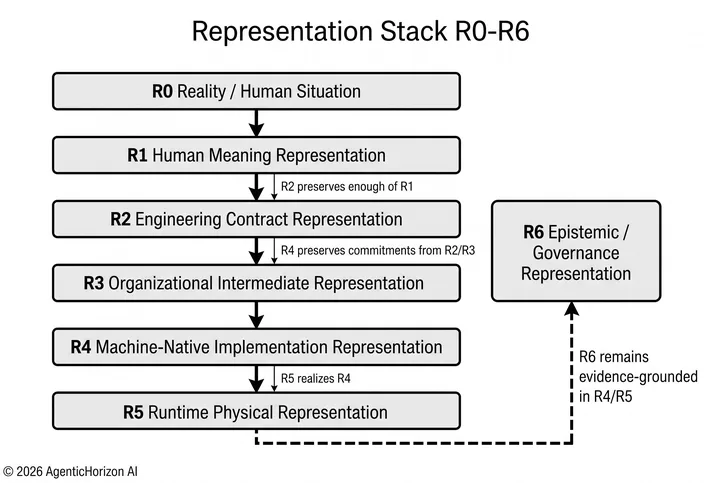
PLATE ABL-03A · +4 Figures Representation Stack R0–R6: Accountable Translation & Evidence Paths Decoupling human meaning (R1) and formal engineering commitments (R2) from machine-native synthesis (R4) and governance verification (R6).
Module 5 · Cognitive Compiler Epistemic Compiler & Software
Adaptive Epistemic Compilation: The Three-Graph Engine (K, Lₜ, Fₜ)
Control-theoretic cognitive compilation separating explanation from verified mastery—backed by a running FastAPI/SQLite engine and 390 automated tests.
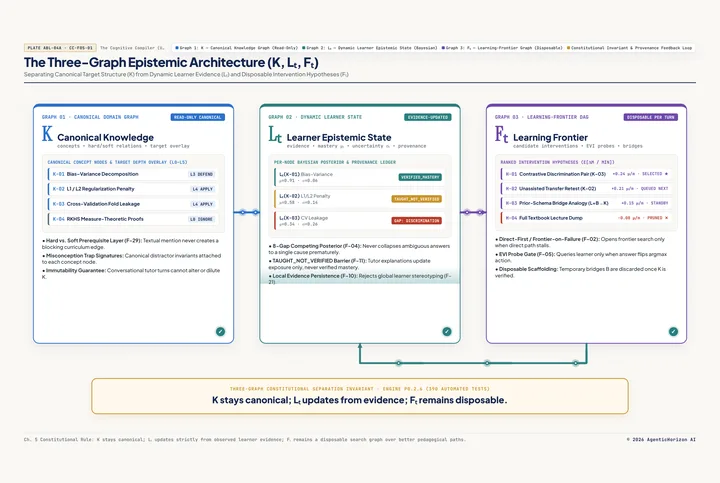
Conversational AI tutors routinely confuse fluent explanation with genuine human understanding—creating a dangerous illusion of competence. The Adaptive Epistemic Compiler formulates human capability building as a closed-loop control system over three mathematical graphs: the Canonical Knowledge Graph (K), the Dynamic Learner Epistemic State (Lₜ), and the Adaptive Compilation DAG (Fₜ).
PLATE ABL-04A · +7 Figures The Three-Graph Epistemic Architecture (K, Lₜ, Fₜ) Separating stable canonical target structure (K) from dynamic learner evidence (Lₜ) and disposable intervention hypotheses (Fₜ).
Module 6 · Post-Scarcity Domain Studies Ontologist Harness & 35 Frontiers
The Ontologist Harness & 35 Post-LLM Semantic Frontiers
The Prompt → Skill → Harness → Verified Artifact progression, the 6-Station Ontologist Workbench, and 35 neuro-symbolic research frontiers.
As organizations mature beyond raw prompting, reusable intelligence crystallizes along a strict four-stage progression: from ad-hoc Prompts to modular Skills, to deterministic Harnesses, and finally to Verified Semantic Artifacts. This module details the 6-Station AI-assisted Ontologist Workbench and maps 35 post-LLM neuro-symbolic frontiers.
PLATE ABL-05A · +3 Figures Eight-Layer Epistemic & Neuro-Symbolic Frontier Map Progression across Know, Regulate, Represent, Intervene, Control, Automatize, and Augment wrapped by closed-loop Compilation.