AgenticHorizon AI Press · 8 Volumes Across 4 Research Pillars

Books & Technical Publications.

Foundational engineering volumes and research monographs published by AgenticHorizon AI Press across Enterprise AI, Semantic Machinery, AbundanceLab, and LiA2036—spanning production agent control planes, enterprise ontologies, post-comprehension software, and the future of human learning.

AgenticHorizon AI Press · 8 Volumes · 4 Research Divisions Enterprise AI · Semantic Machinery · AbundanceLab · LiA2036
AgenticHorizon AI Press

Published & Forthcoming Volumes

Explore each volume’s architectural scope, Table of Contents, and Chapter 1 preview across Enterprise AI, Semantic Machinery, AbundanceLab, and LiA2036.

Division:
Cover View:
Volume 01 · Enterprise AI
Front Cover
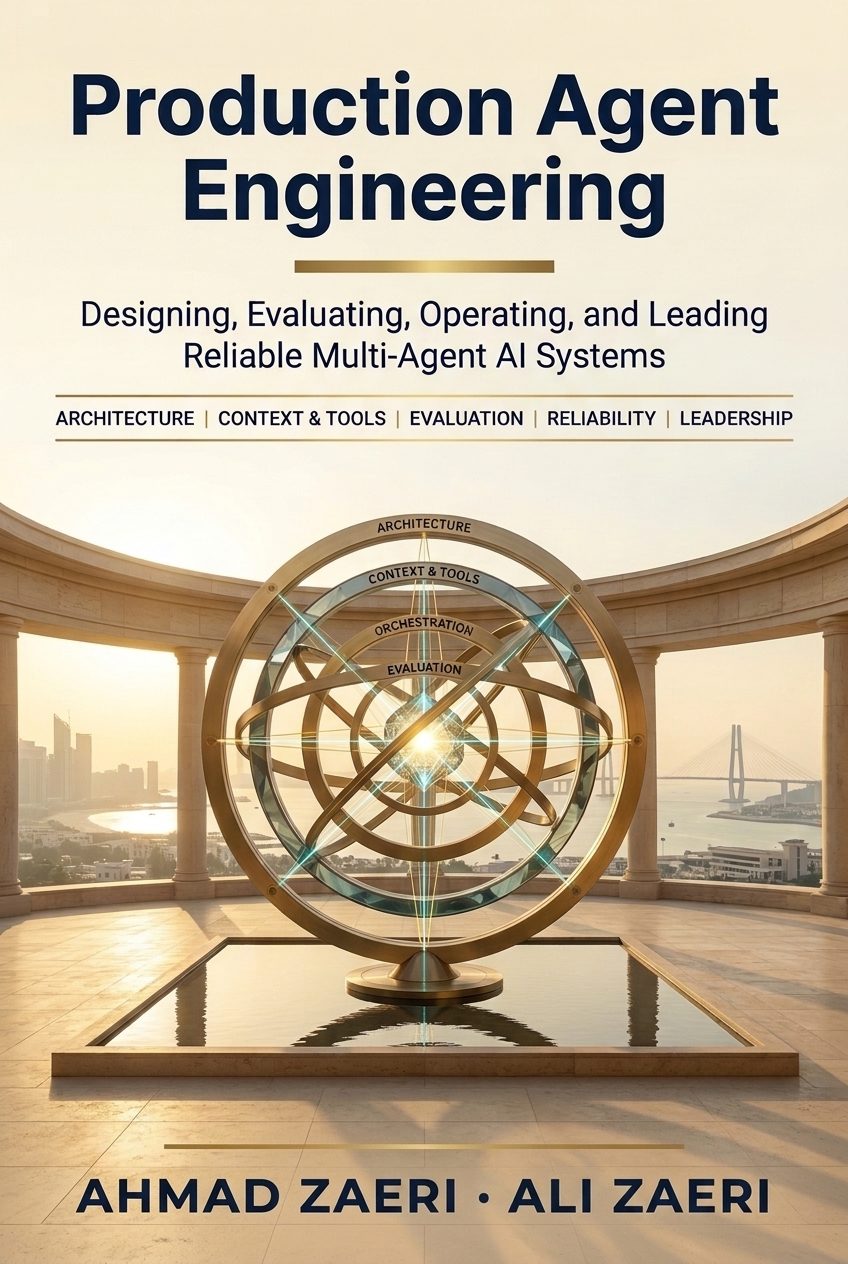
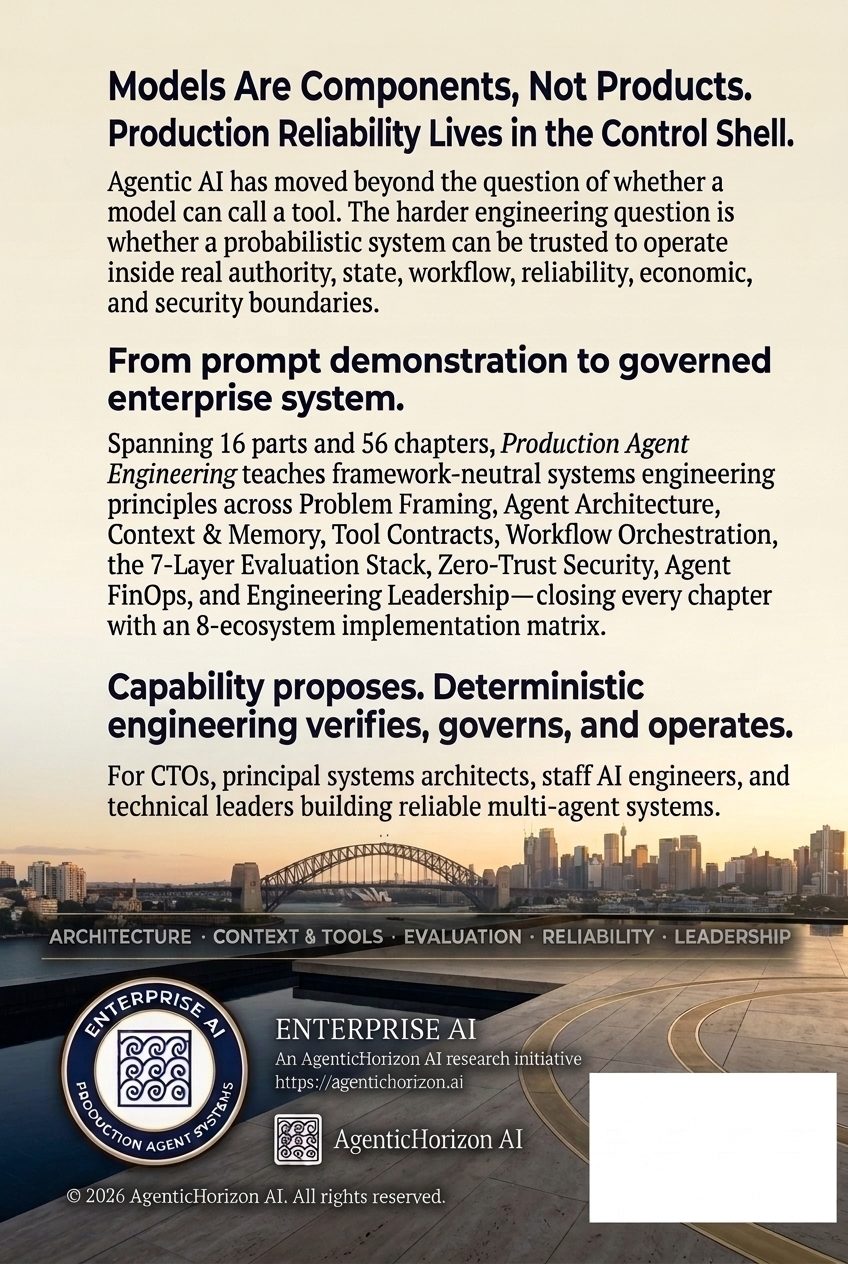
Production Agent Engineering — Front Cover (First Edition · Reader Release Candidate (B0.14))
Back Cover
Production Agent Engineering — Back Cover Synopsis and KDP Specification
Volume 01 Enterprise AI Enterprise AI Engineering Series
● Finalizing for Amazon KDP Release

Production Agent Engineering

Designing, Evaluating, Operating, and Leading Reliable Multi-Agent AI Systems

Author: Ahmad Zaeri · Ali Zaeri · Imprint: AgenticHorizon AI Press
Overview & Architectural Scope

Models Are Components, Not Products. Production Reliability Lives in the Control Shell.

Most enterprise AI initiatives fail in the gap between a compelling prompt demonstration and a governed, auditable production system. Production Agent Engineering establishes the end-to-end systems engineering discipline required to design, verify, secure, and operate multi-agent systems under real enterprise constraints.

Spanning 16 parts, 56 chapters, and 14 appendices, every chapter concludes with a normalized 8-ecosystem implementation matrix comparing architectural patterns across LangGraph, Google ADK, OpenAI Agents SDK, Anthropic MCP, AutoGen/Semantic Kernel, CrewAI, LlamaIndex Workflows, and AWS Bedrock Agents.

  • The 11-Stage Production Agent Engineering Spine: Problem → Autonomy → Architecture → Context → Tools → Orchestration → Evaluation → Reliability → Security → Operations → Leadership
  • The 5-Layer Production Agent Boundary & 60/30/10 Context Compilation Budget
  • The 7-Layer Agent Evaluation Stack, 14-Class Failure Taxonomy, and Agent FinOps (Cost Per Successful Task)
  • 6 End-to-End Industry Case Studies (Ch 47–52) & The 30-Day Production Agent Playbook + Scorecard (Ch 53–56)
For CTOs, Principal Systems Architects, Staff AI Engineers, and Engineering Leaders.
Table of Contents 16 Parts · 56 Chapters · 14 Appendices
Part I
From AI Capability to Production Value
Chapters 1–3

Discipline, Business Problem Framing & Customer Trust

  1. Chapter 1 The Production Agent Engineering Discipline
  2. Chapter 2 Starting from the Business Problem
  3. Chapter 3 Designing for Customer Trust
Part II
Agent Architecture
Chapters 4–7

Anatomy, Architectural Patterns, Decomposition & Multi-Agent Coordination

  1. Chapter 4 The Anatomy of a Production Agent
  2. Chapter 5 Agentic Architecture Patterns
  3. Chapter 6 When Multi-Agent Systems Make Sense
  4. Chapter 7 Multi-Agent Coordination
Part III
Tools, Actions, and External Systems
Chapters 8–10

Tool Contracts, Idempotency, Error Taxonomies, MCP & Integration Boundaries

  1. Chapter 8 Tool Calling as a Systems Problem
  2. Chapter 9 Designing Reliable Agent Tools
  3. Chapter 10 APIs, MCP, and Agent Integration Layers
Part IV
Context, State, and Memory
Chapters 11–14 Full Edition

Context Engineering, Agentic Retrieval, State Machines & Memory Architectures

Part V
Planning and Workflow Orchestration
Chapters 15–17 Full Edition

Explicit Planning, Durable Workflows & Autonomy Envelopes

Part VI
Evaluation: The Core Production Discipline
Chapters 18–24 Full Edition

7-Layer Evaluation Stack, Golden Datasets, Trajectory Scoring & CI/CD Gates

Part VII–X
Reliability, Observability, Latency/Cost Economics & Zero-Trust Security
Chapters 25–34 Full Edition

Failure Modes, Guardrails, OpenTelemetry Tracing, FinOps & Governance

Part XI–XVI
AI-Native Engineering, Agent UX, Leadership, 6 Case Studies & 30-Day Playbook
Chapters 35–56 + Appendices A–N Full Edition

End-to-End Case Studies, Readiness Scorecard & Templates
Volume 02 · Enterprise AI
Front Cover
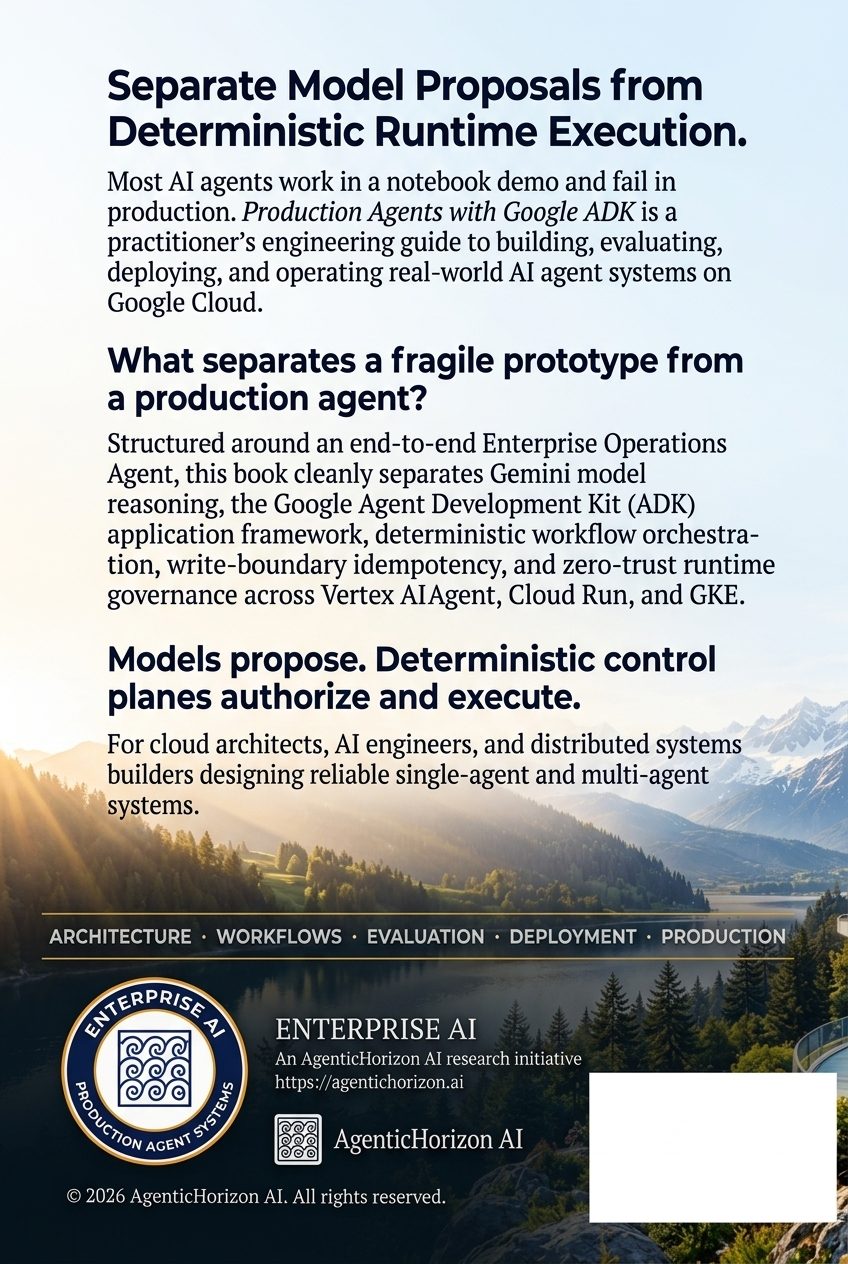
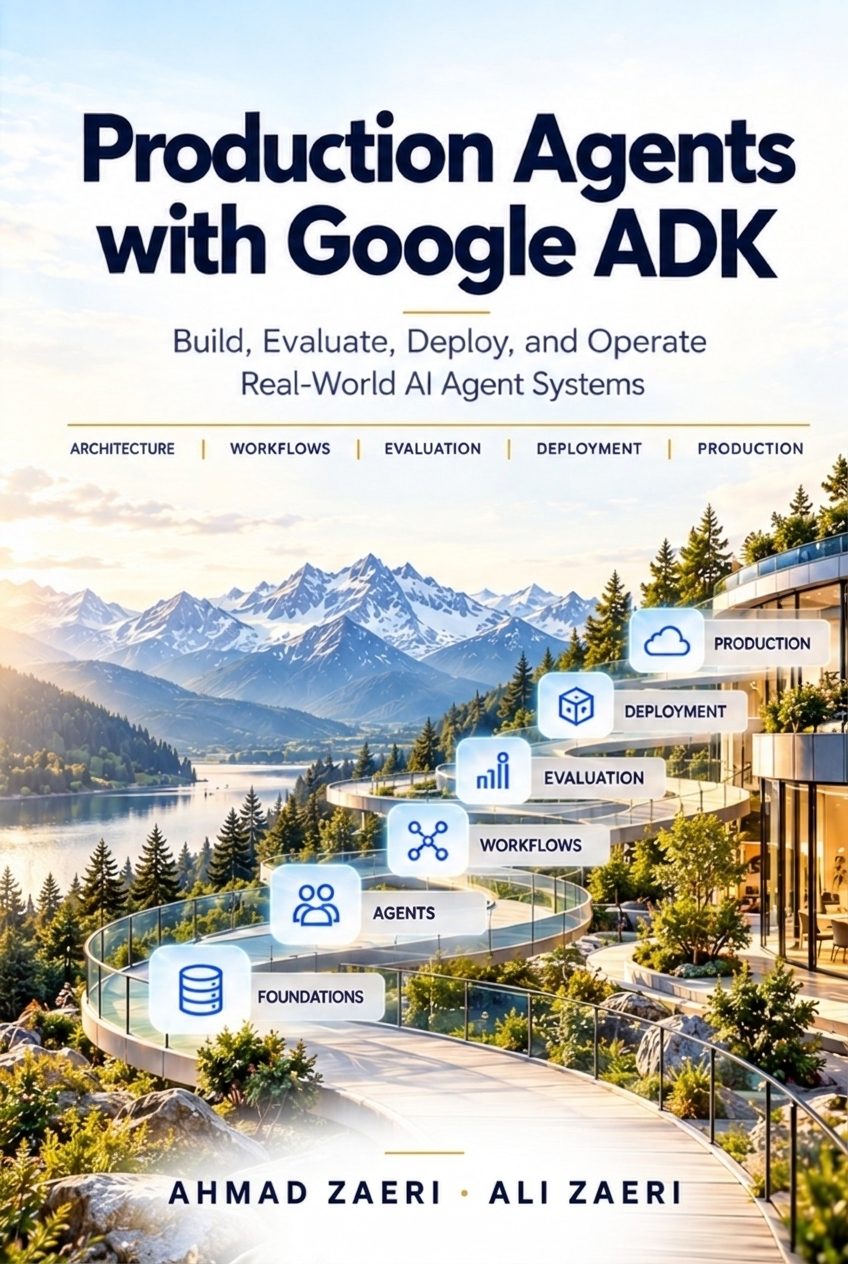
Production Agents with Google ADK — Front Cover (First Edition · Reader Edition (B0.11))
Back Cover
Production Agents with Google ADK — Back Cover Synopsis and KDP Specification
Volume 02 Enterprise AI Enterprise AI Engineering Series
● Finalizing for Amazon KDP Release

Production Agents with Google ADK

Build, Evaluate, Deploy, and Operate Real-World AI Agent Systems

Author: Ahmad Zaeri · Ali Zaeri · Imprint: AgenticHorizon AI Press
Overview & Architectural Scope

Separate Model Proposals from Deterministic Runtime Execution on Google Cloud.

Production Agents with Google ADK is a practitioner treatise structured around an evolving Enterprise Operations Agent on Google Cloud. It cleanly separates Gemini (model capability), Google ADK (agent application framework), Agents CLI (lifecycle, evaluation, and deployment tooling), and Vertex AI Agent Engine / Cloud Run / GKE (managed infrastructure).

Every chapter includes concrete failure-mode engineering, lifecycle callback interception patterns, and senior/principal architecture review drills.

  • The 4-Layer Google Agent Stack & 5-Domain Deterministic Control Shell
  • Scoped Session State (session.state, user:, app:, temp:) & Context Compaction vs. Memory
  • Write-Boundary Idempotency, Proposal-vs-Execution Separation, and before_tool / after_tool Callbacks
  • Supervisor–Specialist Delegation Budgets, A2A Distributed Boundaries, Model Armor & Confused-Deputy Defense
For Cloud Architects, ADK & Vertex AI Engineers, and Principal Distributed Systems Designers.
Table of Contents 12 Chapters · 12 Appendices · 4 Production Labs
Part I
Production Mental Model, Application Boundaries & Scoped State
Chapters 1–3

5-Domain Control Shell, Reproducible ADK Structure & Session/Memory Services

  1. Chapter 1 The ADK Production Mental Model
  2. Chapter 2 Building ADK Applications Correctly
  3. Chapter 3 Sessions, State, Context, and Memory
Part II
Safe Tool Execution, Deterministic Workflows & Multi-Agent Topologies
Chapters 4–6

Write-Boundary Idempotency, Sequential/Parallel/Loop Agents & A2A Delegation

  1. Chapter 4 Production-Grade Tool Calling
  2. Chapter 5 Workflow Agents and Deterministic Orchestration
  3. Chapter 6 Multi-Agent Systems with ADK
Part III
Runtime Interception Callbacks, Policy Guardrails & Trajectory Evaluation
Chapters 7–8

Lifecycle Callbacks, Policy-as-Code & Local-to-CI Evaluation Gates

  1. Chapter 7 Callbacks, Policies, Guardrails, and Control
  2. Chapter 8 Evaluation: From Local Evals to Production Quality
Part IV
Cloud Trace Observability, Google Cloud Deployment, Zero-Trust Security & Platform Readiness
Chapters 9–12 + Appendices A–L Full Edition

OpenTelemetry, Agent Engine vs. Cloud Run vs. GKE, Model Armor & Confused-Deputy Defense

Volume 03 · Semantic Machinery
Front Cover
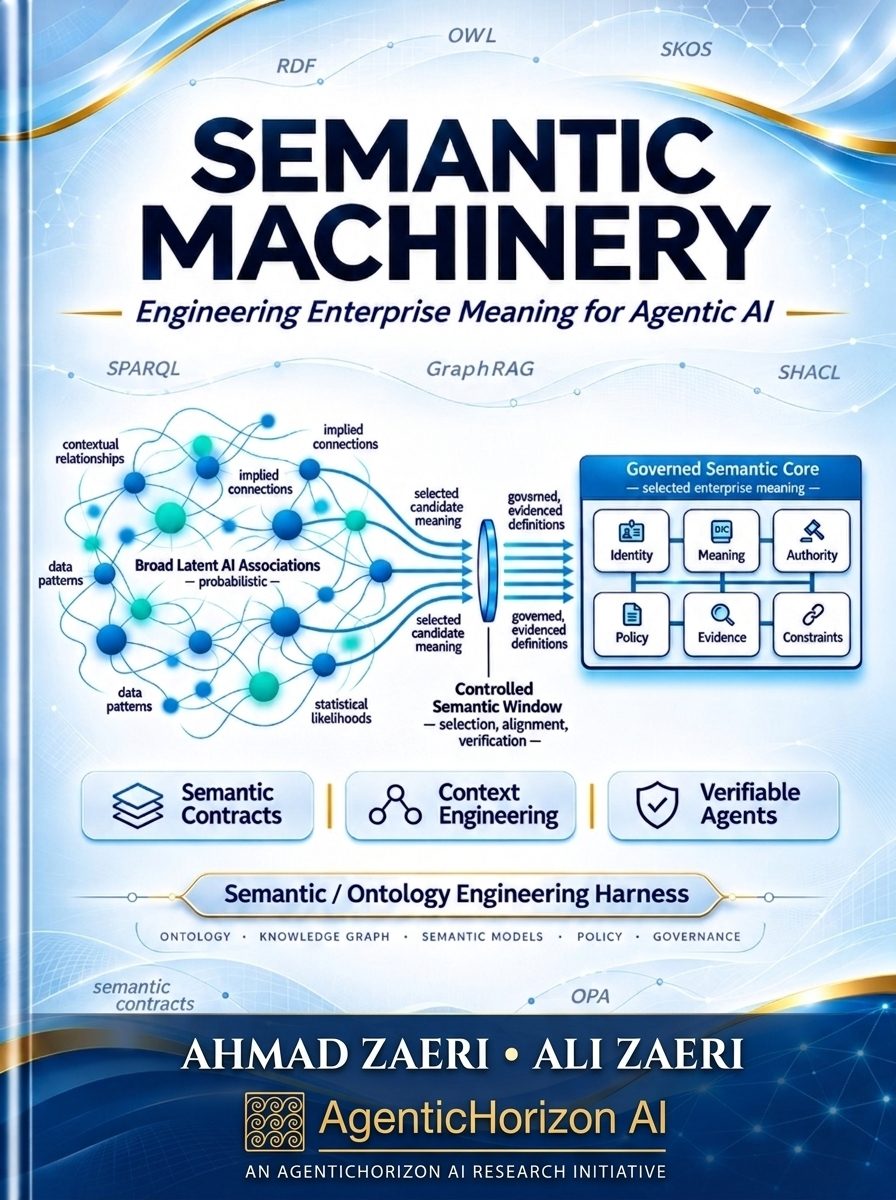
Semantic Machinery — Front Cover (First Edition · Digital Release Candidate (v5.73))
Back Cover
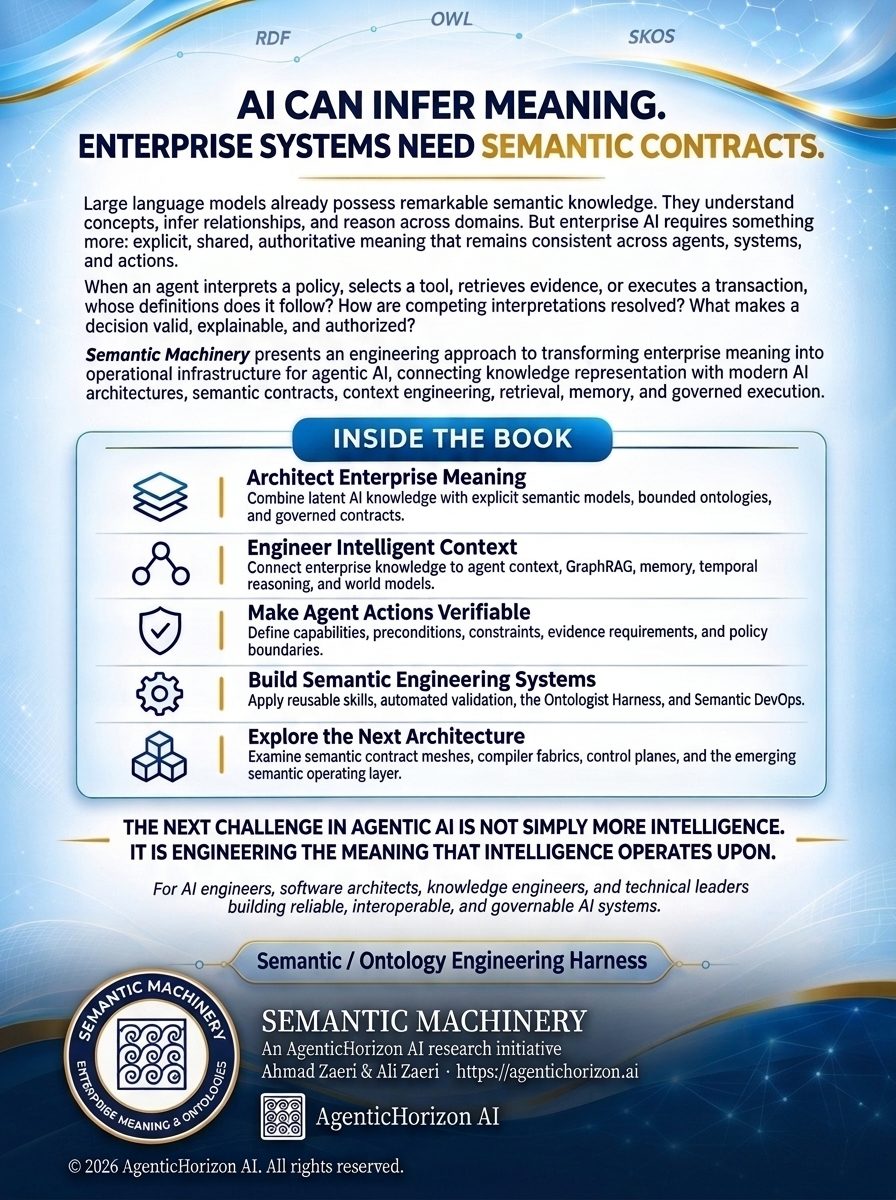
Semantic Machinery — Back Cover Synopsis and KDP Specification
Volume 03 Semantic Machinery Semantic Machinery & Enterprise Ontology Series
● Finalizing for Amazon KDP Release

Semantic Machinery

Engineering Enterprise Meaning for Agentic AI

Author: Ahmad Zaeri · Ali Zaeri · Imprint: Semantic Machinery · AgenticHorizon AI Press
Overview & Architectural Scope

AI Can Infer Meaning. Enterprise Systems Need Semantic Contracts.

Modern language models already possess vast world knowledge, yet enterprise AI initiatives routinely fail when systems move from conversation to real operational decisions. The missing layer is not model intelligence—it is explicit, governed enterprise meaning.

Semantic Machinery introduces the engineering discipline required to design, govern, and operate semantic infrastructure for agentic AI—combining ontologies, knowledge graphs, bitemporal context engineering, and closed-world W3C SHACL action gates.

  • Architect Enterprise Meaning: Minimum Viable Semantics (L1–L7), taxonomies, schemas, knowledge graphs, and ontologies
  • Engineer Intelligent Context: Bitemporal GraphRAG, provenance chains, and structured semantic memory
  • Make Agent Actions Verifiable: Closed-world W3C SHACL validation gates, authority boundaries, and policy constraints
  • Build Semantic Engineering Systems: The 6-Station Ontologist Harness, semantic CI/CD, and 8-platform industrial benchmarks
Essential reading for AI architects, data platform leaders, ontologists, knowledge graph engineers, and technical executives building production agentic systems.
Table of Contents 8 Parts · 23 Chapters · 175 Sections
Part I
Conceptual Foundation & Decision Framework
Chapters 1–3

Institutional Meaning, Human–Machine Contracts & The L1–L7 Spectrum

  1. Chapter 01 The Machine Already Knows the World
  2. Chapter 02 From Machine Understanding to Human–Machine Contract
  3. Chapter 03 How Much Semantics Do You Actually Need?
Part II
The Enterprise Semantic Stack & Reference Architecture
Chapters 4–6

Schemas, Taxonomies, Property/RDF Graphs, OWL, SHACL & Contract Meshes

  1. Chapter 04 Schemas, Taxonomies, Knowledge Graphs, and Ontologies
  2. Chapter 05 The Hybrid Semantic Architecture for Enterprise AI
  3. Chapter 06 Semantic Contracts in an Enterprise System
Part III
Platform & Domain Implementation Evidence
Chapters 7–8

8 Commercial Semantic Platforms & 6 Regulated Industry Blueprints

  1. Chapter 07 Enterprise Semantic Platforms in Practice
  2. Chapter 08 Semantic Systems Across Enterprise Domains
Part IV
Engineering Enterprise Meaning
Chapters 9–12 Full Edition

Bounded Semantics, 3-Layer Extension Model, PROV-O Provenance & FIBO/FHIR Alignment

Part V
Semantics Inside Agentic AI Runtime
Chapters 13–16 Full Edition

Semantic Context Engineering, Bitemporal GraphRAG, World Models & Kinetic Tool Affordances

Part VI
Governed and Verifiable Action
Chapters 17–19 Full Edition

Pre-Execution SHACL Validation Gates, OPA/Cedar Governance & Proof-Carrying Abstention

Part VII–VIII
Semantic Engineering Discipline, The Ontologist Harness & 35 Frontiers
Chapters 20–23 Full Edition

Prompt-to-Harness Progression, 6-Station Ontologist Workbench, Semantic CI/CD & Future Fabrics

Volume 04 · AbundanceLab
Front Cover
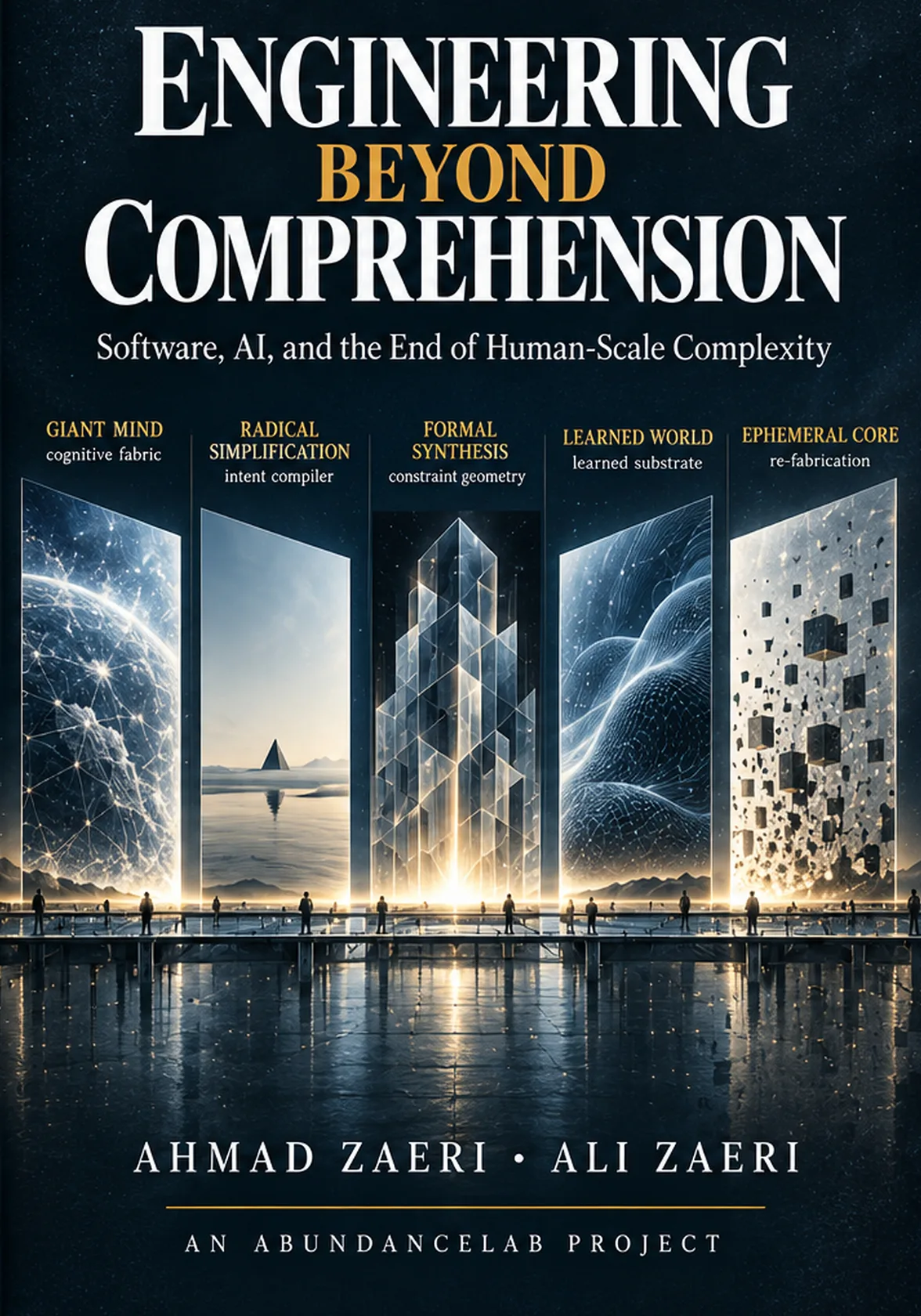
Engineering Beyond Comprehension — Front Cover (First Edition · Editorial Author Proof (v2.11.5))
Back Cover
Engineering Beyond Comprehension — Back Cover Synopsis and KDP Specification
Volume 04 AbundanceLab AbundanceLab Flagship Monograph Series
● Finalizing for Amazon KDP Release

Engineering Beyond Comprehension

Software, AI, and the End of Human-Scale Complexity

Author: Ahmad Zaeri · Ali Zaeri · Imprint: AbundanceLab · AgenticHorizon AI Press
Overview & Architectural Scope

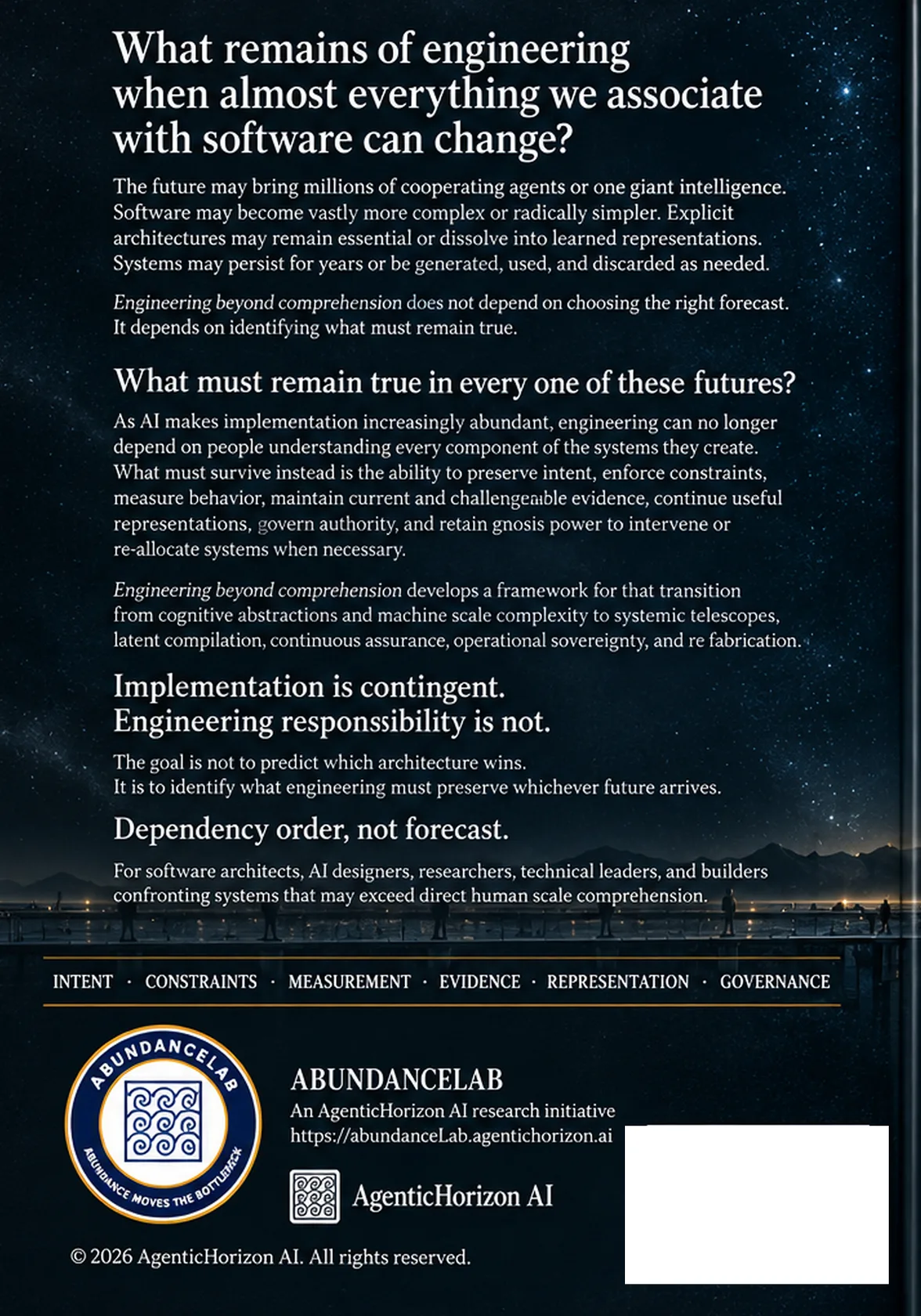
What Remains of Engineering When Almost Everything We Associate with Software Can Change?

The future may bring millions of cooperating agents or one giant intelligence. Software may become vastly more complex or radically simpler. Explicit architectures may remain essential or dissolve into learned representations. Systems may persist for years or be generated, used, and discarded as needed.

As AI makes implementation increasingly abundant, engineering can no longer depend on people understanding every component of the systems they create. What must survive instead is the ability to preserve intent, enforce constraints, measure behavior, maintain current and challengeable evidence, continue useful representations, govern authority, and retain power to intervene or re-fabricate systems when necessary.

  • Implementation is contingent. Engineering responsibility is not — Dependency order, not forecast (INTENT · CONSTRAINTS · MEASUREMENT · EVIDENCE · REPRESENTATION · GOVERNANCE)
  • The 9 Dimensions of Engineering Comprehension Burden (ECB) & The VLSI / EDA Software Foundry Inversion
  • The Epistemic Telescope: 5-Level Semantic Zoom (L5 Constitutional → L1 Substrate) & Causal Navigation
  • The 8-Stage Intent Compiler & Zero-Trust Cognitive Fabrication Loop
For software architects, AI designers, researchers, technical leaders, and builders confronting systems that may exceed direct human-scale comprehension.
Table of Contents 5 Parts · 20 Chapters · 200 Sections
Part I
The End of Human-Scale Software
Chapters 1–4

When the Limiting Resource Is No Longer Computation, but Human Cognition

  1. Chapter 1 The Software We Can No Longer Hold in Our Heads
  2. Chapter 2 Coding Was a Historical Necessity
  3. Chapter 3 Cognitive Abundance Arrives
  4. Chapter 4 Changing the Scale of the Engineer
Part II
How Civilization Escaped Human Limits
Chapters 5–8

Cognitive Offloading, Institutional Mind, The Microscope Moment & Metrology

  1. Chapter 5 The Externalization of Mind
  2. Chapter 6 The Institutional Mind
  3. Chapter 7 The Microscope Moment
  4. Chapter 8 From Seeing to Controlling
Part III
How Complexity Became Engineerable
Chapters 9–12

Interchangeable Parts, VLSI/EDA Foundries, Trust Without Inspection & Software Foundries

  1. Chapter 9 Standardization: The Forgotten Revolution
  2. Chapter 10 The Transistor Was Only the Beginning
  3. Chapter 11 Trust Without Inspection
  4. Chapter 12 Why AI Code Generation Is Not Yet a Foundry
Part IV
Discovering the Post-Code Engineering Stack
Chapters 13–16 (40 Sections) Full Edition

Cognitive Material, Architecture as Law, Developmental Software & The Epistemic Telescope

Part V
Cognitive Fabrication
Chapters 17–20 (40 Sections) Full Edition

The Intent Compiler, The Cognitive Fabrication Loop, Governing Beyond Comprehension & After Software Engineering

Volume 05 · LiA2036
Front Cover
The Cognitive Compiler — Front Cover (First Edition · Unified Release (U1.20.0 / Book B0.6.9))
Back Cover
The Cognitive Compiler — Back Cover Synopsis and KDP Specification
Volume 05 LiA2036 LiA2036 Adaptive Epistemic Compilation Monograph
● In Preparation · Forthcoming on Amazon KDP

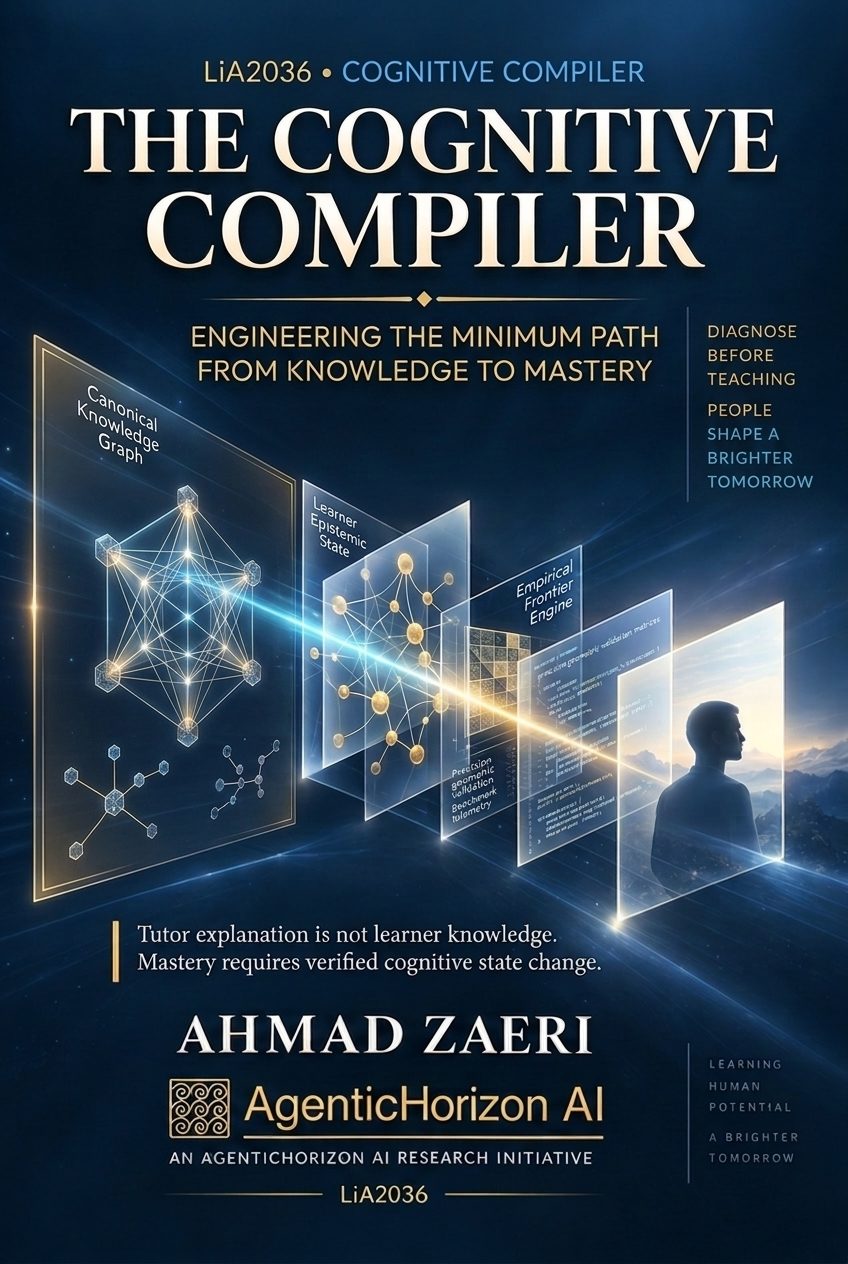
The Cognitive Compiler

Engineering the Minimum Path from Knowledge to Mastery

Author: Ahmad Zaeri · Imprint: LiA2036 · AgenticHorizon AI Press
Overview & Architectural Scope

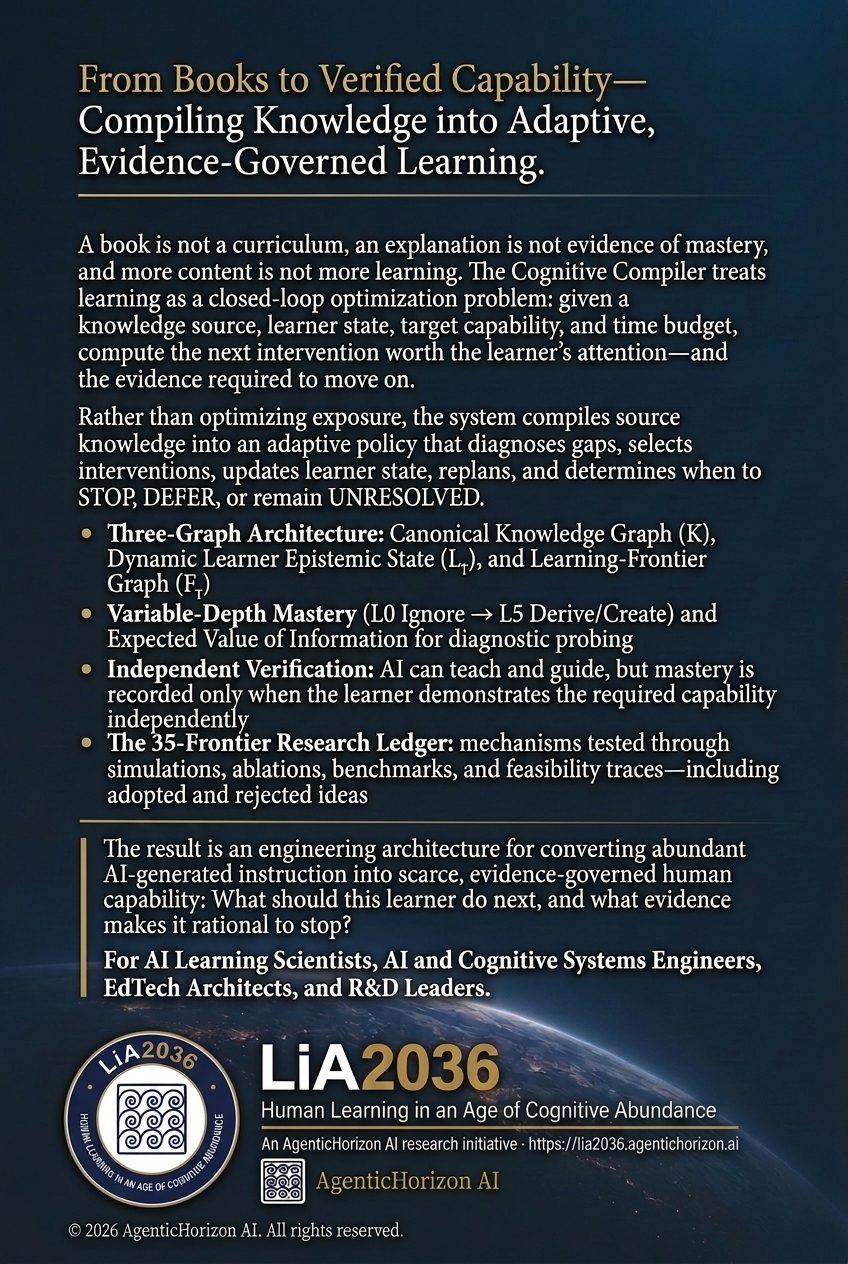
From Books to Verified Capability—Compiling Knowledge into Adaptive, Evidence-Governed Learning.

A book is not a curriculum, an explanation is not evidence of mastery, and more content is not more learning. The Cognitive Compiler treats learning as a closed-loop optimization problem: given a knowledge source, learner state, target capability, and time budget, compute the next intervention worth the learner’s attention—and the evidence required to move on.

Rather than optimizing exposure, the system compiles source knowledge into an adaptive policy that diagnoses gaps, selects interventions, updates learner state, replans, and determines when to STOP, DEFER, or remain UNRESOLVED.

  • Three-Graph Architecture: Canonical Knowledge Graph (K), Dynamic Learner Epistemic State (Lₜ), and Learning-Frontier Graph (Fₜ)
  • Variable-Depth Mastery (L0 Ignore → L5 Derive/Create) and Expected Value of Information for diagnostic probing
  • Independent Verification: AI can teach and guide, but mastery is recorded only when the learner demonstrates the required capability independently
  • The 35-Frontier Research Ledger: mechanisms tested through simulations, ablations, benchmarks, and feasibility traces—including adopted and rejected ideas

The result is an engineering architecture for converting abundant AI-generated instruction into scarce, evidence-governed human capability: What should this learner do next, and what evidence makes it rational to stop?

For AI Learning Scientists, AI and Cognitive Systems Engineers, EdTech Architects, and R&D Leaders.
Table of Contents 5 Parts · 20 Chapters · 10 Appendices
Part I
The Problem: From Content Delivery to Cognitive Control
Chapters 1–4

Task-Ready Mastery per Learner Minute, L0–L5 Mastery & Sequential Control

  1. Chapter 1 Why Reading Is the Wrong Objective
  2. Chapter 2 From Content Delivery to Cognitive Compilation
  3. Chapter 3 What Does It Mean to Know Something?
  4. Chapter 4 Learning as a Control Problem
Part II
Building the Cognitive Compiler
Chapters 5–8

The Three Graphs (K, Lₜ, Fₜ), Diagnostic Probing & Minimum Intervention

  1. Chapter 5 The Three Graphs
  2. Chapter 6 Diagnose Before Teaching
  3. Chapter 7 The Gap Is More Important Than the Topic
  4. Chapter 8 The Minimum Intervention Principle
Part III
Learning Under Uncertainty
Chapters 9–12

Calibrated Epistemic Intervals, EVI(q) Probing & The TAUGHT_NOT_VERIFIED Barrier

  1. Chapter 9 Never Collapse the Learner Too Early
  2. Chapter 10 When Is Another Question Worth Asking? (Expected Value of Information EVI(q) vs. learner fatigue, attention budget, and interaction cost)
  3. Chapter 11 Tutor Knowledge Is Not Learner Knowledge
  4. Chapter 12 STOP, DEFER, and UNRESOLVED
Part IV
The Frontier Engine
Chapters 13–16 Full Edition

8 Frontier Families (KNOW, REGULATE, REPRESENT, INTERVENE, CONTROL, AUTOMATIZE, AUGMENT, COMPILE), Adopted Mechanisms & Rejected Hypotheses

Part V
From Book to Optimized Curriculum & Appendices A–J
Chapters 17–20 + Appendices A–J Full Edition

PDF Ingestion, Mention ≠ Prerequisite, Global Curriculum Optimizer & Human Pilot Traces (PILOT-001, PILOT-002)

Volume 06 · LiA2036 Book I · LiA2036
Front Cover
A New Philosophy of Learning — Front Cover (First Digital Edition · Publication Build v3.0 (v1.0.2))
Back Cover
A New Philosophy of Learning — Back Cover Synopsis and KDP Specification
Volume 06 · LiA2036 Book I LiA2036 The LiA2036 Trilogy · Book I (Capability)
● Finalizing for Amazon KDP Release

A New Philosophy of Learning

Education for the Age of Superintelligence

Author: Ahmad Zaeri · Imprint: LiA2036 · AgenticHorizon AI Press
Overview & Architectural Scope

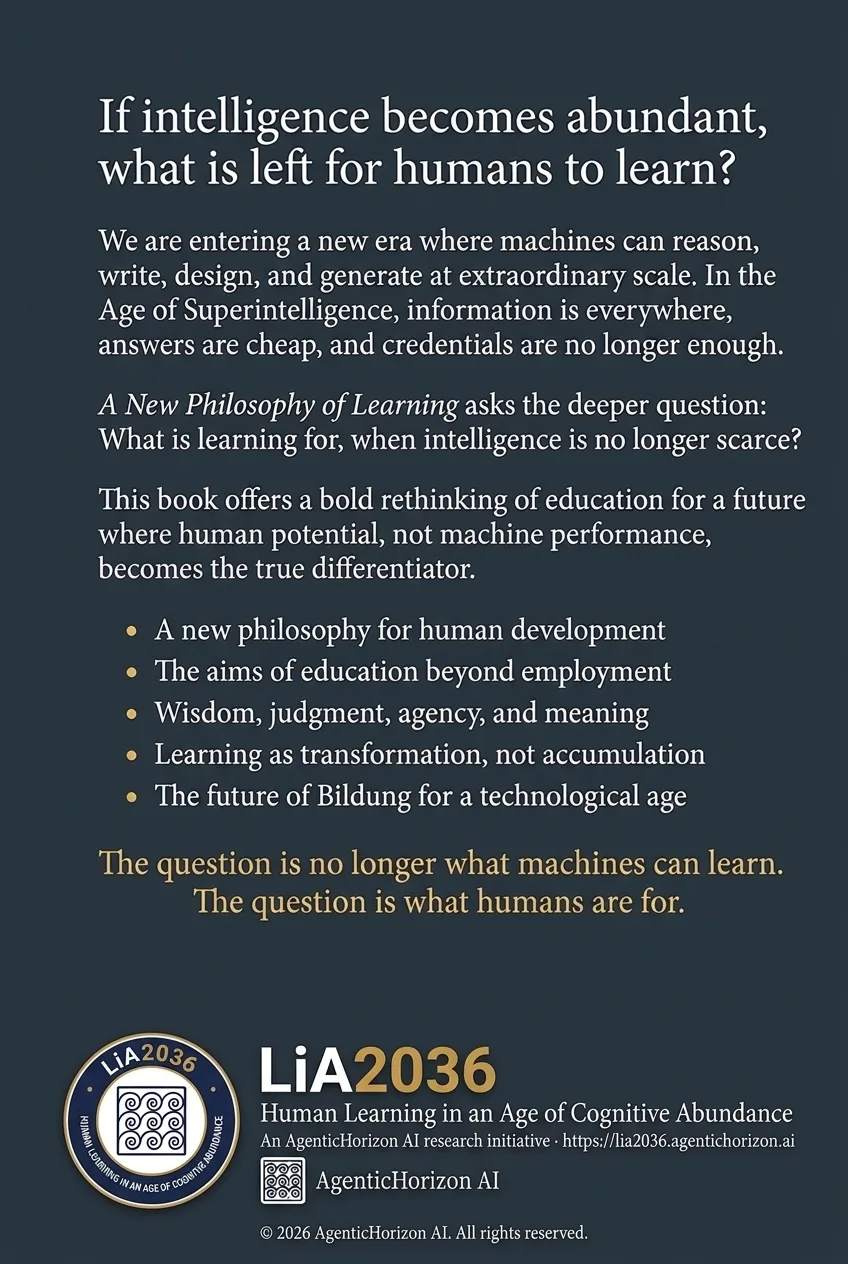
What Should Humans Learn Deeply When Intelligence Becomes an Environmental Condition?

Book I of the LiA2036 Trilogy (Capability → Experience → Institution) begins from a structural shift in human history: generative and agentic AI have made plausible answers, code, and explanations abundant on demand. When output ceases to be a reliable proxy for understanding, education cannot be reduced to "AI literacy" or prompt policy.

A New Philosophy of Learning establishes a rigorous capability architecture for human sovereignty—defining what must remain internally developed, when productive friction must be protected, how to allocate cognitive labor between humans and AI, and how to redesign degrees from course catalogs into computable capability graphs.

  • The Abundance Inversion & The Productive Friction Principle (Distinguishing Constitutive Formation from Mechanical Drudgery)
  • The 6-Element Sovereign Cognitive Core & The 3D Capability Space (Epistemic Depth × Integration × Participation)
  • The 10-Variable LASD Decision Matrix: Learn · Augment · Supervise · Delegate
  • The F-A-I-F Curriculum Architecture (Foundation · Anchor · Integration · Frontier) & The 14-Step 2036 Degree Redesign Pipeline
For University Presidents, Provosts, Curriculum Deans, Education Policy Makers, and Philosophers of Mind & Education.
Table of Contents 5 Parts · 20 Chapters · 50+ Term Glossary
Part I
The Cognitive Shift
Chapters 1–4

Education for Another Cognitive World, Cognitive Load History, Abundance Inversion & Productive Friction

  1. Chapter 1 Education for Another Cognitive World
  2. Chapter 2 The Cognitive Load Shift Across Human History
  3. Chapter 3 The Abundance Inversion
  4. Chapter 4 Productive Friction
Part II
Redesigning Human Capability
Chapters 5–8

The 6-Element Cognitive Core, 3D Capability Space, Agency/Judgment & Capability Specifications

  1. Chapter 5 The Cognitive Core
  2. Chapter 6 The 3D Capability Space
  3. Chapter 7 Agency, Judgment, and Purpose
  4. Chapter 8 Beyond the Future-Skills List
Part III
Humans and Artificial Intelligence
Chapters 9–12

Beyond AI Literacy, The 10-Variable LASD Decision, Cognitive Partnerships & Division of Cognitive Labour

  1. Chapter 9 Beyond AI Literacy: What Humans Need to Learn
  2. Chapter 10 The Learn / Augment / Supervise / Delegate Decision
  3. Chapter 11 Designing Human–AI Cognitive Partnerships
  4. Chapter 12 The New Division of Cognitive Labour
Part IV
From Disciplines to Capability Networks
Chapters 13–16 Full Edition

Epistemic Anchors, Boundary Capability, The Computable Curriculum Graph & Coherent Personalization

Part V
Curriculum Designer 2036 & Canonical Glossary
Chapters 17–20 + 50-Term Glossary Full Edition

Foundation–Anchor–Integration–Frontier (F-A-I-F), Capability Evidence Passports & The 14-Step Degree Redesign Pipeline

Volume 07 · LiA2036 Book II · LiA2036
Front Cover
Rethinking Educational Media — Front Cover (First Digital Edition · Publication Build v3.0 (v1.0.2))
Back Cover
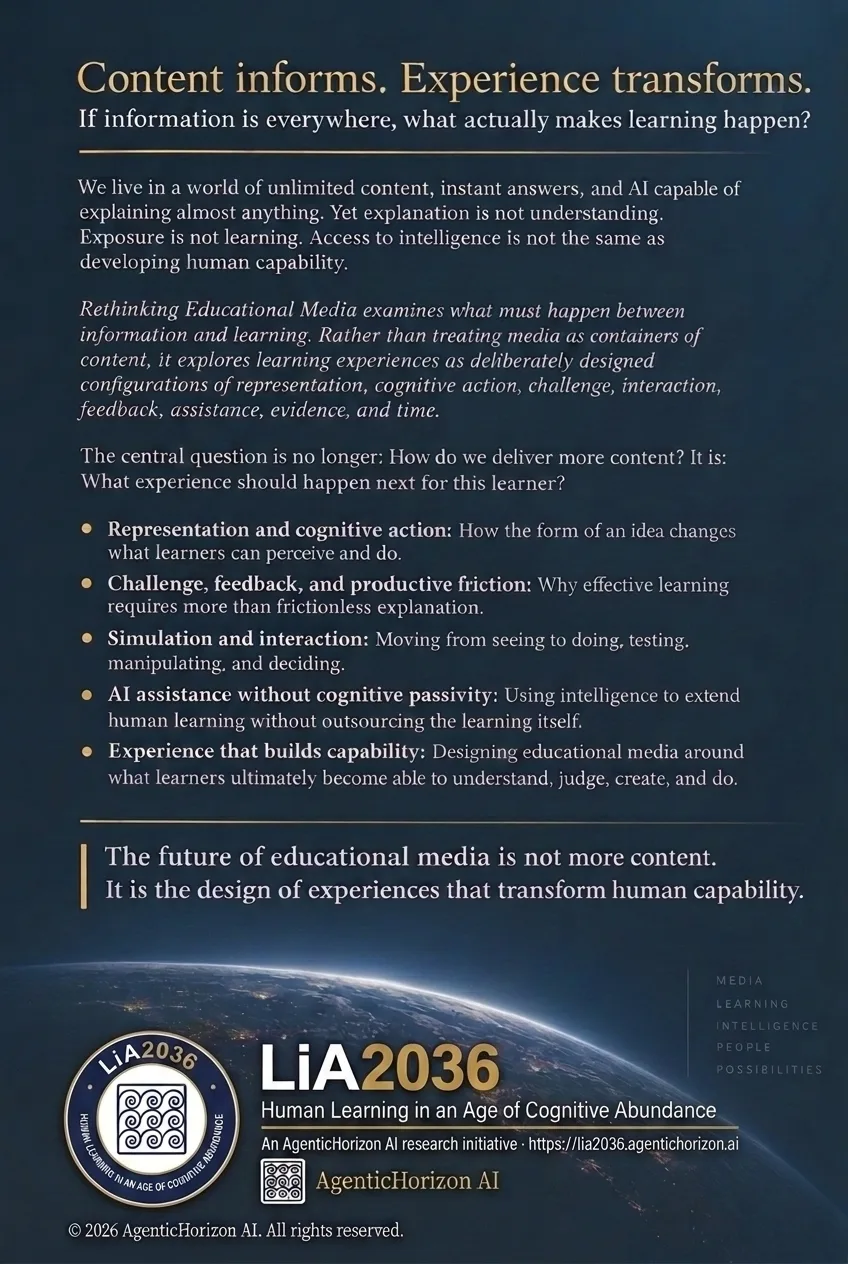
Rethinking Educational Media — Back Cover Synopsis and KDP Specification
Volume 07 · LiA2036 Book II LiA2036 The LiA2036 Trilogy · Book II (Experience)
● In Preparation · Forthcoming on Amazon KDP

Rethinking Educational Media

Designing Learning for a Superintelligent World

Author: Ahmad Zaeri · Imprint: LiA2036 · AgenticHorizon AI Press
Overview & Architectural Scope

Move from Content Delivery to Human-Governed Learning Experience Architecture.

Book II of the LiA2036 Trilogy asks how learning environments should organize representation, cognitive action, challenge, feedback, simulation, and human–AI authority so that capability is genuinely formed rather than merely displayed by an AI copilot.

Rejecting the "answer-machine tutor" paradigm, Rethinking Educational Media introduces Pedagogical Permission Gates, Deliberate AI Non-Intervention protocols, Open Contestable Learner Models, and Capability–Authority–Evidence Orchestration across collaborative human–AI studios.

  • From Passive Multimedia to Multi-Representational Competence & The Representation–Action Contract
  • The Challenge Envelope, Desirable Difficulties, and Friction-Aware Educational Media
  • Open Contestable Learner Models with Student Right-of-Challenge & Deliberate AI Non-Intervention ("Capability ≠ Permission")
  • Capability–Authority–Evidence Orchestration, Teacher–AI Partnership, and The Learning Continuity Architecture
For Learning Experience Architects, Instructional Systems Designers, EdTech Builders, and Faculty Innovators.
Table of Contents 5 Parts · 20 Chapters
Part I
From Media to Experience
Chapters 1–4

History of Mediation, Experience Architecture & Representational Competence

  1. Chapter 1 Education Has Always Been Mediated
  2. Chapter 2 The Learning Experience Shift
  3. Chapter 3 Representations and Representational Competence
  4. Chapter 4 Beyond Multimedia
Part II
What the Learner Does
Chapters 5–8

Cognitive Action, Challenge Envelopes, Dialogic Feedback & Generative Simulation

  1. Chapter 5 What the Learner Does
  2. Chapter 6 Challenge and Productive Friction
  3. Chapter 7 Feedback, Judgment, and Uptake
  4. Chapter 8 Learning Through Simulation
Part III
Intelligent but Human-Governed Environments
Chapters 9–12

Open Contestable Learner Models, AI Non-Intervention & Capability Orchestration

  1. Chapter 9 The Learner Model and Its Limits
  2. Chapter 10 The AI Tutor Reconsidered
  3. Chapter 11 The Intervention Policy Space
  4. Chapter 12 Capability-Oriented Learning Orchestration
Part IV
Learning with Other Minds
Chapters 13–16 Full Edition

Socially Regulated Learning, Teachers After Content Scarcity, Collaborative Intelligence & The Human Experience Layer

Part V
Educational Media 2036
Chapters 17–20 Full Edition

The Capability–Experience–Evidence Network, Co-Orchestrated Studios, Worked Blueprints & Learning Continuity

Volume 08 · LiA2036 Book III · LiA2036
Front Cover
Rebuilding Learning Ecosystems — Front Cover (First Digital Edition · Publication Build v3.0 (v1.0.2))
Back Cover
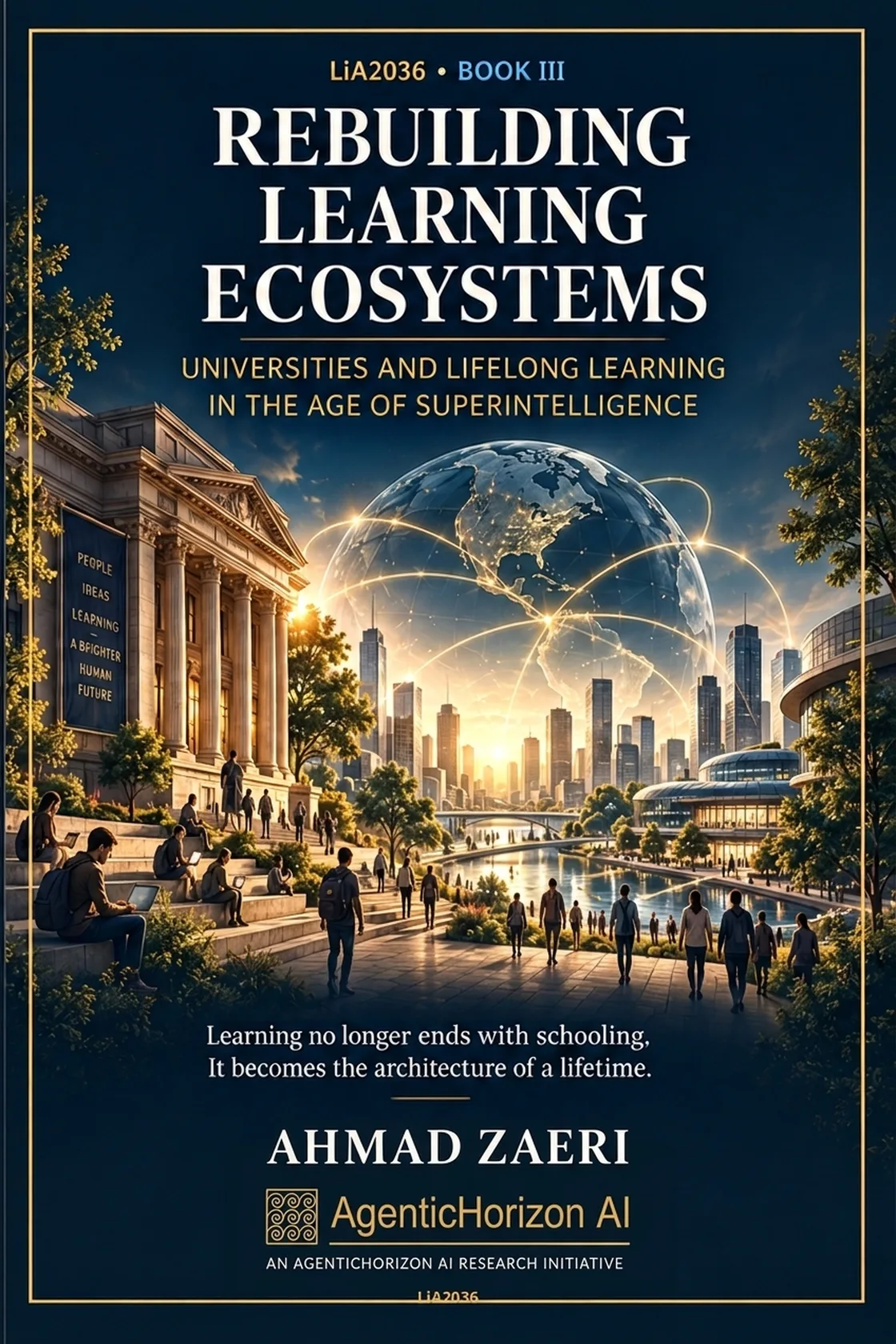
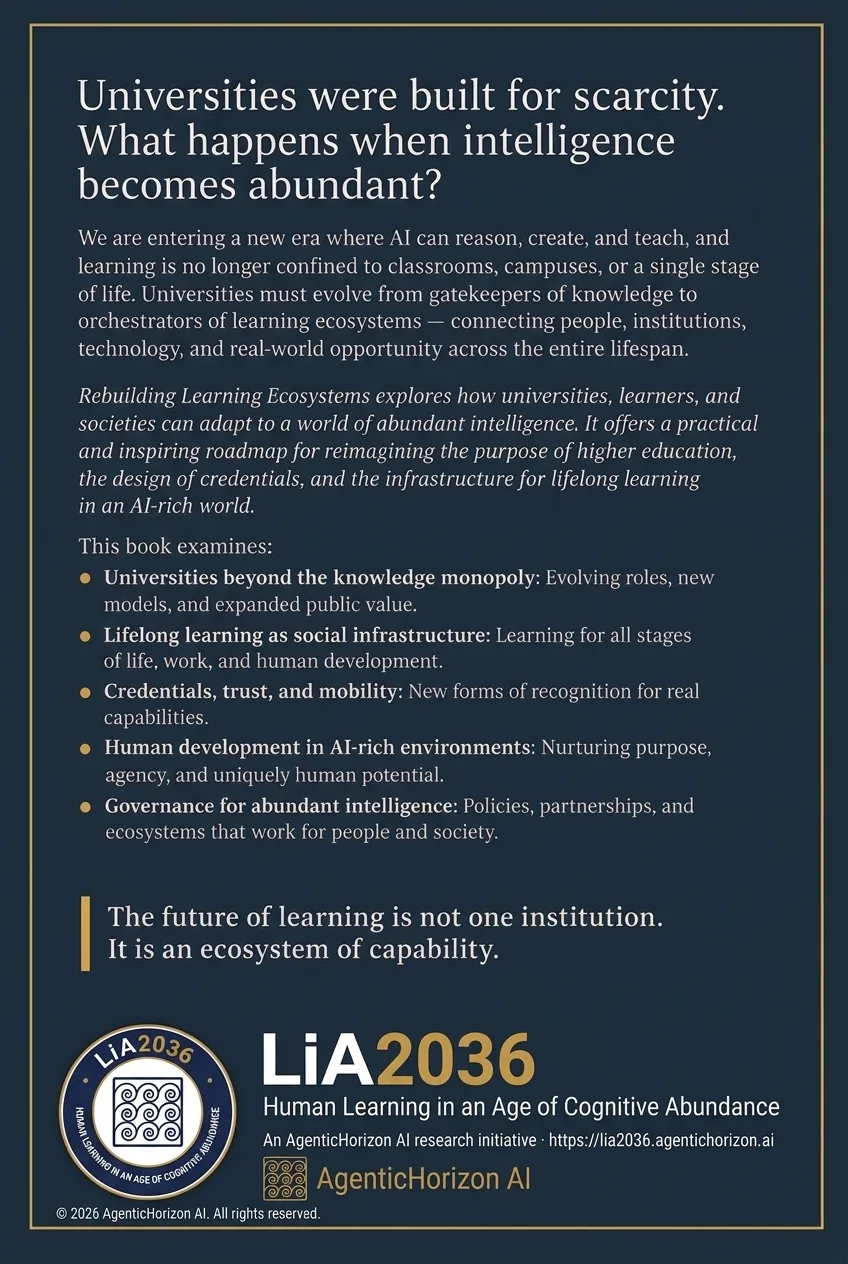
Rebuilding Learning Ecosystems — Back Cover Synopsis and KDP Specification
Volume 08 · LiA2036 Book III LiA2036 The LiA2036 Trilogy · Book III (Institution)
● In Preparation · Forthcoming on Amazon KDP

Rebuilding Learning Ecosystems

Universities and Lifelong Learning in the Age of Superintelligence

Author: Ahmad Zaeri · Imprint: LiA2036 · AgenticHorizon AI Press
Overview & Architectural Scope

The Institutional Blueprint for Universities, Credentials, and Lifelong Learning by 2036.

For centuries, the modern university organized scarcity: scarce books, scarce lectures, scarce laboratories, and scarce credentials. When generative intelligence makes synthesis and explanation ubiquitous, the university can no longer justify itself as an information-delivery pipeline—nor can it survive by retreating into surveillance theater and uncalibrated AI text detectors.

Book III of the LiA2036 Trilogy derives the complete University 2036 institutional operating architecture from the capability and experience foundations of Books I and II, providing actionable governance charters, W3C verifiable capability passports, faculty role redesigns, and staged transformation roadmaps.

  • Purpose-Derived Institutional Recomposition: What Must Remain Bundled and Institutionally Human
  • Evidence-Aware Quality Assurance & Layered W3C Capability Passports Replacing Static Transcripts
  • Institutional AI Autonomy, Governed Multi-Model Gateways, Academic Work Redesign & Learner Data Rights
  • The 6-Layer University 2036 Reference Architecture & Staged 30 / 90 / 365-Day Transition Roadmaps
For University Presidents, Boards of Trustees, Provosts, Ministries of Higher Education, and Chief Learning Officers.
Table of Contents 5 Parts · 20 Chapters
Part I
The University Under New Constraints
Chapters 1–4

Abundance of Generation, Trilogy Interface, Unbundling & The Human Institutional Core

  1. Chapter 1 The University Under New Constraints
  2. Chapter 2 From Capability and Experience to Institutional Requirements
  3. Chapter 3 Unbundling and Purpose-Derived Institutional Recomposition
  4. Chapter 4 What Must Remain Institutionally Human
Part II
The Academic Operating Architecture
Chapters 5–8

Capability Architecture, Epistemic Anchors, Evidence-Aware QA & Layered Credentials

  1. Chapter 5 From Course Architecture to Capability Architecture
  2. Chapter 6 Disciplines, Epistemic Anchors, and Cross-Disciplinary Networks
  3. Chapter 7 Assessment and Evidence-Aware Quality Assurance
  4. Chapter 8 Degree, Capability, and Credential Architecture
Part III
The Human–AI University
Chapters 9–12

Cognitive Allocation Governance, Institutional AI Autonomy, Academic Work & Learner Contestability

  1. Chapter 9 Cognitive Allocation & Authority Governance
  2. Chapter 10 Institutional AI Autonomy, Academic Freedom, and Infrastructure
  3. Chapter 11 Academic Work Architecture
  4. Chapter 12 Learner Models, Data Rights, and Contestability
Part IV
The University as a Living System
Chapters 13–16 Full Edition

Renewable Lifelong Relationships, Research Epistemic Responsibility, Campus Revaluation & Institutional Economics

Part V
University 2036 Reference Architecture & Transition Roadmap
Chapters 17–20 Full Edition

The 6-Layer University 2036 Operating Architecture, Accreditation, Staged Transition Roadmap & Public Legitimacy

Corresponding Online Architecture Specifications on AgenticHorizon AI:
Amazon KDP Release Dispatches & Video Walkthroughs

Subscribe on Substack & YouTube for KDP Print Release Alerts

As each volume completes print proofing and goes live on Amazon KDP in Hardcover, Paperback, and Kindle formats, we publish release announcements, sample chapters, and architectural video walkthroughs on our three initiative Substacks and YouTube channels.

LiA2036 Initiative

The Cognitive Compiler & LiA2036 Trilogy

KDP release alerts and briefings for The Cognitive Compiler, Book I: A New Philosophy of Learning, Book II: Rethinking Educational Media, and Book III: Rebuilding Learning Ecosystems.

Book Cover Full Preview
Look Inside · Chapter 1 Preview Chapter 1 Preview

Chapter 1 Look-Inside Reader

Pages 1–2 / 2
AgenticHorizon AI Press · Chapter 1 Sample Excerpt Read More on Substack ↗