Executive Architectural Synthesis · AbundanceLab · Module 02 (EBC)
Architectural Specification Plates (6)
The Comprehension Ceiling & Reliable Human Decision Envelope
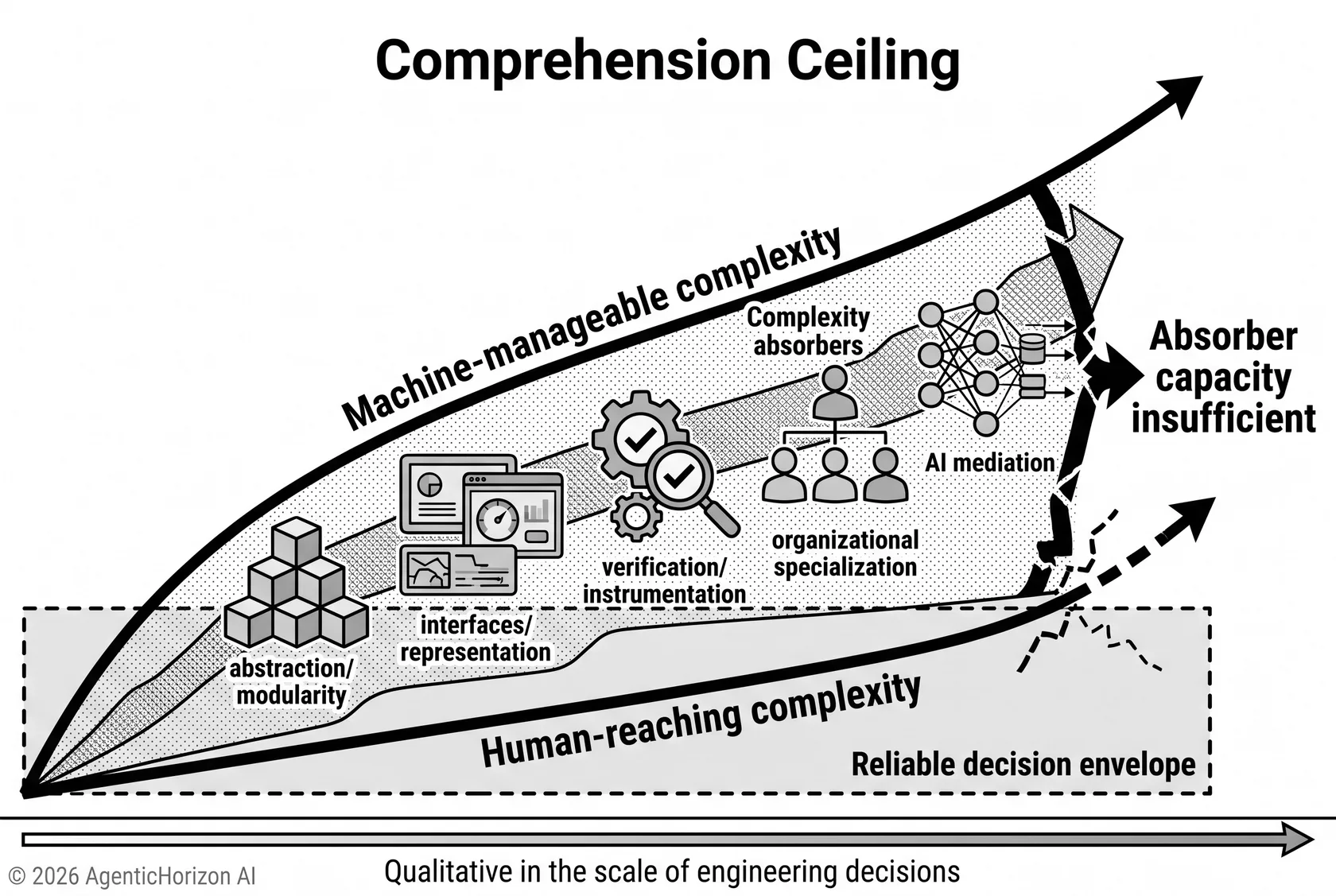
The Nine Dimensions of Engineering Comprehension Burden (ECB) & Architectural Absorbers
| ECB Dimension | What Expands Microscopic Complexity | Failure Mode Under AI Synthesis | EBC Architectural Absorber |
|---|---|---|---|
| 01 · Structural Coupling & Fan-Out | Hidden cross-module dependencies | Local edit cascades into 40 downstream regressions | Strict information-hiding module contracts & acyclic DAGs |
| 02 · Combinatorial State Space | Mutable shared state & adaptive memory | Unreproducible Heisenbugs in production | Explicit finite state machines (FSM) & immutable state deltas |
| 03 · Temporal & Async Dynamics | Retries, timeouts, queues & eventual consistency | Duplicate side effects under partial network failure | TLA+ temporal specifications & write-boundary idempotency |
| 04 · Semantic Heterogeneity | Conflicting domain models across services | Silent semantic drift across agent handoffs | Bounded domain ontologies & SHACL closed-world shapes |
| 05 · Behavioural Non-Determinism | Probabilistic LLM steps inside control loops | Identical inputs yield divergent side effects | Layer 3 Deterministic Control Shell & pinned replay seeds |
| 06 · Change Blast Radius | Unbounded authority & ambient credentials | Single prompt injection compromises tenant DB | Least-privilege capability tokens & cellular blast compartments |
| 07 · Diagnostic Opacity | Black-box multi-agent transcripts | Post-incident root-cause analysis takes days | OpenTelemetry trajectory spans & minimal counterexample shrinking |
| 08 · Specification Entropy | Informal prose tickets & stale docs | Tests ratify the generator’s hallucinations | Executable IntentSpec + independent read-only verification oracle |
| 09 · Verification Latency | Slow manual QA & brittle UI end-to-end tests | Human review queue becomes the bottleneck | Sub-minute property-based, metamorphic & shadow replay gates |
Executable Architecture & Verification Specification
# EBC Cognitive Metrology: Engineering Comprehension Burden (ECB) Budget Contract
ecb_governance_contract:
  module_id: "settlement-reconciliation-core"
  max_human_decision_variables: 7
  verification_leverage_ratio_min: 12.0 # >= 12 lines of generated impl verified per 1 line of spec
  architectural_absorbers:
    information_hiding: "enforce_zero_internal_state_export"
    temporal_model: "specs/settlement_fsm.tla"
    data_invariant_shape: "shapes/settlement_ledger.shacl.ttl"
  promotion_policy:
    allow_unreviewed_syntax: true
    require_human_signoff_on: ["IntentSpec", "SHACL_Shape_Delta", "BlastRadius_Envelope"]
Core Architectural Specifications & Treatises (5 Sections)
01Beyond the Line-by-Line Comprehension Assumption: The VLSI Precedent
For eighty years, software engineering operated under a tacit human-scale assumption: that a system is trustworthy only if a human engineer can read and hold its source code in working memory. Yet civil engineers do not inspect every grain of sand in structural concrete, and semiconductor architects do not manually trace 100 billion transistors on a 2nm die; they govern material specifications, Design Rule Checking (DRC), formal equivalence proofs, and hierarchical timing envelopes. Engineering Beyond Comprehension (EBC) establishes the same constitutional inversion for post-comprehension software.
02Cognitive Metrology & The Nine Dimensions of Comprehension Burden (ECB)
Raw lines of code (LOC) is a deeply flawed metric for human cognitive load: 10,000 lines of generated, side-effect-free lookup tables impose near-zero comprehension burden, whereas 200 lines of asynchronous, shared-state retry logic can exceed human working memory. Our Cognitive Metrology framework quantifies Engineering Comprehension Burden (ECB) across nine orthogonal dimensions: structural coupling fan-out, combinatorial state space, temporal/async dynamics, semantic heterogeneity, behavioural non-determinism, change blast radius, diagnostic opacity, specification entropy, and verification latency.
03Architecture as Constitutional Law & Verification Leverage
In an EBC system, architectural module boundaries, information-hiding contracts, temporal state machines (TLA+), and closed-world data shapes (SHACL) are compiled into an unbypassable constitutional harness. We measure engineering maturity by the Verification Leverage Ratio: the ratio of machine-synthesized implementation complexity governed per unit of human-authored specification and invariant code (enforcing >= 12.0x leverage in production modules).
04Governance-Preserving Compression: Avoiding Both Overload and Blindness
Every post-comprehension interface must navigate between two failure poles: if an abstraction hides too little, human operators drown in microscopic implementation noise; if it compresses too much into a single opaque green checkmark, operators suffer catastrophic control blindness when out-of-distribution edge cases strike. EBC engineers governance-preserving compression—keeping human decision variables bounded (<= 7 active variables) while preserving exact drill-down provenance to underlying verification evidence.
05The Four Computational Pathologies & The VLSI Foundry Precedent
In Engineering Beyond Comprehension (v2.11.5), we diagnose four structural pathologies that strike whenever AI code synthesis outpaces human review:
- 1 Silent Semantic Drift across agent boundaries
- 2 Tautological Test Ratification (where the same model generates both faulty code and matching faulty unit tests)
- 3 Combinatorial State Explosion in adaptive retry loops
- 4 Opaque Cascade Failures across coupled schemas. Just as VLSI semiconductor foundries scaled from manual polygon layout to 100-billion-transistor chips via Register-Transfer Level (RTL) synthesis, Design Rule Checking (DRC), and Formal Equivalence Checking (FEC), EBC moves the human engineering boundary upward from raw syntax to IntentSpec, TLA+ invariants, and independent verification harnesses.
Probabilistic vs. Deterministic Execution Boundary & Verified Benchmark Ledger
Autonomous multi-agent fabrication of machine-scale implementation code (R4) beneath the human comprehension horizon.
Constitutional architectural absorbers: information-hiding module DAGs, TLA+ temporal state machines, SHACL shapes, and bounded ECB budgets.