Executive Architectural Synthesis · AbundanceLab · Module 05
Architectural Specification Plates (8)
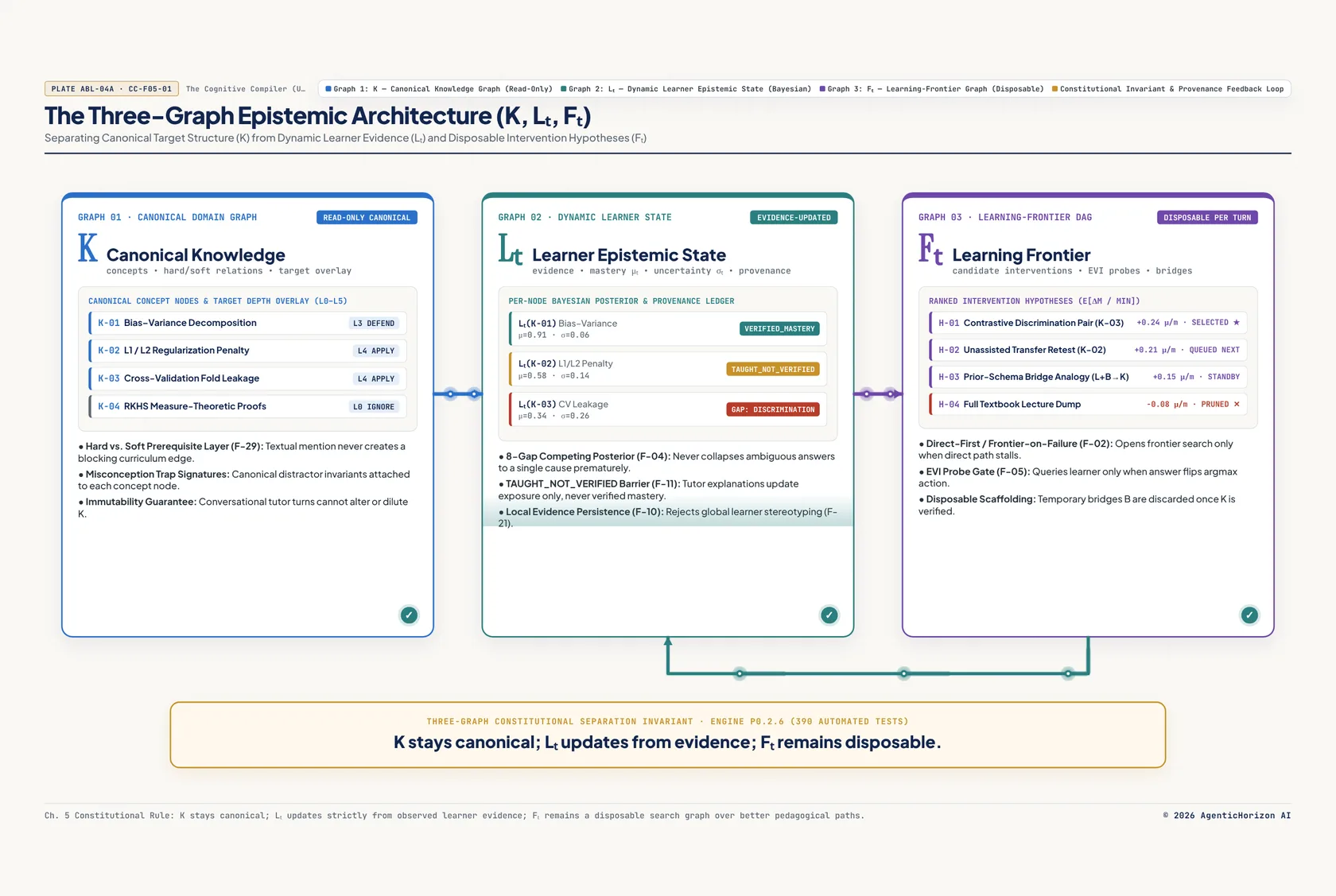
The Three-Graph Epistemic Architecture (K, Lₜ, Fₜ)
The Epistemic Compiler Frontier Decision Ledger (ADOPT / EXPERIMENT / WATCH / REJECT)
| Mechanism / Policy | Ledger Disposition | Empirical / Control Role | Enforced Invariant in FastAPI/SQLite Engine |
|---|---|---|---|
| TAUGHT_NOT_VERIFIED State Barrier | ADOPT (Core Constitutional) | Separates assisted instruction from unassisted mastery | State transition to VERIFIED requires hint_count == 0 on transfer task |
| Three-Graph Separation (K, Lₜ, Fₜ) | ADOPT (Core Constitutional) | Prevents tutor chat history from mutating canonical domain structure | K is read-only during session; Lₜ updates via Bayesian evidence; Fₜ is rebuilt per step |
| Expected Value of Information (EVI) Probing | ADOPT (Controller Policy) | Eliminates redundant diagnostic questioning | Ask probe q iff EVI(q) > QueryCost and argmax action can flip |
| Minimum Intervention Escalation Ladder | ADOPT (Controller Policy) | Preserves productive friction (Cue → Bridge → Teach → Retest) | Select lowest-assistance intervention capable of resolving top gap posterior |
| Calibrated LLM Rubrics with Deterministic Guards | EXPERIMENT (Bounded) | Grades open-ended causal explanations against misconception traps | LLM rubric cannot override deterministic counterexample or hint provenance |
| Biometric / Affective Telemetry Inference | WATCH (Non-Normative) | Research signal for cognitive overload detection | Never used for high-stakes mastery certification |
| Unverified Conversational Self-Report ("Do you get it?") | REJECT (Banned Anti-Pattern) | Primary generator of the Illusion of Competence | Learner self-report never increments μₜ or clears TAUGHT_NOT_VERIFIED |
Executable Architecture & Verification Specification
# Adaptive Epistemic Compiler: TAUGHT_NOT_VERIFIED State Transition Guard (Python / FastAPI Engine)
def apply_verification_observation(
    node_state: LearnerNodeState,
    obs: TaskObservation,
    policy: VerificationPolicy
) -> tuple[LearnerNodeState, FrontierLedgerEntry]:
    # Invariant: Assisted success or explanation exposure CANNOT certify mastery
    if obs.modality == "EXPLANATION_DELIVERED" or obs.hints_used > 0:
        new_status = EpistemicStatus.TAUGHT_NOT_VERIFIED
        verified_delta = 0.0
        reason = "INVARIANT_GUARD: Assisted or instructional turn recorded as exposure only."
    elif obs.is_transfer_probe and obs.passed_misconception_trap and obs.score >= policy.pass_threshold:
        new_status = EpistemicStatus.VERIFIED_MASTERY
        verified_delta = compute_bayesian_mastery_update(node_state.mu, node_state.sigma, obs)
        reason = "VERIFIED_UNASSISTED_TRANSFER: Passed transfer + misconception trap with zero hints."
    else:
        new_status = EpistemicStatus.DIAGNOSED_GAP
        verified_delta = compute_bayesian_mastery_update(node_state.mu, node_state.sigma, obs)
        reason = "GAP_PERSISTS: Escalating intervention ladder on Fₜ."
    return node_state.evolve(status=new_status, mu_delta=verified_delta), FrontierLedgerEntry(reason=reason)
Core Architectural Specifications & Treatises (4 Sections)
01The Illusion of Conversational Fluency & The TAUGHT_NOT_VERIFIED Barrier
When a learner or enterprise operator asks a conversational AI tutor to explain a complex topic, the model produces a crystal-clear, comforting explanation. Both the human and naive edtech platforms mistake that pleasant reading experience for internalized mastery. Our Adaptive Epistemic Compiler eliminates this failure mode via a hard state-machine barrier: delivering an explanation or assisted walkthrough moves a concept node into TAUGHT_NOT_VERIFIED, holding verified mastery growth at zero (verified_delta = 0.0) until the learner solves an unassisted transfer probe (hint_count == 0) and clears the node’s misconception trap.
02Eight Competing Latent Capability Gaps Behind a Single Wrong Answer
In cognitive engineering, a wrong answer is a surface symptom rather than a root cause. Graph 2 (Lₜ) maintains a competing Bayesian posterior across eight latent failure causes:
- 1 Missing upstream prerequisite node in K
- 2 Terminological or notation confusion
- 3 Flawed causal mental model
- 4 Procedural execution slip under high mastery
- 5 Boundary or precondition blindness
- 6 Overgeneralized analogy trap
- 7 Cross-representation translation failure (e.g., equation to code)
- 8 Working-memory overload.
03Expected Value of Information (EVI) Probing & Minimum Intervention Control
Learner attention is finite and expensive. Before asking any diagnostic question, Graph 3 (Fₜ) computes the Expected Value of Information (EVI)—issuing a diagnostic probe if and only if the expected entropy reduction can flip the optimal next pedagogical action across Skip, Bridge, or Teach. Once the latent gap is disambiguated, the controller enforces the Minimum Intervention Escalation Ladder (Focus Cue → Structural Bridge → Targeted Teach → Delayed Unassisted Retest) so the human performs the constitutive cognitive work.
04Production FastAPI/SQLite Reference Engine & PILOT-001/002 Replay Evidence
Unlike speculative educational frameworks, the Adaptive Epistemic Compiler is backed by a complete Python FastAPI + SQLite reference engine (Release P0.2.6) verified by 390 automated unit, state-invariant, and replay tests. The companion research monograph (R0.30) evaluates 32 candidate mechanisms in the Frontier Decision Ledger—formally classifying 15 as ADOPT (Core Constitutional/Controller policies), 5 as WATCH/EXPERIMENT (bounded rubrics and affective signals), and 12 as REJECT (banned anti-patterns such as unverified conversational self-report). Empirical execution traces from PILOT-001 and PILOT-002 prove how the engine catches and blocks provenance defects where assisted hint completions would otherwise corrupt mastery certification.
Probabilistic vs. Deterministic Execution Boundary & Verified Benchmark Ledger
Synthesizing adaptive Socratic bridges, explanations, and candidate diagnostic probes tailored to the learner’s active frontier Fₜ.
FastAPI/SQLite state engine (390 tests) enforcing TAUGHT_NOT_VERIFIED (verified_delta = 0.0 when hints_used > 0), EVI threshold, and Frontier Decision Ledger.