Executive Architectural Synthesis · Semantic Machinery · Module 01
Architectural Specification Plates (8)
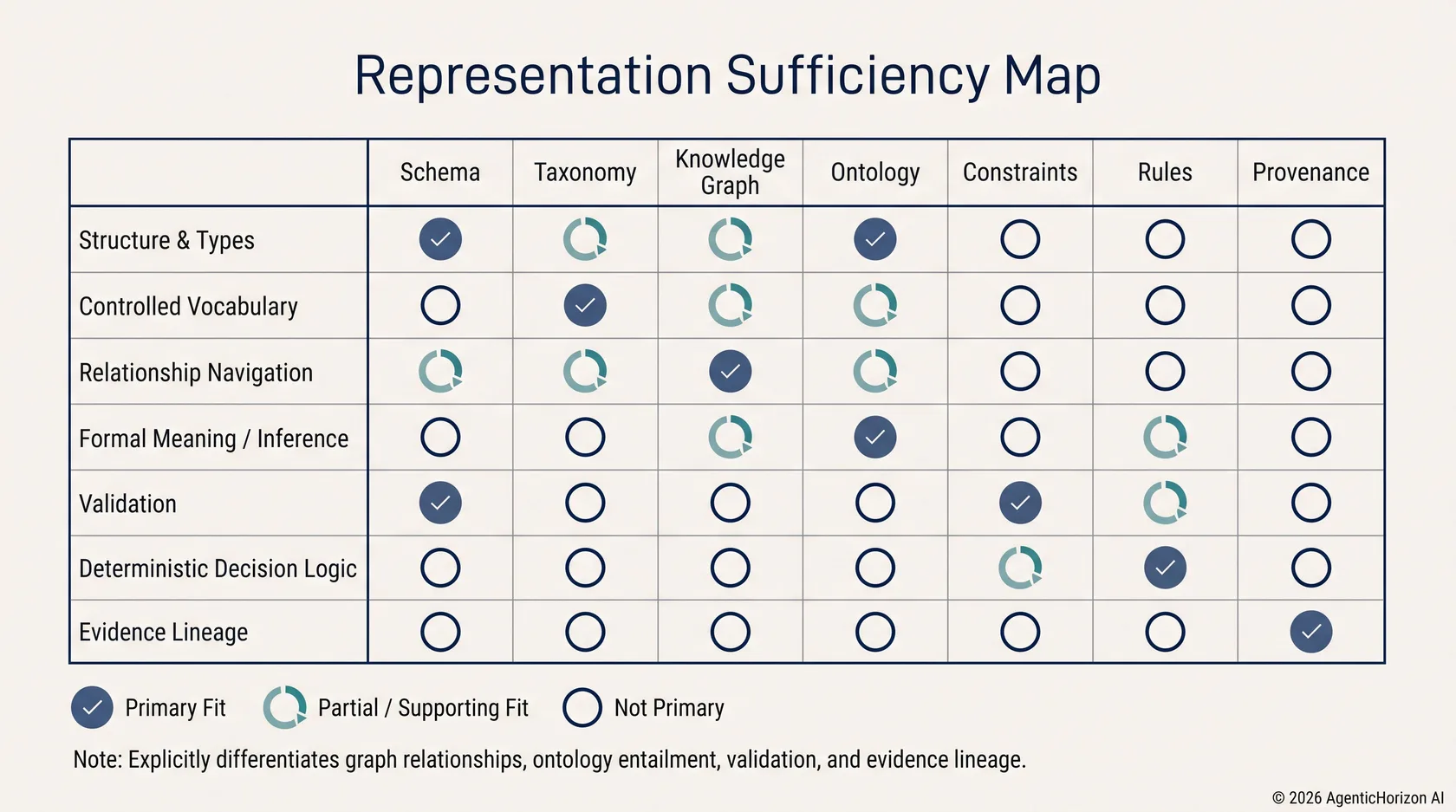
Representation Sufficiency Map Across Seven Semantic Artifacts
The 10 Operational Risk Signals → Minimum Viable Semantics Escalation Matrix
| Risk Signal | Failure Mode if Ungrounded | Minimum Semantic Level Required | Enforcing Artifact |
|---|---|---|---|
| 01 · Homonym & Polysemy Collision ("Customer", "Active", "Margin") | Cross-department metric corruption | L2 · Controlled Vocabulary + SKOS | Canonical URI Registry + Concept Glossary |
| 02 · Downstream API / Tool Payload Mutation | Malformed parameters & runtime crashes | L3 · Strictly Typed Data Contracts | JSON Schema / Pydantic / OpenAPI |
| 03 · Multi-Hop Relational Lineage & Entity Resolution | Vector RAG misses structural joins | L4 · Enterprise Knowledge Graph | RDF/SPARQL 1.1 or Property Graph (Cypher) |
| 04 · Temporal Supersession & Retroactive Restatement | Agent acts on expired prices or policies | L4+ · Bitemporal Provenance Graph | PROV-O + validFrom/validTo + transactionTime |
| 05 · Cross-Domain Taxonomic & Equivalence Reasoning | Brittle hardcoded if/else class checks | L5 · Bounded Domain Ontology | OWL 2 RL/EL + 3-Layer Extension Architecture |
| 06 · Mandatory Field & Cardinality Completeness | Open-world assumption silently passes nulls | L6 · Closed-World Constraint Shapes | W3C SHACL NodeShapes & PropertyShapes |
| 07 · Statutory / Financial / Clinical Policy Compliance | Prompt instructions bypassed under injection | L6 · Deterministic Rule & Policy Engine | SHACL-SPARQL + Datalog + OPA/Cedar |
| 08 · Consequential State Writeback & External Side Effects | Unauthorized mutation or partial failure | L7 · Kinetic Action Ontology | Pre/Postcondition Action Contracts + Dry-Run |
| 09 · Multi-Agent Handoff Across Trust Boundaries | Confused-deputy privilege escalation | L7 · Proof-Carrying Action Envelope | Cryptographic Actor + Policy Attestation |
| 10 · Regulatory Audit & Incident Reconstruction | Inability to prove why an action occurred | L7 · Immutable Epistemic Lineage Ledger | Signed Snapshot + SHACL Validation Receipt |
Executable Architecture & Verification Specification
# 3-Layer Ontology Extension Pattern (Upper Core → Industry Standard → Local Operational Shape)
@prefix ah-core: <https://agentichorizon.ai/ontology/core#> .
@prefix edmc-auto: <https://spec.edmcouncil.org/auto/ontology/VC/> .
@prefix dealer-ops: <https://agentichorizon.ai/ontology/retail-ops#> .
@prefix owl: <http://www.w3.org/2002/07/owl#> .
@prefix rdfs: <http://www.w3.org/2000/01/rdf-schema#> .

# Layer 1 (Upper Core): Governed Asset & Commercial Offer Commitment
ah-core:GovernedCommercialOffer a owl:Class ;
  rdfs:comment "Any externally binding price, financing, or SLA commitment requiring L6+ validation." .

# Layer 2 (Industry Adapter): EDMC Automotive Vehicle Configuration Alignment
dealer-ops:RetailVehicleOffer rdfs:subClassOf ah-core:GovernedCommercialOffer ,
                                              edmc-auto:VehicleCommercialListing ;
  owl:equivalentClass [ a owl:Restriction ;
    owl:onProperty dealer-ops:bindsToCanonicalVIN ;
    owl:someValuesFrom edmc-auto:VehicleIdentificationNumber ] .
Core Architectural Specifications & Treatises (5 Sections)
01The Minimum Semantic Machinery Principle (L1–L7 Escalation)
Use the lightest semantic formalism that makes your highest-priority operational failure modes impossible, detectable, or recoverable. Over-engineering a monolithic enterprise OWL ontology for a low-stakes internal summarizer (where L1 raw vectors or L2 controlled glossaries suffice) wastes months of engineering capital; conversely, deploying an ungrounded L1 vector store for regulated financial underwriting, clinical contraindication checking, or automotive pricing (which require L6 closed-world SHACL shapes and L7 kinetic action contracts) guarantees compliance failures.
02Open-World Reasoning (OWL 2) vs. Closed-World Validation (W3C SHACL)
A foundational error in enterprise semantic engineering is confusing OWL description-logic reasoning with data validation. OWL operates under the Open-World Assumption (OWA) and Non-Unique Name Assumption: if a mandatory VIN or interest rate is missing on an offer node, an OWL reasoner simply infers that the value might exist somewhere unknown—never raising an error. Production agent execution gates require Closed-World Validation via W3C SHACL (Shapes Constraint Language), JSON Schema, and Datalog, where missing mandatory properties, out-of-range prices, or cardinality violations immediately halt execution.
03Bounded Domain Ontologies & The 3-Layer Extension Architecture
Universal enterprise-wide "megagraphs" collapse under committee gridlock because different departments legitimately hold distinct operational commitments for terms like "Customer", "Order", or "Margin". We align semantic models to Domain-Driven Design (DDD) bounded contexts using a strict 3-Layer Extension Architecture: Layer 1 (Upper Enterprise Core of 15–30 invariant institutional classes), Layer 2 (Industry Standard Adapters such as FIBO for finance, HL7 FHIR/SNOMED for healthcare, and EDMC Automotive Ontology), and Layer 3 (Local Operational & SHACL Action Shapes).
04Eliminating the Five Ontology Anti-Patterns Across 7 Commercial Stacks
Whether deploying on Palantir AIP/Foundry, Microsoft Fabric IQ, SAP Knowledge Graph, Databricks Unity Catalog, AWS Bedrock/Cedar, Google Cloud Vertex ADK, or Snowflake/Ontotext GraphDB, our architecture prevents five recurring failure modes:
- 1 The Boil-the-Ocean Enterprise Megagraph
- 2 Using Open-World OWL as a Pre-Action Validator
- 3 Embedding Volatile Runtime State Inside Terminological Axioms
- 4 Relying on Prompt-Only "Soft Semantics" for Regulated Mutations
- 5 Mutating Ontologies Without Automated SHACL & SPARQL Competency-Question Regression Suites.
05Six Regulated Domain Adapters & Harness³ / ResearchOS Compilation Provenance
In Semantic Machinery for the AI Age (v5.73, Chapters 15–22), the 3-Layer Ontology Extension Pattern is instantiated across six regulated industry domains: Financial Services (FIBO alignment + bitemporal Basel/ledger auditability), Healthcare & Life Sciences (HL7 FHIR + SNOMED-CT + ICD-10 closed-world clinical contraindication gates), Automotive & Software-Defined Vehicles (EDMC Auto + VSDS + 17-character VIN/incentive SHACL shapes), Manufacturing & Supply Chain (ISA-95 + bill-of-materials blast-radius graphs), Retail & Commerce (GS1 + 64-bit SimHash anti-cannibalization), and Public Sector Statutory Administration (Akoma Ntoso rule traceability). Across all 9 volumes of the AgenticHorizon AI publication corpus (~4,000+ pages), every ontological schema, SHACL gate, and cross-reference was compiled and regression-verified through our internal Harness³ / ResearchOS knowledge-compilation pipeline.
Probabilistic vs. Deterministic Execution Boundary & Verified Benchmark Ledger
Extracting candidate entities, mapping surface phrasing to SKOS synonym rings, and proposing candidate graph traversals.
Minimum Viable Semantics Escalation Ladder (L1–L7), 3-Layer Ontology Alignment (FIBO/FHIR/EDMC), and Closed-World SHACL Shapes.