Executive Architectural Synthesis · Enterprise AI · Module 06
Architectural Specification Plates (5)
Action Proposal vs. Authorized Execution Boundary
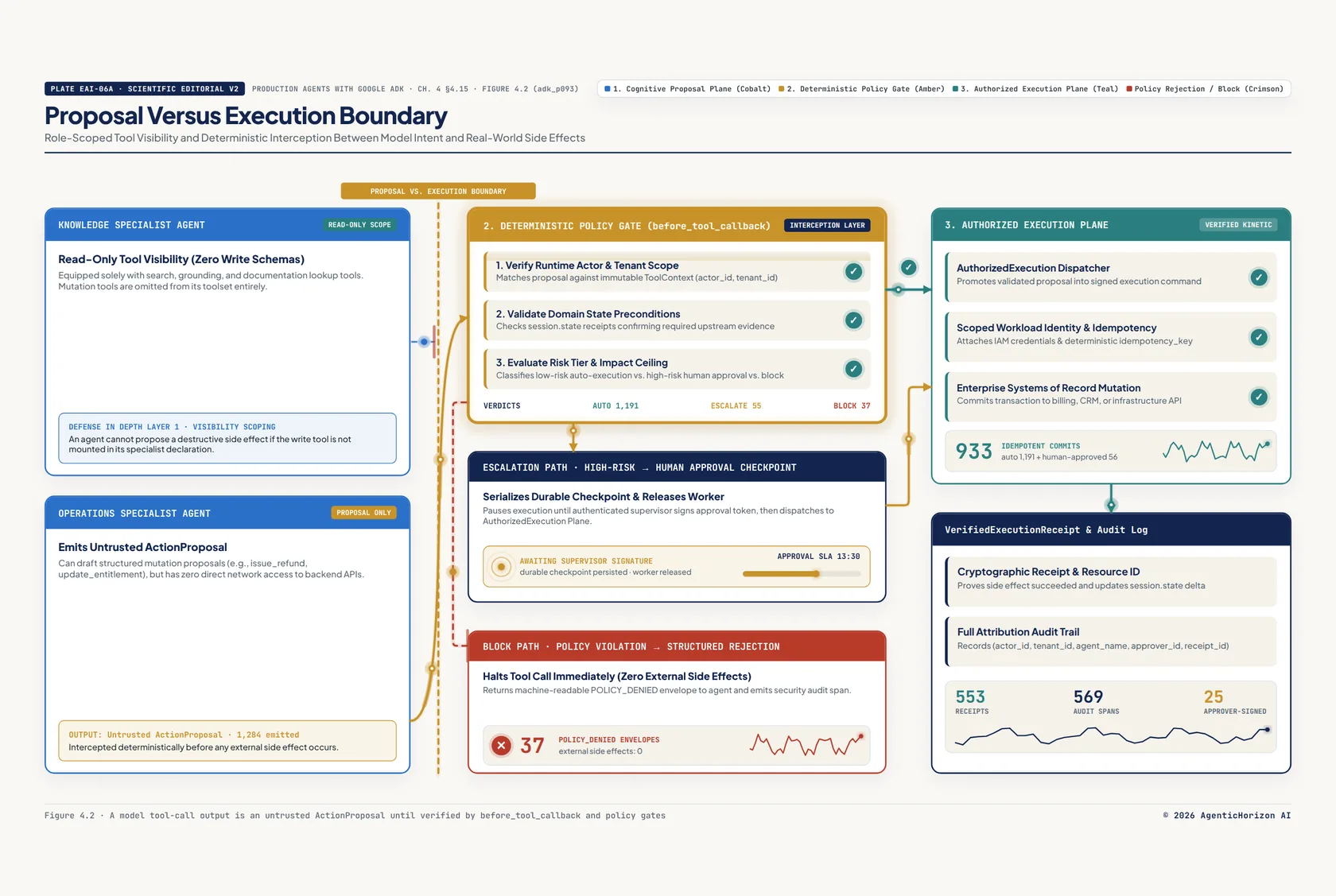
Zero-Trust Agent Threat Model & Deterministic Control Countermeasures
| Threat Vector | Attack Mechanism | Why Prompt Guardrails Fail | Deterministic Layer 3 Countermeasure |
|---|---|---|---|
| Indirect Prompt Injection | Malicious instructions hidden in retrieved PDFs, emails, or web pages | LLMs cannot reliably separate instructions from data in the same token stream | Taint-track untrusted context; block high-consequence write tools when tainted data is present without human cosign |
| Confused-Deputy Escalation | Model is tricked into passing another tenant_id or admin role into a tool call | Model has visibility into parameter schema and guesses/copies privileged IDs | Strip security parameters from tool schema; bind tenant_id and principal scopes cryptographically from Layer 1 session |
| Cross-Agent Privilege Laundering | Low-trust agent delegates task to high-privilege specialist agent | Specialist executes using its own ambient service account | Enforce authority intersection: EffectiveScope = CallerScope ∩ SpecialistScope |
| Tool Parameter Data Exfiltration | Injected prompt tells agent to encode secrets into external URL/webhook tool | Outbound call looks syntactically valid to the LLM | Strict egress domain allowlists + DLP payload inspection at Layer 3 proxy |
| Runaway Recursive Loop / Denial of Wallet | Cyclic subagent handoffs or repeated tool retry storms | Model attempts to self-correct indefinitely | Hard per-trace iteration counter, token budget ceiling, and velocity circuit breaker |
Executable Architecture & Verification Specification
# Cedar Policy-as-Code: Confused-Deputy & Authority Intersection Gate
permit (
  principal,
  action == AgentAction::"ExecuteCustomerRefund",
  resource
)
when { · 1. Tenant isolation: principal and resource must belong to the exact same tenant
  principal.tenant_id == resource.tenant_id && · 2. Taint defense: block autonomous execution if context contains untrusted external ingestion
  context.context_taint_level == "VERIFIED_INTERNAL_ONLY" && · 3. Monetary bound: autonomous refund ceiling for this role
  context.proposed_amount_cents <= principal.max_autonomous_refund_cents && · 4. Canonical SHACL conformance attestation must be present
  context.shacl_conformance_verified == true
};
Core Architectural Specifications & Treatises (4 Sections)
01Capability Is Not Authority: Preventing the Confused-Deputy Failure Mode
Just because a foundation model can infer how to call a refund, wire-transfer, or database-mutation API does not mean it possesses institutional authority to execute it. In enterprise agent engineering, blurring linguistic capability with operational permission produces the confused-deputy vulnerability: an attacker or malformed document persuades a privileged agent runtime to execute actions on behalf of an unauthorized caller. To eliminate this failure mode structurally, our architecture binds cryptographic actor identity and tenant scope at Layer 1 and enforces a strict Authority Intersection Rule at Layer 3: EffectiveAuthority = ActorPermission ∩ AgentRoleScope ∩ WorkflowStepEnvelope ∩ EnvironmentPolicy. The probabilistic model can only emit an untrusted ActionProposal; it can never self-authorize or forge an ApprovalRecord.
02Taint Tracking & Defending Against the Lethal Trifecta
Indirect prompt injection transitions from a nuisance to a catastrophic security breach whenever an agent simultaneously possesses the "Lethal Trifecta":
- A access to private enterprise or customer data
- B exposure to untrusted external content (such as web pages, inbound emails, vendor PDFs, or third-party MCP tool outputs)
- C the ability to communicate externally or mutate persistent state. Our Layer 3 Control Shell attaches cryptographic taint labels (VERIFIED_INTERNAL_ONLY vs. UNTRUSTED_EXTERNAL_INGEST) to every context segment during Layer 2 compilation. Whenever untrusted tokens enter the reasoning window, the Cedar/OPA policy gate automatically disables unapproved external egress and high-blast-radius write tools unless an explicit human-in-the-loop verification checkpoint intervenes.
03Durable Checkpoints, Pause/Resume & Exactly-Once Side Effects
When a proposed action exceeds the autonomous monetary or risk ceiling (for example, a commercial credit adjustment above principal.max_autonomous_refund_cents), the workflow does not fail—it transitions cleanly into an asynchronous APPROVAL_REQUIRED state. The Layer 3 control shell serializes the exact workflow state, compiled context hash, and proposed tool payload into a version-pinned durable checkpoint. When an authorized human supervisor signs the cryptographic approval receipt hours or days later, the runtime resumes from the exact checkpoint without re-running upstream side effects, using deterministic write-boundary idempotency keys to guarantee at-most-once kinetic execution.
04Adversarial Red-Teaming, Circuit Breakers & Runtime Kill Switches
No production agent is promoted without passing an automated pre-release adversarial red-team suite covering indirect prompt injection, cross-tenant entity probing, tool-argument exfiltration, and multi-agent collusion loops. In production, the Control Shell enforces deterministic token-velocity circuit breakers, maximum step-count ceilings, and sub-second per-tenant, per-agent, and per-tool kill switches that allow SRE and security teams to downgrade any workflow from bounded autonomy to read-only shadow mode instantly.
Probabilistic vs. Deterministic Execution Boundary & Verified Benchmark Ledger
Untrusted reasoning over mixed-provenance inputs to emit candidate ActionProposals without ambient credentials.
Cedar/OPA Authority Intersection Rule, context taint tracking (VERIFIED_INTERNAL_ONLY), durable pause/resume checkpoints, and kill switches.