Executive Architectural Synthesis · Semantic Machinery · Module 02
Architectural Specification Plates (8)
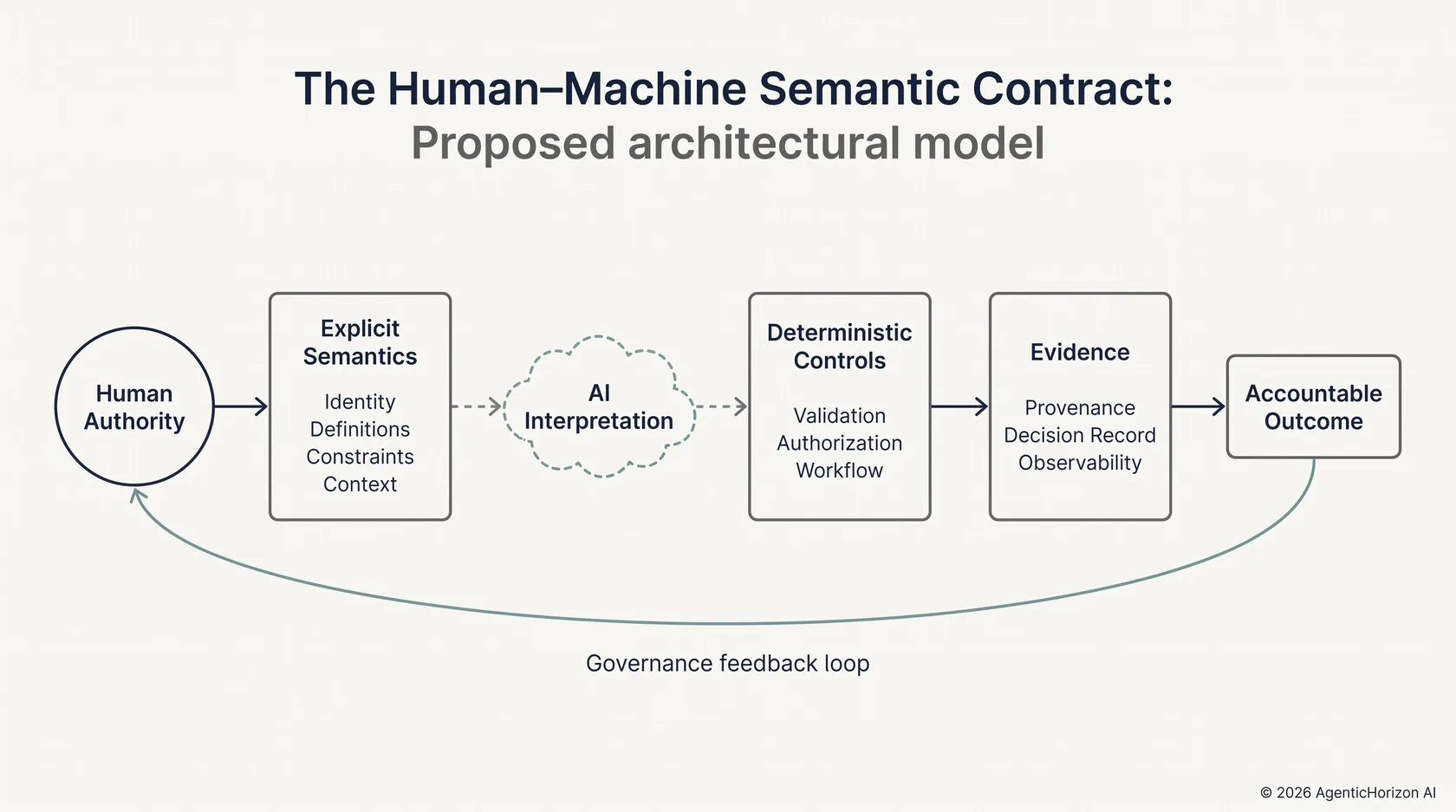
The Human–Machine Semantic Contract Architectural Model
The Four Interlocking Enterprise Semantic Contract Classes
| Contract Class | Boundary Governed | Primary Formalism | Verification Timing | Failure Verdict |
|---|---|---|---|---|
| 01 · Data Product Contract | System-of-Record → Knowledge Graph / Feature Store | JSON Schema + RDF/SHACL + Freshness SLA | Ingestion & Context Compilation | QUARANTINE_STALE_OR_MALFORMED |
| 02 · Event & Handoff Contract | Coordinator Agent → Specialist Subagent (A2A) | Protobuf / AsyncAPI + DelegationBudget | Pre-Handoff Boundary | REJECT_HANDOFF_SCHEMA_DRIFT |
| 03 · Tool Capability Contract | Layer 2 ActionProposal → Layer 4 Kinetic API | Typed Input/Output + Pre/Postcondition SPARQL | Pre-Execution & Post-Write Check | BLOCK_PRECONDITION_UNMET |
| 04 · Policy & Authority Contract | Authenticated Actor + Tenant → Target Resource URI | OPA (Rego) / AWS Cedar + Graph Relationship Check | Layer 3 Deterministic Gate | DENY_CONFUSED_DEPUTY_ESCALATION |
Executable Architecture & Verification Specification
# Deterministic SHACL Action Gate Contract (Validation Before Action)
ex:AuthorizedIncentivePublishShape a sh:NodeShape ;
  sh:targetClass ex:AgentContentPublicationProposal ;
  sh:property [
    sh:path ex:hasVerifiedVIN ;
    sh:datatype xsd:string ;
    sh:minCount 1 ; sh:maxCount 1 ;
    sh:pattern "^[A-HJ-NPR-Z0-9]{17}$" ;
    sh:message "INVARIANT BLOCK: Proposal must bind to an exact 17-character canonical VIN."
  ] ;
  sh:property [
    sh:path ex:quotedPriceCents ;
    sh:equals ex:graphCanonicalPriceCents ;
    sh:message "ZERO-HALLUCINATION GATE: Quoted price must match canonical GraphDB ledger."
  ] .
Core Architectural Specifications & Treatises (4 Sections)
01The Enterprise Contract Mesh: Four Interlocking Contract Classes
Rather than relying on fragile natural-language prompt instructions ("never offer more than a 15% discount or touch another tenant’s records"), the Enterprise Contract Mesh encodes operational invariants across four machine-enforceable boundaries:
- 1 Data Product Contracts governing ingestion freshness and referential integrity into the Knowledge Graph
- 2 Event & A2A Handoff Contracts governing multi-agent delegation payloads
- 3 Tool Capability Contracts specifying preconditions, postconditions, and idempotency keys
- 4 Policy & Authority Contracts governing principal-to-resource permissions.
02Validation Before Action: The 4-Stage Deterministic Interception Pipeline
Every candidate tool call emitted by Layer 2 is treated as an untrusted ActionProposal that must cross a four-stage deterministic gate in Layer 3 before reaching Layer 4 kinetic APIs: Stage 1 validates syntactic and type conformance via JSON Schema/Pydantic; Stage 2 resolves surface strings into canonical enterprise Knowledge Graph URIs; Stage 3 evaluates closed-world W3C SHACL NodeShapes and SPARQL domain invariants against live graph state; and Stage 4 evaluates attribute- and relationship-based access control in Open Policy Agent (Rego) or AWS Cedar.
03Proof-Carrying Action Envelopes & Distributed Transaction Reconciliation
No enterprise database, ERP endpoint, or external webhook accepts a raw model tool call. Layer 4 kinetic executors require a cryptographically signed Proof-Carrying Action Envelope containing the correlation ID, the authenticated Layer 1 ActorContext, the SHA-256 digest of the compiled context slice, the passing SHACL ValidationReport URI, the OPA/Cedar ALLOW decision ID, and an authoritative write-boundary idempotency key. Postcondition verifiers confirm that the downstream mutation actually occurred before reporting success to the agent.
04Formal Abstention Taxonomy & Semantic Compensation Handlers
When a SHACL precondition fails, required bitemporal evidence is stale, or authority is insufficient, the control shell emits a deterministic abstention code (ABSTAIN_KNOWLEDGE_GAP, ABSTAIN_SHACL_VIOLATION, ABSTAIN_POLICY_CEILING) rather than allowing the model to guess or improvise. Furthermore, because long-running agent workflows cannot hold distributed ACID database locks across human approval pauses, every mutating Tool Capability Contract binds to an explicit inverse semantic compensation handler (saga undo).
Probabilistic vs. Deterministic Execution Boundary & Verified Benchmark Ledger
Drafting candidate structured JSON/RDF action proposals from unstructured user intent and contextual telemetry.
Closed-world SHACL NodeShape validation before action execution, cryptographic Proof-Carrying Action Envelopes, and semantic compensation.