Module 1 · Minimum Viable Semantics & Enterprise Ontology Ontological & Sufficiency Framework (L1–L7)
Ontology & Semantic Machinery (Minimum Viable Semantics L1–L7)
Why foundation models fail on private enterprise meaning—and how to engineer the exact level of semantic machinery required by operational risk.
Foundation models possess broad statistical world knowledge but lack four categories of private enterprise meaning: institutional definitions, bitemporal state commitments, closed-world constraint invariants, and kinetic action authority. The Minimum Semantic Machinery Principle matches semantic formalism directly to operational consequence.
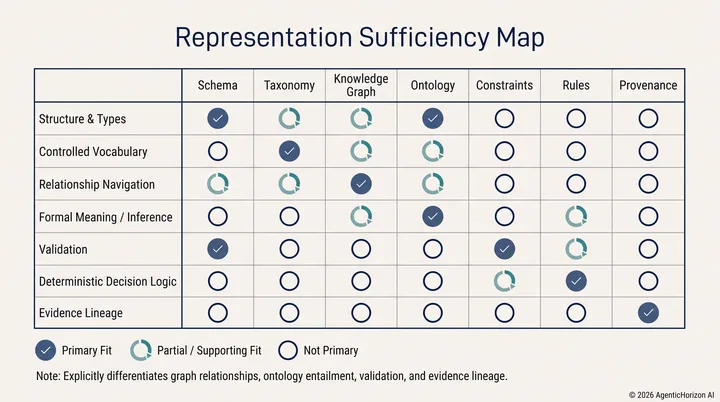
PLATE EAI-03A · +7 Figures Representation Sufficiency Map Across Seven Semantic Artifacts Engineering decision matrix comparing Schemas, Taxonomies, Knowledge Graphs, Ontologies, Constraints, Rules, and Provenance across enterprise guarantees.
Module 2 · Closed-World Validation & Proof-Carrying Agency SHACL & Semantic Contract Architecture
Semantic Contracts, SHACL Action Gates & Proof-Carrying Agency
Machine-enforceable data product, tool capability, and policy contracts that validate every agent proposal before consequential execution.
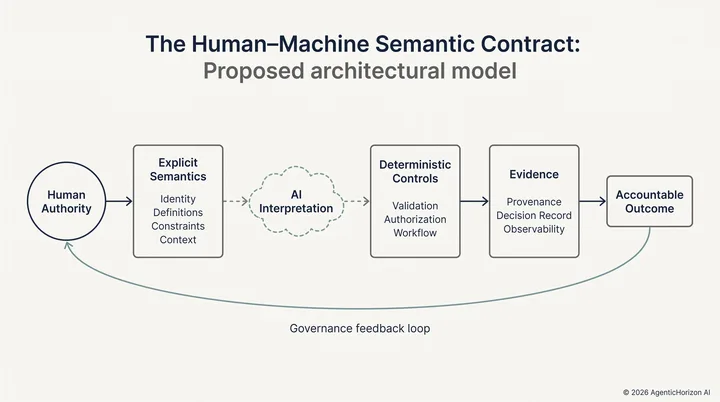
When an autonomous agent proposes an enterprise action, natural-language plausibility is irrelevant. The Enterprise Semantic Control Plane intercepts every proposal and executes a four-stage deterministic verification pipeline—emitting a cryptographic Proof-Carrying Action Envelope before any database or API mutation occurs.
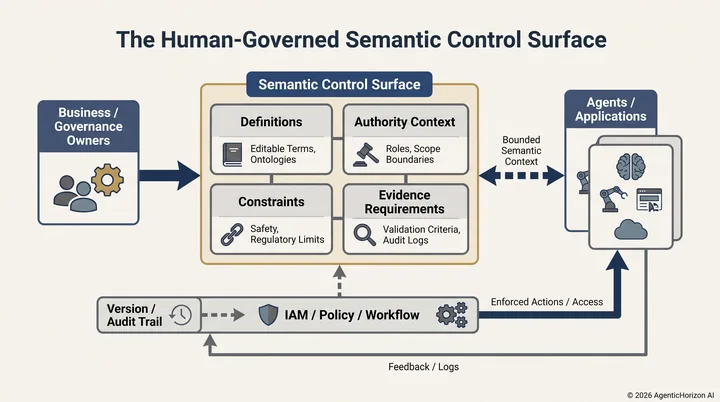
PLATE EAI-04A · +7 Figures The Human–Machine Semantic Contract Architectural Model Division of responsibility connecting human-governed meaning, AI interpretation, independent deterministic controls, and accountable audit evidence.
Module 3 · Hybrid GraphRAG & Bitemporal World Models Knowledge Graph & Context Architecture
Context Compilation, Hybrid GraphRAG & Bitemporal World Models
Treating model context as a compiled, budgeted resource grounded in hybrid vector + knowledge graph retrieval and bitemporal state.
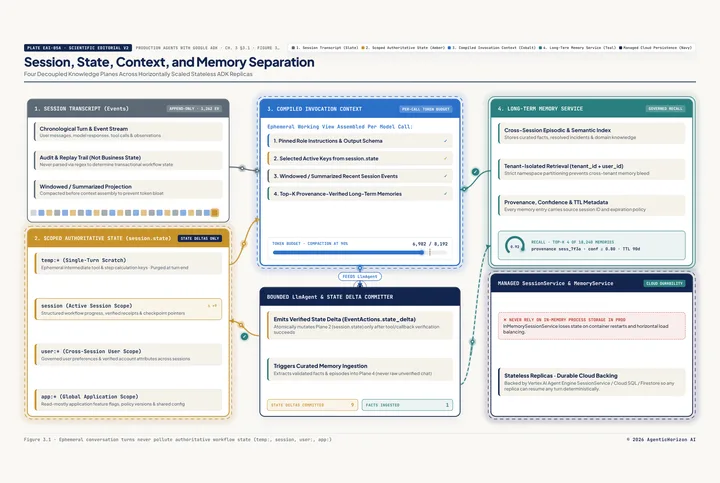
Dumping raw retrieval chunks into a context window degrades reasoning accuracy, inflates latency, and introduces contradictory stale facts. Context Compilation treats the prompt window as a compiled artifact assembled from canonical graph facts, episodic session state, and provenance-ranked retrieval.
PLATE EAI-05A · +7 Figures Session Transcript, Workflow State, Compiled Context & Memory Separation Architectural separation preventing ephemeral chat history from polluting authoritative workflow state or unverified long-term memory.
Module 4 · Enterprise Ontology FinOps & Semantic Rollout Playbook
Production Operations, Agent FinOps (CPST) & 30/90-Day Rollout Playbooks
Optimizing Cost-per-Successful-Task (CPST), executing the 30-Day Agent & 90-Day Semantic Rollout Playbooks, and deploying across 6 industry domains.
Moving from architectural design to enterprise-wide production requires disciplined operational playbooks and unit-economic governance. This module details Agent FinOps (optimizing Cost-per-Successful-Task rather than raw token price), the week-by-week 30-Day Production Agent Playbook, the 90-Day Semantic Control Plane Rollout, and 6 domain reference blueprints.
PLATE EAI-08A · +3 Figures Enterprise Semantic Rollout & Escalation Decision Matrix Operational playbook mapping domain problem classes to initial semantic investments and clear escalation triggers.
Module 5 · Post-Scarcity Domain Studies Ontologist Harness & 35 Frontiers
The Ontologist Harness & 35 Post-LLM Semantic Frontiers
The Prompt → Skill → Harness → Verified Artifact progression, the 6-Station Ontologist Workbench, and 35 neuro-symbolic research frontiers.
As organizations mature beyond raw prompting, reusable intelligence crystallizes along a strict four-stage progression: from ad-hoc Prompts to modular Skills, to deterministic Harnesses, and finally to Verified Semantic Artifacts. This module details the 6-Station AI-assisted Ontologist Workbench and maps 35 post-LLM neuro-symbolic frontiers.
PLATE ABL-05A · +3 Figures Eight-Layer Epistemic & Neuro-Symbolic Frontier Map Progression across Know, Regulate, Represent, Intervene, Control, Automatize, and Augment wrapped by closed-loop Compilation.