The Unifying Institutional Thesis · AgenticHorizon AI
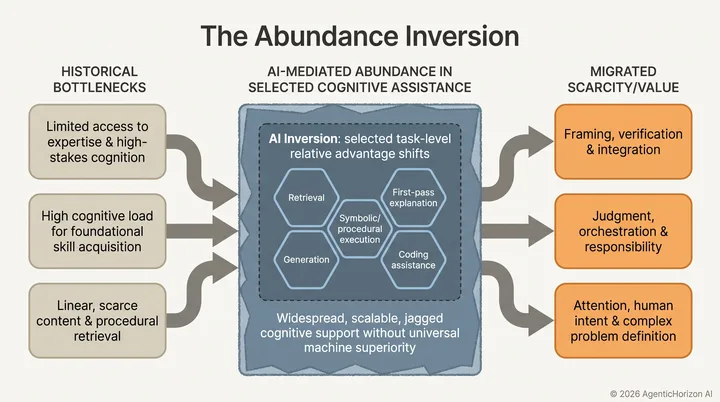
Whenever a cognitive capability—whether drafting enterprise actions, fabricating software, or generating explanations—crosses from scarcity into abundance, the bottleneck migrates immediately to semantic grounding, deterministic verification, and human sovereignty.
Projection 1 · In Enterprise Agents & Semantic Machinery (Enterprise AI & Semantic Machinery)
Foundation models infer plausible candidate interpretations, but they lack private institutional definitions, bitemporal state commitments, closed-world constraints, and action authority. Through our Enterprise AI and Semantic Machinery initiatives (Institutional Meaning (L1–L7) → Closed-World Validation (SHACL) → Proof-Carrying Action), we wrap probabilistic reasoning inside a 5-Layer Agent Boundary and an OWL/SHACL semantic control plane.
Projection 2 · In Software Engineering (AbundanceLab Division)
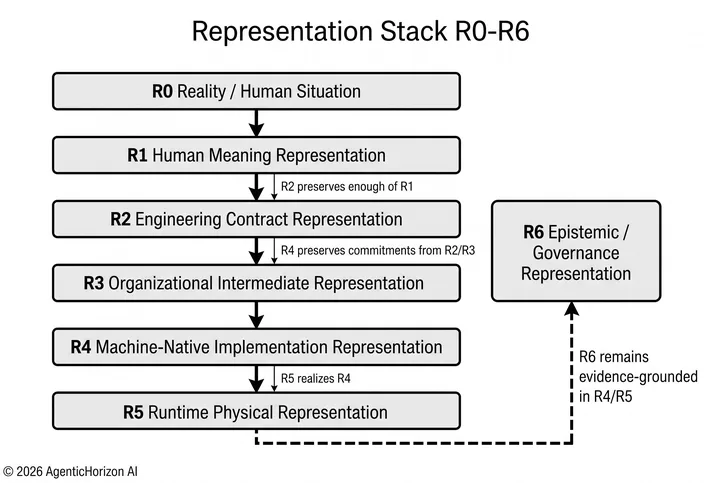
As multi-agent synthesis velocity outpaces human line-by-line code review, traditional pull-request inspection collapses into rubber-stamping. Within AbundanceLab, our Engineering Beyond Comprehension (EBC), Intent Compiler, and Cognitive Compiler programs elevate the human interface to structured Intent Specifications (R1), locked independent verification harnesses (R2), and the 5-Level Epistemic Telescope.
Projection 3 · In Human Learning, Educational Media & Institutions (LiA2036 Research Initiative)
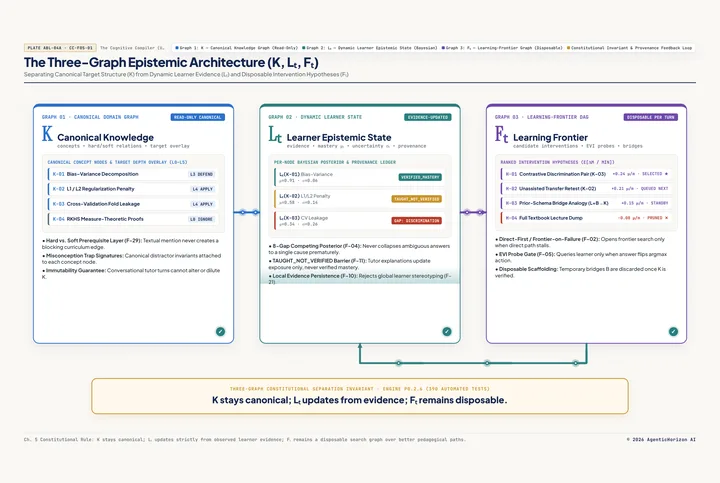
As artificial intelligence transforms the production of knowledge and the nature of cognitive work, unguarded delegation hollows out human capability. Organized around three interconnected domains—Philosophy of Human Learning, Educational Media & Learning Experience, and Learning Ecosystems & Institutional Futures—LiA2036 establishes the philosophical frameworks, educational architectures, methodologies, and institutional models (Human Capability → Learning Experience → Learning Ecosystems) that sustain meaningful human development.