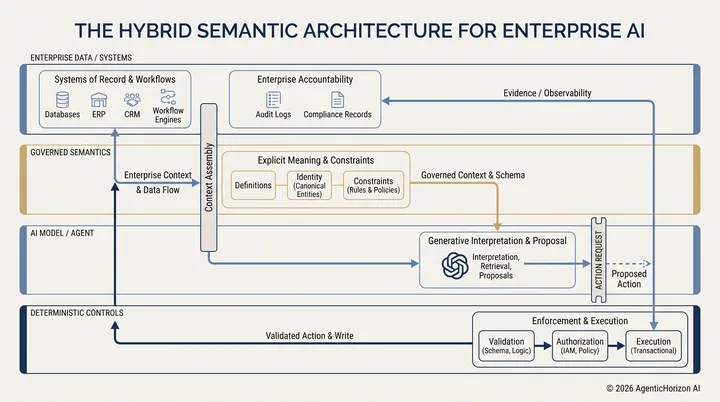
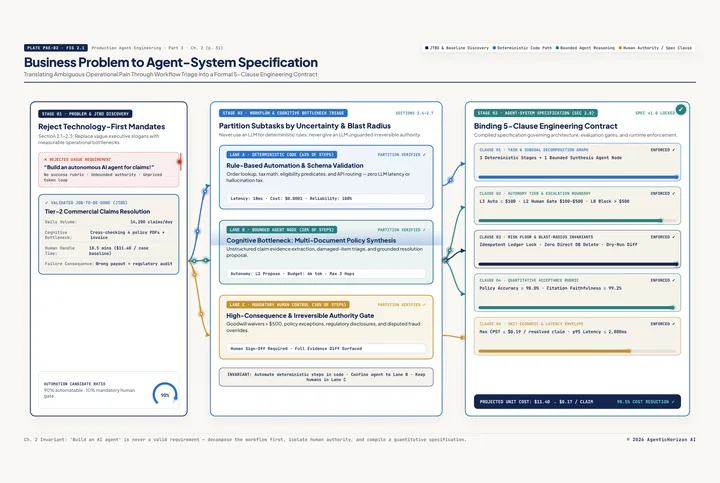
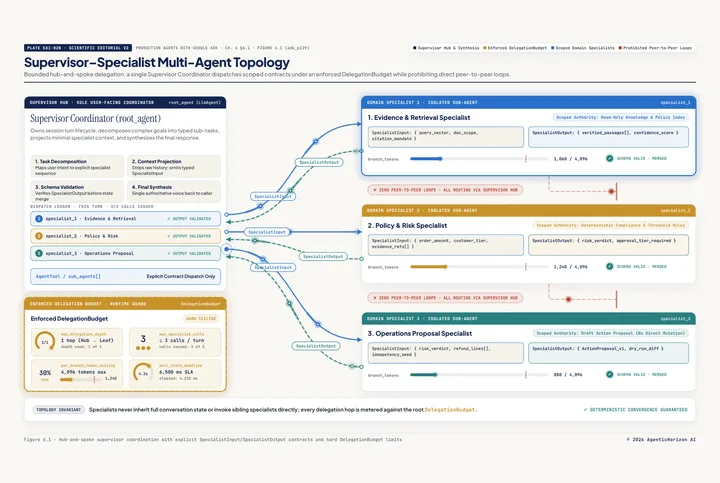
PILLAR 4 · ENGINEERING APPLIED SYSTEMS 3 DEPLOYED PRODUCTION PLATFORMS 45 OWL/RDF ONTOLOGY MODULES 6-STAGE GOOGLE ADK PIPELINES
PRODUCTION VALIDATION OF ENTERPRISE AI, SEMANTIC MACHINERY & EBC HARNESSES
Pillar 04 · Applied Reference Engineering

Applied Systems.

Neuro-symbolic and multi-agent architectures validated in live enterprise operations.

Our production platforms apply deterministic OWL/SPARQL control shells, bitemporal knowledge graphs, and multi-agent orchestration across enterprise knowledge & decision intelligence, domain-specific AI portfolio management, and enterprise evidence & decision engineering.

Applied Systems institutional banner — Enterprise Knowledge, Portfolio and Decision Engineering
Applied Systems · Enterprise Knowledge & Decision Engineering Bay 3 Platforms
Deployed Production Platforms · 3 Reference Implementations

Applied Systems Portfolio

Each production platform pairs probabilistic reasoning with a deterministic control shell.

System 01 · Enterprise Knowledge & Decision Intelligence Deployed Commercial Platform

Enterprise Knowledge & Decision Intelligence

From Enterprise Knowledge Models to Governed, Explainable Decisions

Research and engineering in ontology-driven intelligence, semantic reasoning, neuro-symbolic architectures, and multi-agent decision systems. The work investigates how structured domain knowledge, symbolic constraints, and intelligent agents can support explainable, auditable, and operationally reliable enterprise decisions—normalizing live enterprise feeds and telemetry into a formal Knowledge Graph (Ontotext GraphDB across 45 modular OWL/RDF files and 21 SPARQL 1.1 resolvers) that wraps an 8-agent specialist swarm inside pre- and post-generation deterministic verification shells.

52-Page React 19 SPA45 Modular OWL/RDF Files (>25k LOC)98.9% Compliance (2,571/2,600 Checks)21 SPARQL 1.1 Resolvers14-State Atomic FSM
Enterprise Knowledge Graph & Neuro-Symbolic Verification Topology
PLATE PRJ-01A · Architecture Figure Enterprise Knowledge Graph & Neuro-Symbolic Verification Topology Tri-repository Ontotext GraphDB + modular OWL/RDF ontology architecture wrapping the 8-agent Gemini 2.5 decision and synthesis swarm.
Stack: React 19 · Node.js 20 · Cloud Serverless Functions · Document Store · Ontotext GraphDB (SPARQL 1.1) · Gemini 2.5 Pro/Flash · Tailwind CSS 4
Explore System →
System 2 · Domain-Specific AI Portfolio Management Deployed Decision Platform

Domain-Specific AI Portfolio Management: Agentic Strategy, Simulation & Investment Decision Platform

Autonomous Portfolio Discovery, Operational Simulation & Risk-Adjusted AI Investment Decisions

Domain-Specific AI Portfolio Management investigates how autonomous research agents, operational simulation, and deterministic decision models support evidence-grounded AI investment planning across industry-specific value chains. The platform couples a normalized Domain-Specific AI Opportunity Registry and four specialized autonomous agent swarms with a deterministic Domain-Calibrated Financial Sensitivity Engine and a 30/60/90/120-day governed rollout sequencer.

Domain-Specific AI Opportunity Registry4 Autonomous Agent SwarmsCoupled Domain Workflow SimulationDomain-Calibrated Financial Sensitivity Engine30/60/90/120-Day Governed Rollout
Domain-Specific AI Portfolio Orchestration Across Autonomy & Value-Chain Quadrants
PLATE PRJ-02A · Architecture Figure Domain-Specific AI Portfolio Orchestration Across Autonomy & Value-Chain Quadrants Separating Immediate Quick Wins from multi-year Strategic Transformation Bets across coupled value-chain stages (demonstrated on Variable Ops, Fixed Ops, F&I, and Fleet).
Stack: 4 Autonomous Research & Simulation Swarms · Domain-Specific AI Opportunity Registry · 5-Axis Multi-Criteria Evaluation · Domain-Calibrated Financial Sensitivity Engine · React Executive Cockpit
Explore System →
System 3 · Enterprise Evidence & Decision Engineering Deployed Multi-Agent Platform

Enterprise Evidence & Decision Engineering

Governed Multi-Agent Evidence Synthesis and Decision Artifact Generation

Enterprise Evidence & Decision Engineering investigates how governed multi-agent systems transform complex, heterogeneous information into traceable evidence, structured assessments, and decision-ready artifacts. Built on a Six-Stage Google ADK Evidence Processing Architecture, the system combines large-context document ingestion, parallel 47-question evidence and constraint analysis, deterministic readiness scoring, an immutable versioned data bus (.v1, .v2), draft → validated → promoted Checkpoint Promotion with human oversight, and a 20-schema Deterministic Decision Artifact Compiler.

6-Stage Google ADK Pipeline10× Data-Bus Speedup (~500ms → ~50ms)43% Smaller Codebase via Unified Bus47-Question Parallel Taxonomies20 Deterministic Artifact Schemas
Governed Multi-Agent Evidence-to-Decision Pipeline (Six-Stage Google ADK Architecture)
PLATE PRJ-03A · Architecture Figure Governed Multi-Agent Evidence-to-Decision Pipeline (Six-Stage Google ADK Architecture) Decoupling 1M+ token full-corpus evidence ingestion and parallel 47-question analytical taxonomies from governed reasoning, checkpoint promotion, and deterministic artifact compilation.
Stack: Google Agent Development Kit (ADK) · Gemini 1M+ Token Context · React 19 · Immutable Versioned Data Bus · Deterministic 20-Schema Artifact Compiler (.pptx)
Explore System →
Cross-Pillar Architecture Validation · Research-to-Production Provenance

How Applied Systems Validate Our Core Research Pillars

Every production platform in the Applied Systems portfolio is an executable validation of our Enterprise AI, Semantic Machinery, and AbundanceLab specifications—replacing unconstrained prompt chaining with formal ontologies, closed-world validation gates, and bounded multi-agent topologies.

Validation Pattern 01 Semantic Machinery (L5–L6)

Closed-World Ontology & SPARQL Fact Grounding

In high-volatility domains such as automotive retail and complex enterprise document-to-decision workflows, unconstrained foundation models hallucinate trims, pricing incentives, and contractual terms. Our deployed platforms enforce the Minimum Viable Semantics Spectrum (L1–L7) by compiling domain state into modular OWL 2 DL ontologies and deterministic SPARQL 1.1 query resolvers. Generative agents never invent domain facts; they synthesize narratives strictly from verified subgraph projections.

Explore Semantic Machinery (L1–L7) →
Validation Pattern 02 5-Layer Agent Boundary

Proposal vs. Execution Separation & Typed ADK Buses

Across all three systems, probabilistic reasoning is strictly isolated inside a Deterministic Control Shell. Whether orchestrating an 8-agent knowledge & decision synthesis pipeline, 4 portfolio simulation swarms, or a 6-stage Google ADK evidence-to-decision bus, every stage transition is governed by typed JSON Schema contracts, explicit token/iteration budgets, and idempotent state checkpoints that prevent retry storms and cascading hallucinations.

Explore 5-Layer Agent Architecture →
Validation Pattern 03 EBC & Verification Harnesses

Independent Verification Oracles & Financial Stress-Testing

Applying Engineering Beyond Comprehension (EBC) principles, synthesis agents never grade their own output. In the Domain-Specific AI Portfolio Management platform (demonstrated in automotive retail and mobility operations), generative discovery swarms propose candidate use cases, while an independent deterministic financial sensitivity engine computes 5-axis risk-adjusted returns and 30/60/90/120-day dependency critical paths before any executive recommendation is emitted.

Explore Intent Compiler & Harnesses →
Interactive Pillar 4 Studio · Stage-by-Stage Deterministic Boundary Inspector

Interactive Production Pipeline & Invariant Studio

Select any of the three deployed production systems below and step through its multi-agent pipeline stages and deterministic verification invariants.