01 · Philosophy of Human Learning
Investigating the purposes of education, human agency, understanding, independent judgment, epistemic responsibility, and the capabilities that remain essential in an AI-rich world.
As artificial intelligence transforms the production of knowledge and the nature of cognitive work, the fundamental questions of education must be reconsidered: What capabilities should humans develop? How should learning experiences evolve? And what institutions can sustain meaningful human development?
Investigating the purposes of education, human agency, understanding, independent judgment, epistemic responsibility, and the capabilities that remain essential in an AI-rich world.
Researching how intelligent media, interactive environments, simulations, adaptive experiences, and human–AI collaboration can support meaningful learning without undermining cognitive development.
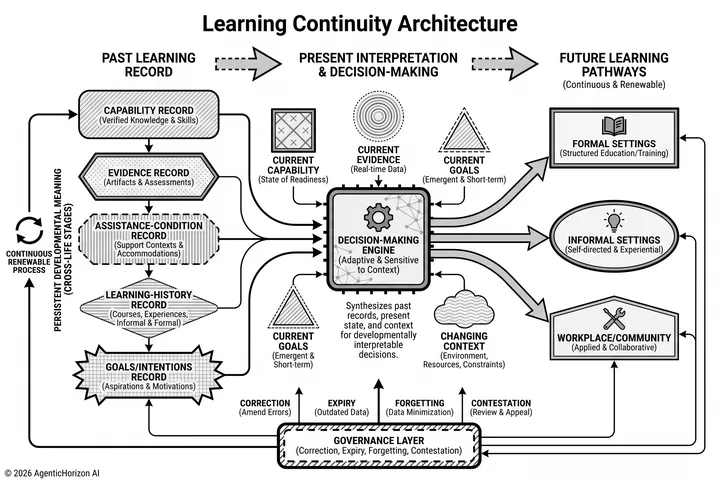
Exploring the transformation of educational institutions, curricula, assessment, credentials, governance, and lifelong learning systems, including the University 2036 architecture.
Explore the three interconnected research domains of LiA2036, test the Learn · Augment · Supervise · Delegate (LASD) decision framework across high-consequence scenarios, or inspect the 27 LiA2036 architectural plates.
Select any research specification below to examine its formal frameworks, methodologies, institutional models, and reference figures.
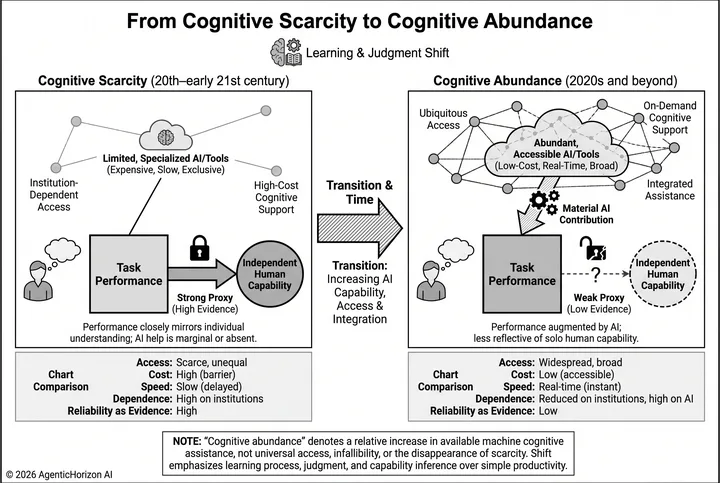
Why the end of cognitive scarcity invalidates legacy schooling—and how the Abundance Inversion and Productive Friction redefine human development across three interconnected research domains.
LiA2036 (Human Learning in an Age of Cognitive Abundance) is an interdisciplinary AgenticHorizon AI research initiative organized around three interconnected domains: Philosophy of Human Learning, Educational Media & Learning Experience, and Learning Ecosystems & Institutional Futures. When AI makes cognitive output abundant, unguarded delegation causes cognitive atrophy; LiA2036 establishes the philosophical frameworks, educational architectures, methodologies, and institutional models that sustain meaningful human development.
The 6-Element Cognitive Core, the 3D Capability Space, and the 10-Variable Learn · Augment · Supervise · Delegate (LASD) Decision Framework.
In 2036, what must a human still know inside their own head, and what should they delegate to autonomous agents? This module defines the irreducible 6-Element Cognitive Core required for human agency and introduces the 10-Variable LASD Decision Router to govern every cognitive task.
Replacing static credit hours and easily gamed take-home essays with the F-A-I-F Curriculum Graph, 14-Step Degree Pipeline, and Capability Evidence Passports.
Legacy curricula organized around seat-time credit hours and unverified take-home artifacts are structurally obsolete. The 2036 Curriculum Architecture reorganizes learning into an adaptive Foundation–Anchor–Integration–Frontier (F-A-I-F) graph, engineered via a 14-step degree design pipeline and validated by tamper-evident Capability Evidence Passports.
Engineering the Challenge Envelope, Deliberate AI Non-Intervention protocols, 7 Studio Archetypes, and learner-contestable epistemic profiles.
Next-generation educational media must act as cognitive gym equipment rather than an escalator. Intelligent Learning Environments dynamically regulate the Challenge Envelope, enforce Deliberate AI Non-Intervention when productive struggle is occurring, and expose Contestable Learner Models that students and faculty can inspect and challenge.
The complete operational blueprint for transforming universities and enterprise academies over a 30/90/365-day governance horizon.
University 2036 synthesizes the entire LiA2036 research program into a six-layer institutional reference architecture for provosts, deans, ministries of education, and chief learning officers—complete with versioned governance charters, assessment redesign matrices, and phased transformation playbooks.