Executive Architectural Synthesis · LiA2036 · Module 02
Architectural Specification Plates (4)
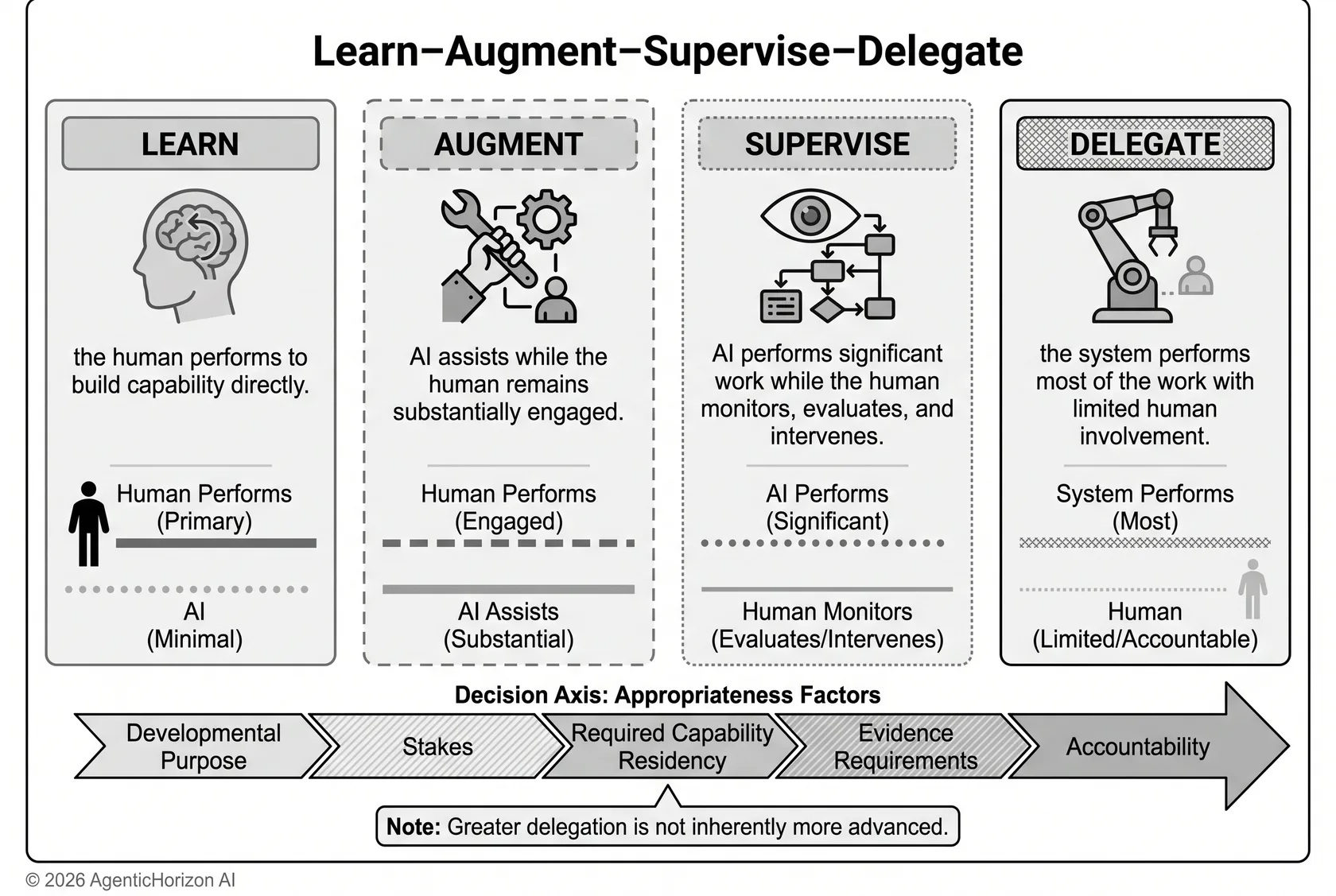
Learn–Augment–Supervise–Delegate (LASD) Cognitive Allocation Axis
The 10-Variable LASD Cognitive Allocation Decision Matrix (Learn · Augment · Supervise · Delegate)
| Decision Variable | Route to LEARN (Internalize) | Route to AUGMENT (Co-Think) | Route to SUPERVISE (Verify) | Route to DELEGATE (Automate) |
|---|---|---|---|---|
| 01 · Foundation Dependency | High: prerequisite for downstream schemas | Medium: extends existing core schema | Low-Medium: core already verified | Low: leaf-node execution task |
| 02 · Error Detectability Without Model | Opaque: cannot spot subtle AI hallucinations | Moderate: requires side-by-side critique | High: operator has strong mental oracle | Deterministic: machine-verifiable check |
| 03 · Consequence Blast Radius | High developmental or safety stakes | High exploration / synthesis value | High operational stakes requiring sign-off | Bounded / reversible / low-blast-radius |
| 04 · Temporal Decision Pressure | Sub-second clinical/cockpit reflex required | Deliberative studio design window | Asynchronous review queue | High-volume batch or background loop |
| 05 · Moral & Legal Sovereignty | Non-delegable human moral/fiduciary duty | Human-led normative tradeoff exploration | Human accountable cosign on proposal | Routine administrative execution |
| 06 · Learner Current State (Lₜ) | Novice / unverified on target concept | Intermediate / consolidating transfer | Verified expert on core domain model | Verified or domain-independent utility |
| 07 · Resilience Under AI Outage | Mission-critical manual fallback required | Degrades gracefully to slower manual work | Can pause queue during outage | Non-critical convenience automation |
| 08 · Epistemic Novelty / Ill-Structuredness | Core conceptual framing & problem definition | Multi-perspective hypothesis stress-testing | Known domain with edge-case exceptions | Well-specified repeatable transformation |
| 09 · Identity & Craft Formation | Constitutive of human professional identity | Deepens creative & analytical range | Exercises architectural stewardship | Extrinsic mechanical drudgery |
| 10 · Verification Cost vs. Generation Cost | Doing the work IS the verification | Co-generation + adversarial probing | Verification cheaper than manual drafting | Zero-cost automated schema/SHACL check |
Executable Architecture & Verification Specification
# LiA2036 10-Variable LASD Routing Policy Specification
lasd_cognitive_router:
  invariant_1_supervision_prerequisite: |
    IF task.consequence_stakes == "HIGH" AND learner.verified_mastery(task.core_model) < 0.85
    THEN FORCE_MODE("LEARN") # Cannot Supervise or Delegate what you cannot model
  invariant_2_sovereign_core: |
    IF task.requires_moral_fiduciary_judgment == true OR task.latency_budget_ms < 1000
    THEN DISALLOW_MODES(["DELEGATE"])
  modes:
    LEARN: "Unassisted schema formation + Socratic misconception probes; zero solution generation."
    AUGMENT: "Human-led framing + AI counterfactuals, simulation sandboxes, and rival hypotheses."
    SUPERVISE: "AI generates candidate proposal + Human executes constitutional verification & sign-off."
    DELEGATE: "Autonomous agent execution governed by deterministic SHACL/policy harness."
Core Architectural Specifications & Treatises (4 Sections)
01You Cannot Supervise What You Cannot Model
The popular cliché that "humans will just act as editors and supervisors of AI" fails whenever the human lacks the underlying causal model to spot subtle, high-fluency errors. The LASD Router mandates internal Learning whenever error detectability is low and consequence blast radius is high.
02The Irreducible 6-Element Human-Sovereign Cognitive Core
Across every profession, six capabilities must remain internalized inside the human mind:
- 1 Problem Framing & Question Formulation
- 2 Causal & Structural Mental Models
- 3 Epistemic Verification & Error Detection Judgment
- 4 Normative & Ethical Responsibility
- 5 Cross-Domain Analogical Synthesis
- 6 Embodied Social & Relational Agency.
03The Four LASD Agency Modes & Developmental Progression
LEARN builds internal neural schemas without AI short-circuiting; AUGMENT pairs human reasoning with AI counter-arguments and simulation; SUPERVISE places the human at the constitutional verification boundary; DELEGATE hands off bounded, machine-verifiable execution. Crucially, LASD allocation is dynamic: a medical student must LEARN differential diagnosis unassisted before earning the right to SUPERVISE clinical decision-support agents as an attending physician.
04The Possibility–Vulnerability–Importance Triangle
Whenever a curriculum or enterprise externalizes a cognitive task to AI, architects evaluate three coupled questions: What new scale or inquiry becomes Possible? What human capability becomes Vulnerable to atrophy or deception? And what residual human judgment becomes newly Important?
Probabilistic vs. Deterministic Execution Boundary & Verified Benchmark Ledger
Co-thinking partner in AUGMENT mode, candidate proposal generator in SUPERVISE mode, and bounded executor in DELEGATE mode.
10-Variable LASD Decision Router forcing LEARN mode whenever task stakes are high and verified mastery in Lₜ is below 0.85.