01 · The Operational Bottleneck & Failure of Unconstrained LLMs
Enterprise decision workflows require architects and analytical teams to synthesize hundreds of pages of heterogeneous source material—unstructured RFPs, technical architecture specifications, security questionnaires, and financial disclosures—into traceable assessments and executive decision artifacts. Manual synthesis consumes 20 to 40 hours per complex evaluation cycle, whereas unconstrained single-prompt LLMs suffer from lossy vector chunking, hallucinate baseline metrics, conflate external requirements with internal capabilities, and emit unverified prose.
02 · Neuro-Symbolic Reasoning Architecture & Multi-Agent Breakthrough
Enterprise Evidence & Decision Engineering investigates how governed multi-agent systems transform complex, heterogeneous information into traceable evidence, structured assessments, and decision-ready artifacts. Built on a Six-Stage Google ADK Evidence Processing Architecture, the system combines large-context document ingestion, parallel 47-question evidence and constraint analysis, deterministic readiness scoring, an immutable versioned data bus (.v1, .v2), draft → validated → promoted Checkpoint Promotion with human oversight, and a 20-schema Deterministic Decision Artifact Compiler.
Enterprise Evidence & Decision Engineering · Core Research & Content Architecture
01Evidence Ingestion & Context Engineering
Large-context document processing with preservation of source structure and quantitative evidence. Implemented via a zero-chunking Markdown-native corpus loader that feeds complete multi-document packages—such as RFPs, technical architecture specifications, security questionnaires, and financial disclosures—into Gemini’s 1M+ token context window while preserving cross-section tables, architectural footnotes, and quantitative baselines.
02Parallel Evidence & Constraint Analysis
Independent analytical agents examining requirements, capabilities, limitations, and contradictory evidence. Executes two strictly separated 47-question analytical taxonomies in parallel—one extracting external stakeholder requirements, operational constraints, and evaluation criteria, and the other auditing internal system capabilities, verified proofs, and integration gaps to eliminate confirmation bias.
03Deterministic Assessment & Decision Support
Structured scoring, uncertainty identification, and explicit decision criteria. Computes a deterministic multi-factor Readiness and Assessment Score across intent clarity, stakeholder and constraint coverage, evidence confidence, and integration friction risk, paired with structured evaluation matrices (Requirement-Capability Alignment, Cost-of-Problem Modeling, Comparative Trade-Off Matrices, and Stakeholder Decision Maps).
04Governed Multi-Agent Orchestration
Google ADK coordination and immutable versioned inter-agent data exchange. Built on the Six-Stage Google ADK Evidence Processing Architecture, where specialist agents never mutate shared state in place; every stage emits an immutable versioned artifact envelope (.v1, .v2) with cryptographic parent hashes on the unified data bus—delivering a 10× data-access speedup (~500ms to ~50ms) and a 43% smaller orchestration codebase in the reference implementation.
05Checkpoint Promotion & Human Oversight
Draft → validated → promoted lifecycle with explicit downstream enforcement. Enforces a three-state Checkpoint Promotion gate across 11 formal narrative and decision structuring frameworks with mandatory quantitative needed_data bindings, ensuring human reviewers or policy gates explicitly promote verified structures before downstream artifact compilation can proceed.
06Deterministic Artifact Compilation
Schema-driven generation of structured, editable, traceable decision artifacts. Maps promoted decision structures and verified quantitative bindings into 20 deterministic master slide layout schemas (process flows, 2×2 trade-off matrices, TCO comparisons, and architecture defenses) compiled into editable executive presentation artifacts (.pptx via the Gamma API) with zero ungrounded metrics.
03 · Deterministic Control Shell & Execution Topology
Architectural Specification Plates (4)
Governed Multi-Agent Evidence-to-Decision Pipeline (Six-Stage Google ADK Architecture)
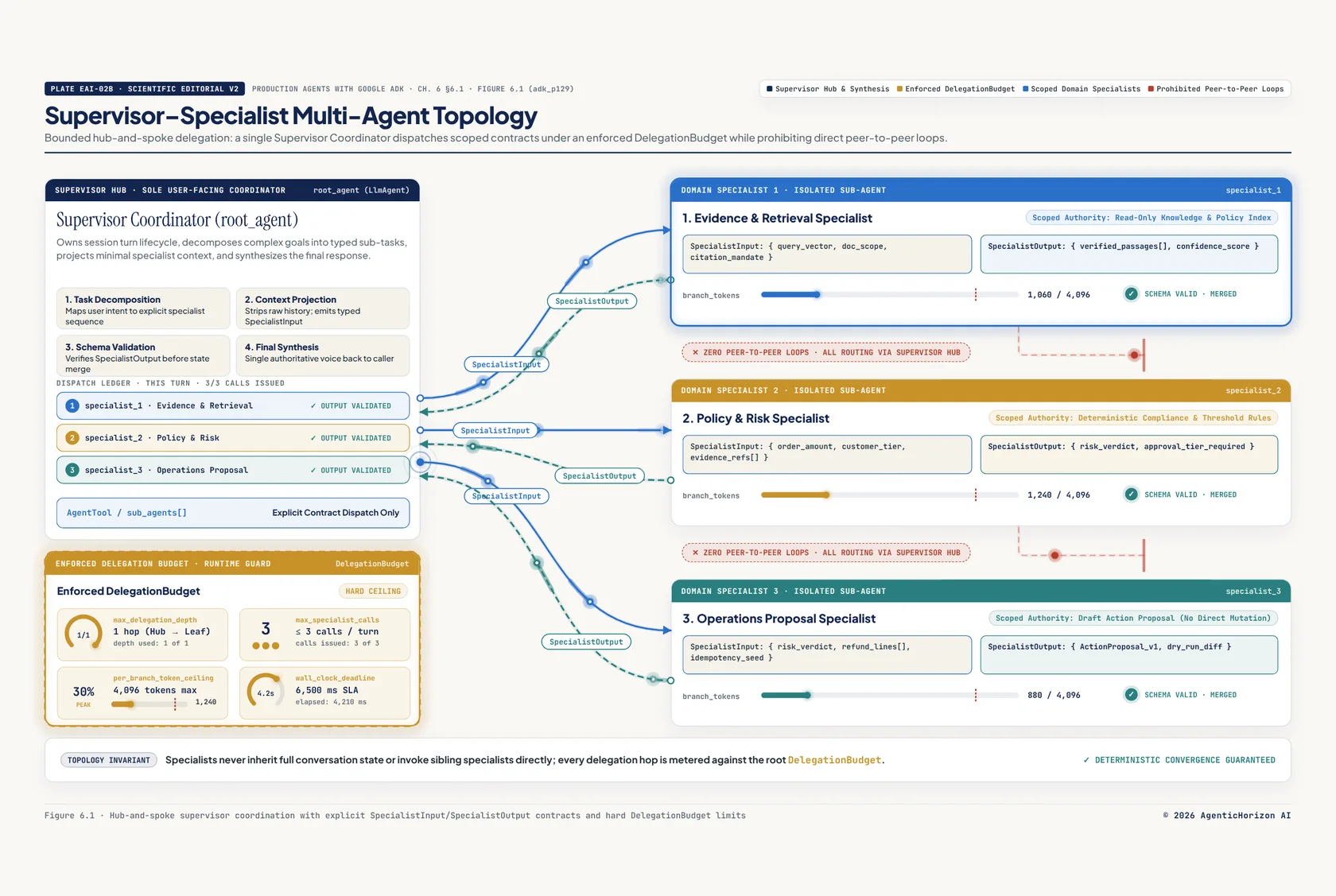
04 · Stage-by-Stage Deterministic vs. Probabilistic Boundary (6 Stages)
Stage 1Evidence Ingestion & Context Engineering (Source Corpus)
Replaces lossy vector chunking with a Markdown-native corpus loader that feeds complete multi-document corpora (RFPs, technical architecture specs, security questionnaires, and financial disclosures) into Gemini’s 1M+ token context window for single-pass cross-document evidence extraction.
Stage 2Parallel Evidence & Constraint Analysis (47-Question Taxonomies)
Executes two parallel Google ADK analytical agent tracks across structured 47-question checklists—one isolating external stakeholder requirements, governance constraints, and evaluation criteria; the other auditing internal capabilities, verified proofs, and limitations.
Stage 3Deterministic Assessment & Decision Support (Structured Scoring)
Computes a deterministic multi-factor Readiness and Assessment Score across Intent Clarity, Stakeholder & Constraint Coverage, Evidence Confidence, and Integration Friction Risk.
Stage 4Governed Reasoning & Strategic Evaluation Engine
Applies structured evaluation models—Requirement-Capability Alignment Matrices, Total Cost of Problem modeling, Comparative Differentiation matrices, and Stakeholder Decision Maps—communicating exclusively via immutable versioned envelopes (.v1, .v2) on the inter-agent data bus.
Stage 5Checkpoint Promotion & Human Oversight (11 Structuring Frameworks)
Structures verified findings across 11 formal narrative and decision frameworks (such as Situation–Complication–Resolution, Commercial Insight Reframe, CFO TCO Defense, and CTO Architecture Defense) and binds explicit quantitative payloads (needed_data) to each decision beat.
Stage 6Deterministic Artifact Compilation (20 Master Slide Schemas)
Maps promoted decision structures into 20 strict master slide layout schemas with deterministic visual bindings (process flows, 2×2 trade-off matrices, TCO comparisons), compiling directly into editable, traceable presentation artifacts (.pptx via Gamma API).
Verified Reference Implementation & Engineering Evidence Ledger (Project 03)
| Engineering Dimension | Measured Reference Implementation Benchmark | Architectural Mechanism & Provenance Scope |
|---|---|---|
| Reference Workflow Cycle Time | 20–40 hours compressed to <15 minutes (documented B2B deal workflow) | Six-Stage Google ADK Evidence Processing Architecture with parallel 47-question evidence extraction |
| Inter-Agent Data-Bus Latency | 10× speedup (~500ms → ~50ms in reference implementation) | Unified in-memory/indexed Immutable Versioned Data Bus (.v1, .v2) with O(1) artifact resolution |
| Orchestration Codebase Footprint | 43% smaller codebase after bus unification (reference system) | Eliminated ad-hoc point-to-point agent adapters in favor of canonical versioned envelopes |
| Parallel Evidence Analysis Depth | 47-question dual analytical taxonomies | Independent External Requirement/Constraint and Internal Capability/Proof extraction tracks |
| Decision & Narrative Frameworks | 11 formal structuring frameworks | Includes Situation–Complication–Resolution, Commercial Insight Reframe, CFO TCO Defense, and Technical Architecture Deep-Dive |
| Artifact Compilation Determinism | 20 master slide layout schemas + 8-stage enrichment | Strict JSON-to-Gamma API (.pptx) Decision Artifact Compiler with mandatory needed_data quantitative bindings |
| Human Oversight & Governance | 3-state Checkpoint Promotion lifecycle | Explicit draft → validated → promoted state transitions prevent unverified upstream drift |
06 · Reusable Enterprise AI Patterns & Cross-Industry Transfer
Pattern 01Immutable Versioned Inter-Agent Data Bus (.v1, .v2)
Agents never mutate shared state in-place; every stage emits an immutable versioned artifact (e.g., positioning.v2) with cryptographic parent lineage, enabling instant diffing and rollback.
Pattern 02The Checkpoint Promotion Lifecycle (draft → validated → promoted)
Downstream agents can only consume upstream artifacts that have transitioned from draft through schema validation (validated) to human or policy sign-off (promoted).
Pattern 03Parallel Adversarial Dual-Taxonomy Evidence Analysis
Run two strictly separated agent tracks—one representing external requirements/constraints and one auditing internal capabilities/evidence—to prevent sycophantic confirmation bias.
Pattern 04Full-Context Document-Native Ingestion Over Lossy Chunking
Leverage 1M+ token context windows with structured Markdown hierarchy preservation rather than shredding cross-referenced tables into disconnected 500-token vector chunks.
07 · Production Verification & Control Contract
// Project 03: Immutable Versioned Data Bus & Checkpoint Promotion Gate (draft → validated → promoted)
export interface VersionedArtifactEnvelope<T> {
  readonly artifactKey: string; · e.g., "decision_narrative.v2"
  readonly version: number;
  readonly parentHashes: readonly string[];
  readonly lifecycleState: 'draft' | 'validated' | 'promoted';
  readonly neededDataBindings: Record<string, string | number>;
  readonly payload: T;
}

export function requirePromotedUpstream<T>(env: VersionedArtifactEnvelope<T>): T {
  if (env.lifecycleState !== 'promoted') {
    throw new CheckpointGateError(`STAGE_BLOCKED: Artifact ${env.artifactKey} is in '${env.lifecycleState}' state (requires 'promoted').`);
  }
  return env.payload;
}
08 · Verified Production Innovations
- Immutable Versioned Data Bus (.v1, .v2, ...) delivering 10× faster inter-agent data access (~50ms), a 43% smaller orchestration codebase, and deterministic state rollback in the six-stage reference implementation.
- Checkpoint Promotion Lifecycle (draft → validated → promoted) combining multi-agent evidence synthesis with explicit human oversight and downstream compilation gates.
- Parallel 47-Question Evidence & Constraint Taxonomies separating external requirements analysis from internal capability auditing to prevent confirmation bias.
- Deterministic Decision Artifact Compiler mapping verified quantitative needed_data bindings across 11 structuring frameworks into 20 editable presentation schemas (.pptx).
Reference Implementation: Complex Enterprise Document-to-Decision Workflows
The Enterprise Evidence & Decision Engineering architecture was implemented, deployed, and benchmarked as a concrete Six-Stage Google ADK Evidence Processing Architecture for complex enterprise B2B document-to-decision and deal-engineering workflows. Positioning this workflow as a documented reference implementation separates the reusable multi-agent governance substrate from its initial domain application.
01Applied Workflow: Requirements Analysis, Capability Assessment & Executive Artifact Generation
In its deployed reference implementation, the six-stage Google ADK pipeline ingests hundreds of pages of unstructured enterprise RFPs, technical architecture specifications, security questionnaires, and 10-K financial disclosures into Gemini’s 1M+ token context window. Parallel analytical agents execute dual 47-question buyer-requirement and seller-capability taxonomies, feed a deterministic readiness and strategic evaluation engine (computing Value-Driver Alignment, Total Cost of Problem, and Stakeholder Decision Maps), and structure executive narratives across 11 formal frameworks. Human leads review and promote verified artifacts (draft → validated → promoted) before the 20-schema Deterministic Decision Artifact Compiler generates editable PowerPoint (.pptx) decks via the Gamma API—compressing a 20–40 hour manual synthesis cycle into under 15 minutes.
02Implemented Benchmark Scope vs. Cross-Industry Transfer Opportunities
All reported performance metrics—including the 20–40 hour to <15 minute cycle-time compression, the 10× data-bus access speedup (~500ms to ~50ms), and the 43% orchestration codebase reduction—were measured directly on this six-stage enterprise document-to-decision reference implementation. While the core architectural mechanisms (Immutable Versioned Data Bus, Parallel Dual-Taxonomy Analysis, Checkpoint Promotion, and Schema-Driven Artifact Compilation) are designed for reuse across adjacent domains such as M&A technical due diligence, regulatory compliance audits, and procurement evaluation, those cross-industry applications represent architectural transfer opportunities rather than separately deployed or independently benchmarked industry systems.
Probabilistic vs. Deterministic Execution Boundary & Verified Benchmark Ledger
Six-Stage Google ADK Evidence Processing Architecture performing 1M+ token full-corpus document ingestion, parallel 47-question requirement/capability extraction, and 11-framework narrative & decision structuring.
Immutable Versioned Data Bus (.v1, .v2), Checkpoint Promotion Gate (draft → validated → promoted) with human oversight, mandatory needed_data quantitative bindings, and 20-schema Deterministic Decision Artifact Compiler (.pptx).