Executive Architectural Synthesis · Enterprise AI · Module 01
Architectural Specification Plates (6)
The Build–Evaluate–Deploy–Observe Production Agent Lifecycle
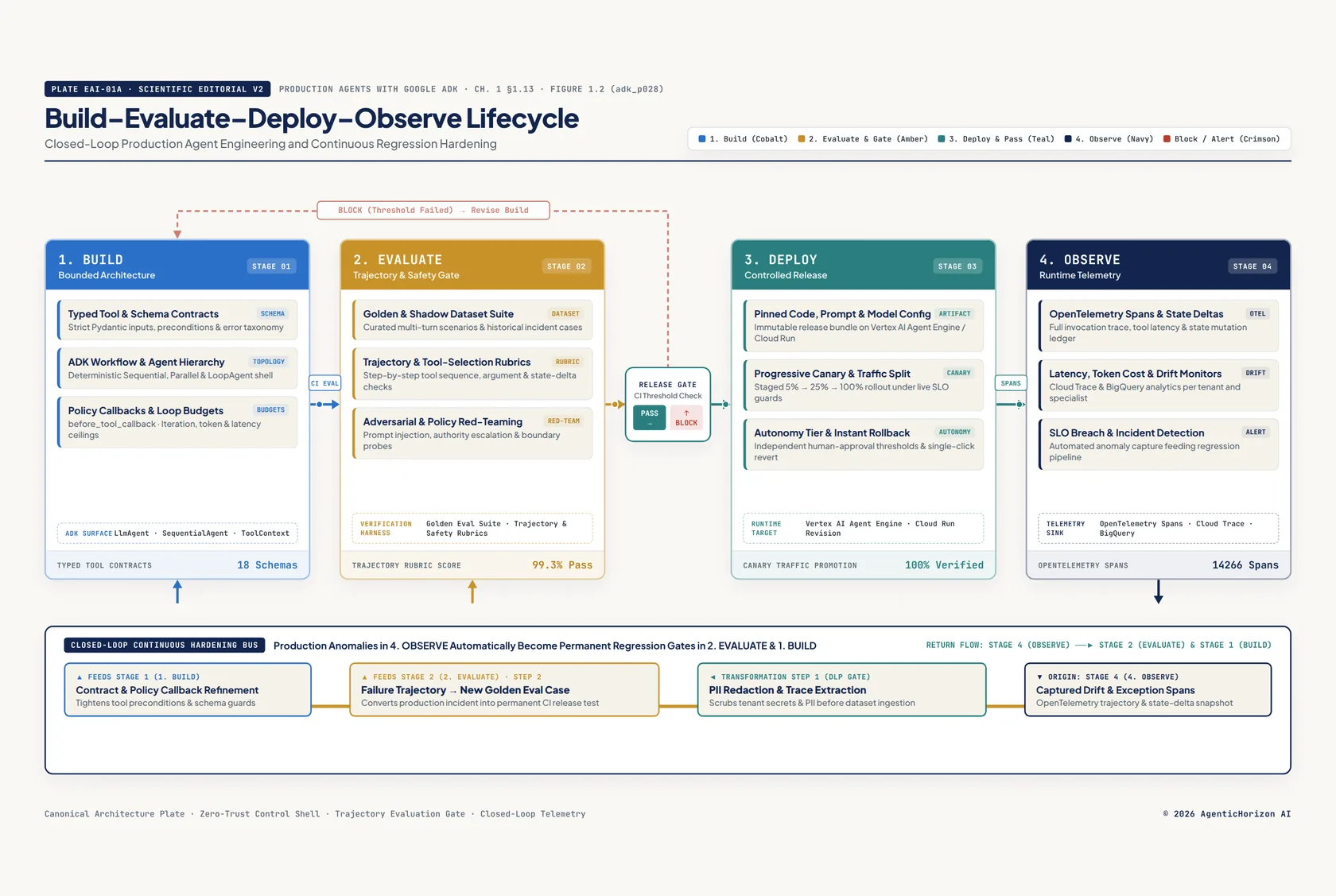
The Bounded Autonomy & Execution Mode Decision Matrix
| Execution Mode | Input Ambiguity | Blast Radius & Reversibility | Required Control Plane Gate | Canonical Enterprise Fit |
|---|---|---|---|---|
| Deterministic Microservice / Rules | Low (Typed Schema) | High Consequence / Low Cost | Compile-time types + ACID Transaction | Billing calculation, statutory tax ledger, IAM token issuance |
| Deterministic Workflow + LLM Step | High (Unstructured Input) | Medium / Reversible Draft | JSON Schema + Confidence Threshold | Document extraction, RFP triage, support ticket routing |
| Bounded Single Agent (L1–L5) | High + Dynamic Tool Choice | Medium-High / Compensatable | Layer 3 SHACL + OPA Gate + Idempotency Key | Customer credit adjustment within policy ceiling, inventory merchandising |
| Governed Multi-Agent Topology | Multi-Domain / Cross-Boundary | High / Multi-System State | Typed Delegation Budget + Checkpoint Promotion | Enterprise evidence & decision workflows, multi-repository code fabrication, clinical synthesis |
Executable Architecture & Verification Specification
# Enterprise Architecture Decision Record (ADR): Autonomy Envelope Contract
autonomy_envelope:
  workflow_id: "ent-commercial-credit-adjustment-v2"
  primitive_allocation:
    interpretation: "probabilistic_llm_agent"
    state_transition: "deterministic_fsm"
    policy_gate: "layer3_shacl_opa_enforcer"
  autonomy_tiers:
    tier_1_autonomous:
      condition: "amount_usd <= 250.00 && customer_tenure_months >= 12"
      compensation_sla_ms: 500
    tier_2_supervised_proposal:
      condition: "amount_usd > 250.00 && amount_usd <= 5000.00"
      requires: "human_operator_cosign_token"
    tier_3_hard_block:
      condition: "amount_usd > 5000.00 || missing_canonical_invoice_uri"
      action: "ABSTAIN_AND_ESCALATE"
Core Architectural Specifications & Treatises (5 Sections)
01The Four Fundamental Primitives of Agentic Systems
Every production agentic system decomposes into four orthogonal primitives:
- 1 Probabilistic Interpretation & Reasoning under input ambiguity
- 2 Explicit Scoped State & Memory across time
- 3 Kinetic Tool & Environment Execution
- 4 Deterministic Governance & Policy Enforcement. Treating a foundation model as all four primitives simultaneously is the root cause of enterprise hallucination, silent state corruption, and confused-deputy privilege escalation. Our reference architecture restricts the model strictly to Primitive 1 (interpretation and typed candidate proposal generation), while Primitives 2, 3, and 4 execute inside deterministic, version-controlled runtime infrastructure.
02The Bounded Autonomy Decision Matrix (Recommend → Approve → Bound → Escalate → Kill)
Autonomy is never a binary toggle; it is an earned operational budget governed by three measurable axes: Consequence Blast Radius, State Reversibility, and Verification Latency. Where inputs are structured and rules are statutory (such as tax calculation or IAM token issuance), an agent is an anti-pattern—use a deterministic microservice. Where input ambiguity is high and tool selection is dynamic, the Risk × Autonomy Permission Control Plane routes execution across five explicit tiers: Recommend-Only, Human-Cosigned Proposal, Bounded Autonomous Execution (with monetary/scope ceilings), Automatic Abstention/Escalation, and Instant Circuit-Breaker Kill.
03Closed-Loop Trust UX (Evidence → Proposal → Confirm → Act → Recover)
Customer and operator trust is not achieved through conversational politeness or streaming typing indicators; it is engineered as a five-stage closed control loop. Production human-agent interfaces separate what the model inferred from what the control plane verified: surfacing span-level provenance citations (Evidence), rendering typed pre-commit action cards with diff previews (Proposal), enforcing explicit operator sign-off on high-consequence mutations (Confirm), committing idempotently via Layer 4 (Act), and exposing one-click semantic undo handlers (Recover).
04Executive AI Architecture Decision Records (ADRs) & Organizational Ownership
Before writing a single prompt or selecting an orchestration framework, principal architects ratify a machine-readable Architecture Decision Record (ADR). The ADR locks the non-negotiable domain invariants, the probabilistic-to-deterministic boundary, the maximum acceptable Cost-per-Successful-Task (CPST), the four-state degradation ladder (NOMINAL → RESTRICTED → READ_ONLY → HARD_KILL) when model latency or error rates spike, and named human risk owners across engineering, domain semantics, and security.
05The 11-Stage Production Agent Engineering Spine & Six Production Case Studies
In Production Agentic Engineering (Release B0.14), every enterprise deployment progresses through a canonical 11-stage engineering spine:
- 1 Problem Formulation →
- 2 Bounded Autonomy Budgeting →
- 3 5-Layer Systems Architecture →
- 4 Context & Memory Compilation →
- 5 Typed Tools & Distributed Execution →
- 6 Knowledge & Semantic Grounding →
- 7 Multi-Agent Orchestration →
- 8 7-Layer Evaluation →
- 9 Zero-Trust Security & Governance →
- 10 Production Operations & CPST FinOps →
- 11 Cross-Domain Case Studies (spanning Customer Operations, Financial Deal Triage, Healthcare Prior-Authorization, Software-Defined Vehicle Merchandising, Supply-Chain Exception Recovery, and Enterprise Code Fabrication).
Probabilistic vs. Deterministic Execution Boundary & Verified Benchmark Ledger
Synthesizing unstructured multi-source requests, drafting candidate plans, and navigating open-ended linguistic ambiguity.
Risk × Autonomy Envelope Classifier, ADR Pre-Deployment Gate, and Recommend / Approve / Bound / Escalate / Kill transitions.