Executive Architectural Synthesis · Enterprise AI · Module 07
Architectural Specification Plates (4)
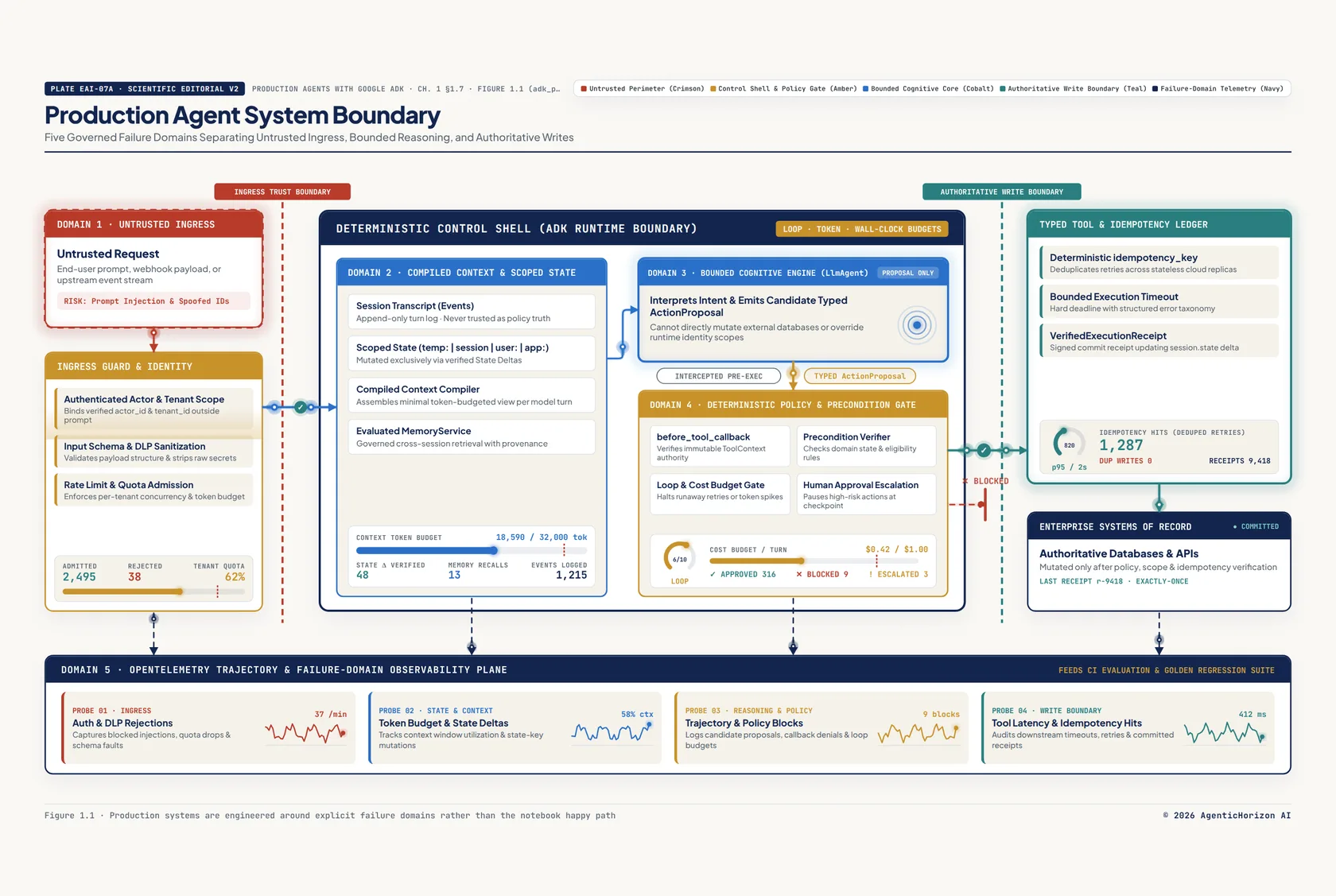
Production Agent System Boundary & Failure Domain Telemetry
The 7-Layer Production Agent Evaluation Stack & Release Gates
| Eval Layer | Target Under Test | Verification Mechanism | Execution Cadence | CI/CD Release Gate Policy |
|---|---|---|---|---|
| L1 · Deterministic Contract & Schema | Tool schemas, SHACL shapes, state reducers | Unit tests + JSON Schema / SHACL conformance | Every commit (<10s) | 100% pass required (Hard Block) |
| L2 · Single-Step Decision & Tool Args | Model tool selection & argument extraction | Pinned golden contexts + AST exact/semantic match | Every PR | >= 99.0% critical tool accuracy (Hard Block) |
| L3 · Retrieval & Context Grounding | Context Compiler & Hybrid GraphRAG slice | Entity recall@K, bitemporal freshness, citation fidelity | Every PR + Nightly | Zero ungrounded numeric/policy assertions |
| L4 · Multi-Step Trajectory & Convergence | Full agent loop across mocked/sandbox tools | Step-efficiency ratio, loop termination, handoff schema | Pre-merge & Staging | Zero infinite loops; <= 1.25x optimal step count |
| L5 · Policy, Security & Adversarial Gate | Confused-deputy, injection & abstention behavior | Automated red-team suite + Cedar/OPA invariant checks | Pre-release Gate | 100% policy enforcement & abstention pass |
| L6 · Calibrated Domain Judge & Human Rubric | Nuanced synthesis quality & persona alignment | Bias-corrected LLM-as-Judge calibrated against human SMEs | Staging Release Candidate | Confidence-interval lower bound >= baseline |
| L7 · Online Canary & Shadow Telemetry | Live production traffic under progressive rollout | OpenTelemetry drift alerts, CPST, human override rate | Continuous Production | Automated rollback on >2σ error or cost spike |
Executable Architecture & Verification Specification
// OpenTelemetry Production Agent Trajectory Span & Reproducibility Bundle
{
  "trace_id": "be74d90a1f884c219b00412e881a",
  "span_name": "agent.workflow.commercial_incentive_publish",
  "attributes": {
    "ah.layer1.tenant_id": "tenant_oem_north_america",
    "ah.layer2.context_budget_tokens": { "graph_facts": 2410, "policy": 1150, "telemetry": 380 },
    "ah.layer3.shacl_shape": "ex:AuthorizedIncentivePublishShape",
    "ah.layer3.shacl_conforms": true,
    "ah.layer3.policy_verdict": "ALLOW",
    "ah.layer4.idempotency_key": "idem_vin_1FA6P8CF0R5100001_20261029",
    "ah.layer5.trajectory_steps": 3,
    "ah.layer5.cpst_usd": 0.0142
  }
}
Core Architectural Specifications & Treatises (4 Sections)
01Why Final-Answer Evaluation Fails in Agentic Systems
Grading an enterprise agent solely on the fluency or helpfulness of its final text response is one of the most dangerous anti-patterns in production AI. An agent can produce a polite, plausible final answer while having silently called the wrong API, mutated the wrong customer record, leaked cross-tenant attributes, or burned $4.50 in redundant retry loops. Our 7-Layer Evaluation Stack treats evaluation as a closed-loop engineering release gate—grading deterministic schema contracts (L1), single-step tool selection and argument extraction (L2), bitemporal retrieval grounding (L3), multi-step trajectory convergence (L4), adversarial policy compliance (L5), SME-calibrated domain rubrics (L6), and live production canary telemetry (L7).
02OpenTelemetry Trajectory Spans & Incident Reproducibility Bundles
Every production workflow emits structured OpenTelemetry spans correlating Layer 1 tenant identity, Layer 2 compiled context budgets, Layer 3 SHACL/policy verdicts, Layer 4 idempotency keys, and Layer 5 Cost-per-Successful-Task (CPST) attribution. Whenever a production anomaly, human override, or policy block occurs, the observability plane exports a self-contained Reproducibility Bundle (pinned context slice, model configuration, tool mock responses, and expected invariant check) that is automatically promoted into the CI/CD golden regression dataset.
03Calibrating LLM-as-a-Judge Against Human Domain Experts
Unvalidated LLM-as-a-Judge pipelines suffer from severe verbosity bias, self-preference, position bias, and blindness to hard domain invariants. We enforce a strict division of labor: never use a probabilistic LLM judge where a deterministic SHACL shape, AST comparison, or numeric fact-echo check exists. Where open-ended synthesis quality must be evaluated at Layer 6, judge rubrics are decomposed into binary evidentiary criteria and continuously calibrated against stratified human SME annotations using Cohen’s kappa and confidence-interval bounds.
04The 14 Production Failure Mode Containment Matrix
Our engineering corpus codifies 14 recurring production agent failure modes—including entity homonym collision, stale bitemporal retrieval, tool timeout write ambiguity, confused-deputy escalation, indirect prompt injection, sycophantic constraint relaxation, and multi-agent cyclic deadlock. Each of the 14 failure modes is bound to a three-part operational contract: a design-time Prevention gate (e.g., closed-world SHACL validation), a runtime Containment circuit breaker (e.g., step-budget cutoff and taint quarantine), and an automated Recovery protocol (e.g., semantic compensation handler or human exception queue).
Probabilistic vs. Deterministic Execution Boundary & Verified Benchmark Ledger
Layer 6 SME-calibrated domain judge rubrics for open-ended tonal and multi-perspective synthesis evaluation.
Layers 1–5 hard CI/CD release blocks (JSON/SHACL schema, AST tool-arg match, citation recall, step-efficiency ratio, and policy red-teaming).