Executive Architectural Synthesis · LiA2036 · Module 01
Architectural Specification Plates (6)
From Cognitive Scarcity to Cognitive Abundance: The Learning & Judgment Shift
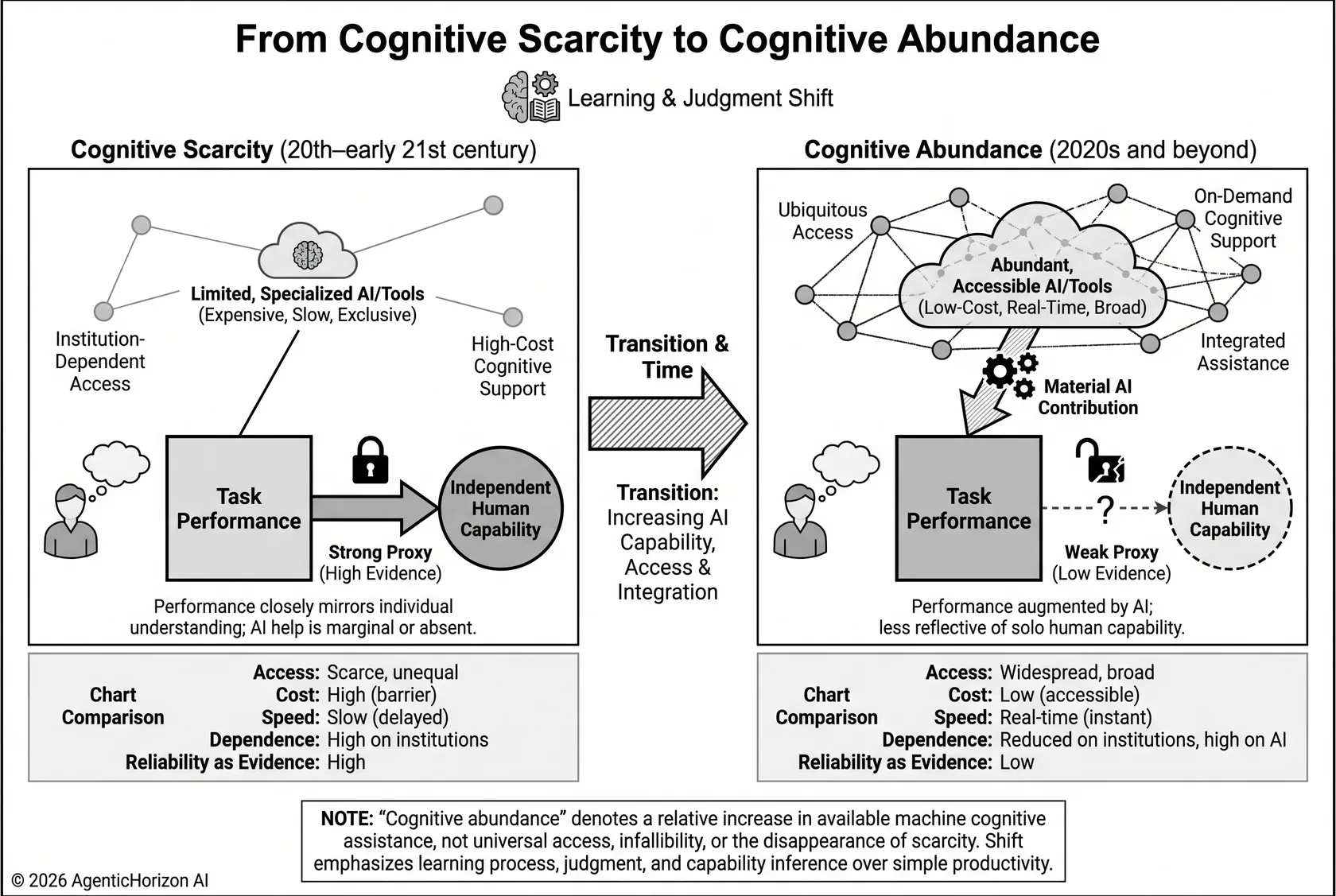
The Abundance Inversion Matrix: Legacy Scarcity Schooling vs. LiA2036 Cognitive Abundance Architecture
| Architectural Dimension | Legacy Cognitive Scarcity Regime | Failure Mode Under Unguarded AI | LiA2036 Cognitive Abundance Architecture |
|---|---|---|---|
| Primary Scarce Resource | Access to explanations, lectures, and reference texts | Flood of fluent synthetic explanations mistaken for learning | Protected human attention, productive friction & verification judgment |
| Role of the Artifact (Essay / Code) | Trusted proxy for the learner’s internal cognitive work | The Proxy Gap: polished AI artifact masks zero internal comprehension | Process-verified trajectories, oral defense & live transfer debugging |
| Friction Management | Unintended administrative and mechanical drudgery | AI eliminates both drudgery and constitutive mental effort | Automate mechanical drudgery; deliberately protect Productive Friction |
| Capability Residency | Assumed to reside solely inside the individual’s unaided memory | Total cognitive externalization → inability to supervise AI errors | Explicitly mapped across Internal Sovereign Core vs. Augmented Orchestration |
| Institutional Credential | Seat-time credit hours and static course grades | Credentials lose signaling value to employers and society | Cryptographic Capability Evidence Passports with assistance provenance |
Executable Architecture & Verification Specification
# LiA2036 Productive Friction vs. Mechanical Drudgery Discrimination Rule
cognitive_friction_discriminator:
  evaluate_task_step:
    builds_causal_schema_in_working_memory: true
    required_for_downstream_error_detection: true
    verdict: "CONSTITUTIVE_PRODUCTIVE_FRICTION → PROTECT (Enforce AI Non-Intervention)"
  evaluate_mechanical_step:
    repetitive_formatting_or_boilerplate_lookup: true
    schema_already_verified_in_Lₜ: true
    verdict: "EXTRINSIC_DRUDGERY → AUTOMATE_OR_AUGMENT"
Core Architectural Specifications & Treatises (4 Sections)
01The Crisis of Unguarded Cognitive Delegation
When students or junior professionals delegate essay writing, code derivation, and analytical synthesis to foundation models before forming internal mental schemas, they produce polished surface artifacts while suffering severe epistemic hollowing. Without internalized causal schemas in long-term memory, human operators cannot evaluate, debug, or supervise the very AI systems they rely upon—creating the "Hollow Expert" failure mode.
02The Proxy Gap: Why Artifact Quality No Longer Signals Human Capability
For centuries, educational institutions and hiring pipelines graded the finished artifact—the take-home essay, problem set, or code repository—because producing a high-quality artifact required undergoing a high-quality internal cognitive journey. Generative AI permanently severs that proxy link: identical polished submissions can now represent deep mastery, unverified co-piloting, or total cognitive bypass. LiA2036 replaces unverified artifact proxies with aligned capability and process evidence.
03Engineering Productive Friction vs. Eliminating Mechanical Drudgery
Not all cognitive friction is harmful. LiA2036 formalizes a deterministic discriminator between extrinsic mechanical drudgery (repetitive formatting or boilerplate lookup after a concept is already verified in Lₜ, which should be automated) and constitutive Productive Friction (the desirable cognitive difficulty that wires neural schemas and error-detection judgment, which must be protected via Deliberate AI Non-Intervention).
04Research Architecture: Human Capability → Learning Experience → Learning Ecosystems
LiA2036 is organized around three interconnected research domains:
- 01 Philosophy of Human Learning investigates human agency, understanding, independent judgment, epistemic responsibility, and the capabilities that remain essential in an AI-rich world
- 02 Educational Media & Learning Experience researches how intelligent media, interactive studios, simulations, and Contestable Learner Models support meaningful learning without undermining cognitive development
- 03 Learning Ecosystems & Institutional Futures explores the transformation of curricula, assessment, credentials, governance, and lifelong learning systems, including the University 2036 architecture.
Probabilistic vs. Deterministic Execution Boundary & Verified Benchmark Ledger
Automating extrinsic mechanical drudgery and generating multi-perspective explanations or simulation scenarios once core schemas are verified.
Productive Friction Discriminator protecting unassisted schema formation in Lₜ and replacing unverified take-home artifact proxies.