Executive Summary & Key Architectural Takeaways
- When AI code synthesis velocity exceeds 20,000+ lines per hour, human line-by-line pull-request review collapses into rubber-stamping cognitive theatre.
- Enforce zero-trust oracle separation (generator_write_access_to_tests = false) so the agent synthesizing application code never writes or weakens its own tests.
- Move human governance upward from raw syntax (R4) to structured IntentSpecs (R1), TLA+ and SHACL invariants (R2), and property-based/metamorphic harnesses.
- Use the 5-Level Epistemic Telescope (L5–L1 semantic zoom) to bound human review to <= 7 decision variables at >= 12× verification leverage.
The Comprehension Ceiling & Reliable Human Decision Envelope
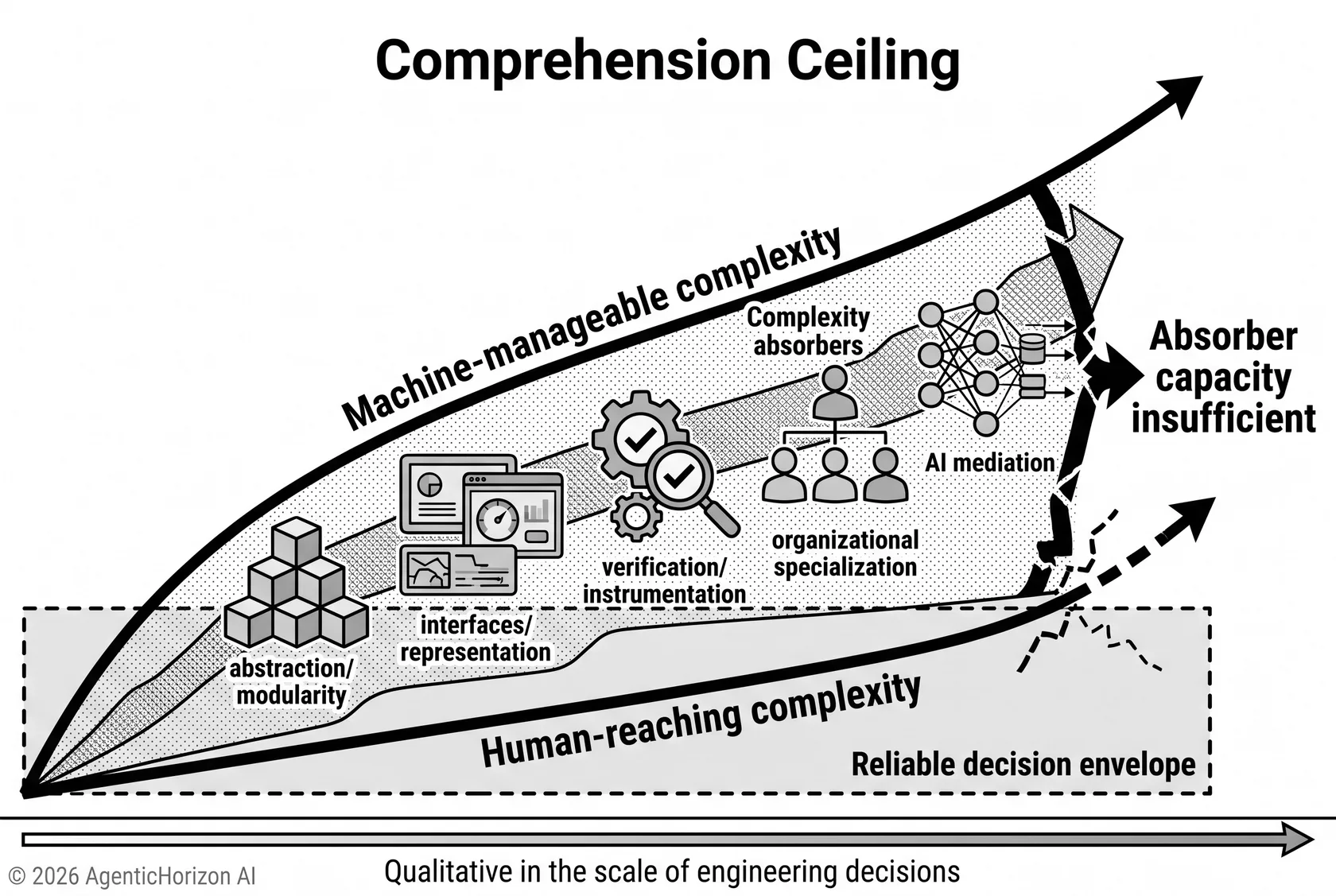
1. Crossing the Comprehension Horizon: Why Syntax-Level Code Review Fails at Scale
For eight decades, software engineering rested on an unspoken human-scale axiom: a software system is trustworthy only to the extent that a human engineer can read its source code line by line and hold its execution paths in working memory. Under AbundanceLab’s central law—"When generation cost approaches zero, the bottleneck migrates to verification, meaning, and governance"—autonomous multi-agent code fabrication shatters that axiom permanently.
Empirical Collapse of Large Pull-Request Reviews
Empirical software engineering studies consistently show that human defect-detection effectiveness plummets once a pull-request diff exceeds 200 to 400 lines of code. When an autonomous fabrication swarm synthesizes or refactors 30,000 lines of interconnected services overnight, presenting a principal engineer with a syntax-level GitHub diff produces cognitive theatre: reviewers either nitpick variable naming on the first 50 lines and rubber-stamp the remaining 29,950, or become a paralyzing human queue bottleneck.
The VLSI Semiconductor Foundry Precedent
Other engineering disciplines crossed their manual comprehension horizon decades ago without sacrificing reliability. Hardware architects designing a 100-billion-transistor 2nm processor do not visually inspect individual transistor polygons on a photomask; they govern higher-level representations via Register-Transfer Level (RTL) specifications, automated Design Rule Checking (DRC), Formal Equivalence Checking (FEC), and timing envelopes. Post-comprehension software engineering applies this exact structural inversion to AI-fabricated software.
2. Cognitive Metrology and the Nine Dimensions of Engineering Comprehension Burden (ECB)
To govern complexity scientifically, we must first retire raw Lines of Code (LOC) as a proxy for cognitive load. Ten thousand lines of generated, side-effect-free serialization adapters impose almost zero human comprehension burden, whereas 250 lines of asynchronous, shared-state retry logic with implicit cross-service assumptions can overwhelm a staff engineer’s working memory.
Our Cognitive Metrology framework quantifies Engineering Comprehension Burden (ECB) across nine orthogonal dimensions, pairing each with a mandatory architectural absorber:
- 01 · Structural Coupling & Fan-Out: Absorbed by strict information-hiding module boundaries and acyclic contract DAGs.
- 02 · Combinatorial State Space: Absorbed by explicit finite state machines (FSMs) and immutable versioned state deltas.
- 03 · Temporal & Asynchronous Dynamics: Absorbed by TLA+ temporal specifications and authoritative write-boundary idempotency.
- 04 · Semantic Heterogeneity: Absorbed by bounded domain ontologies and closed-world W3C SHACL shapes.
- 05 · Behavioral Non-Determinism: Absorbed by Layer 3 Deterministic Control Shells and pinned replay seeds.
- 06 · Change Blast Radius: Absorbed by least-privilege capability tokens and cellular blast compartments.
- 07 · Diagnostic Opacity: Absorbed by OpenTelemetry trajectory spans and automated minimal counterexample shrinking.
- 08 · Specification Entropy: Absorbed by executable
IntentSpec.yamlartifacts and read-only verification oracles. - 09 · Verification Latency: Absorbed by sub-minute property-based, metamorphic, and shadow-replay verification suites.
3. Breaking the Tautological Test Trap via the R0–R6 Representation Stack
The most insidious pathology of unconstrained AI coding assistants is Tautological Test Ratification. When a developer prompts a single coding agent to generate both a microservice implementation and its accompanying unit test suite, any domain misunderstanding in the model’s reasoning is written simultaneously into the application code and into the test assertions. The CI pipeline turns bright green because the hallucinated test ratifies the hallucinated implementation.
Why "Vibe Coding" Ratifies Its Own Hallucinations
Static, example-based unit tests (such as checking three happy-path inputs) are trivially overfit by synthesis agents. Even worse, when a coding agent is granted write access to the test directory during an automated repair loop, its path of least resistance to making a failing build pass is to weaken or delete the failing assertion.
Zero-Trust Oracle Separation (generator_write_access_to_tests = false)
The 8-Stage Cognitive Fabrication Loop eliminates tautological testing by decoupling representations across the R0–R6 Stack: human architects author R0 (Constitutional Purpose & Risk Bounds) and R1 (Structured IntentSpec.yaml). In Stage 02—before a single line of R4 application syntax is synthesized—an independent verification compiler translates R1 into R2 (Formal TLA+ state machines, SHACL shapes, and Property-Based/Metamorphic test generators) and locks the verification harness read-only at the filesystem and CI boundary (generator_write_access_to_tests = false). The multi-agent fabrication swarm operating at R4 can never view or modify the oracle’s adversarial seeds.
4. Multi-Modal Verification Oracles and Automated Counterexample Shrinking
Because post-comprehension software treats R4 source syntax as an ephemeral compilation target that can be regenerated on demand, Stage 05 of the fabrication loop subjects every candidate build to a four-tier independent oracle:
- Closed-World Type & SHACL Conformance: Verifies structural interface contracts and acyclic dependency budgets across the module DAG (
R3). - Property-Based Testing (Hypothesis / QuickCheck): Generates 50,000+ randomized, adversarial inputs testing universal domain invariants (for example, conservation of physical warehouse inventory across arbitrary concurrent order allocations).
- Metamorphic Invariance Relations: Verifies structural relationships across input perturbations when no closed-form point oracle exists (for example, proving that increasing a customer’s priority tier never decreases their allocated fill rate under identical stock).
- TLA+ Temporal Model Checking: Exhaustively verifies state-machine safety and liveness properties (such as exactly-once settlement and absence of deadlock across retry loops).
When candidate build #1 fails property-based test case #14,209, Stage 06 does not feed a noisy 8,000-line stack trace back to the synthesis agent. Instead, the harness runs automated delta-debugging and counterexample shrinking to isolate the minimal reproducing failure trace (such as two concurrent orders for 1 remaining unit with identical millisecond timestamps) and feeds that exact formal diagnostic back into a bounded repair loop.
5. The Epistemic Telescope: 5-Level Semantic Zoom (L5–L1) for Human Sovereignty
Once a candidate build passes all automated verification gates, how does a human principal architect exercise meaningful sign-off without reading 50,000 lines of syntax? The answer is the Epistemic Telescope—a five-level semantic zoom instrument designed to maintain Governance-Preserving Compression (keeping active human decision variables $le 7$ while enforcing a Verification Leverage Ratio $ge 12.0\times$, where each line of human-authored spec governs at least twelve lines of generated implementation).
Architects review releases from the top down: L5 (Constitutional & Purpose Lens) displays authority envelope and OPA/Cedar policy diffs; L4 (Semantic & Contract Topology Lens) renders 3-Layer Ontology, SHACL shape, and module coupling deltas; and L3 (Behavioral & Simulation Delta Lens) compares state-machine transitions and tail-latency distributions across 25,000+ shadow-replayed production requests. Only if L3–L5 flag a boundary shift does the architect zoom into L2 (Verification & Shrunk Counterexample Lens) or L1 (Execution & AST Substrate Lens). Crucially, every L5–L3 projection is compiled deterministically from cryptographic test receipts and model-checker outputs—never summarized by an unverified LLM—preserving absolute human sovereignty over post-comprehension systems.