Executive Summary & Key Architectural Takeaways
- Default to a single bounded agent; decompose into multi-agent topologies only at genuine capability, context-window, or security-authority boundaries.
- Shared conversational transcript flooding degrades specialist accuracy, amplifies early hallucinations, and spreads untrusted prompt-injection taint.
- Compile a least-context view for each specialist using a deterministic 60/30/10 token allocation budget over separated state and memory scopes.
- Route inter-agent handoffs through typed DelegationEnvelopes and an immutable versioned data bus (.v1, .v2) with draft → validated → promoted checkpoints.
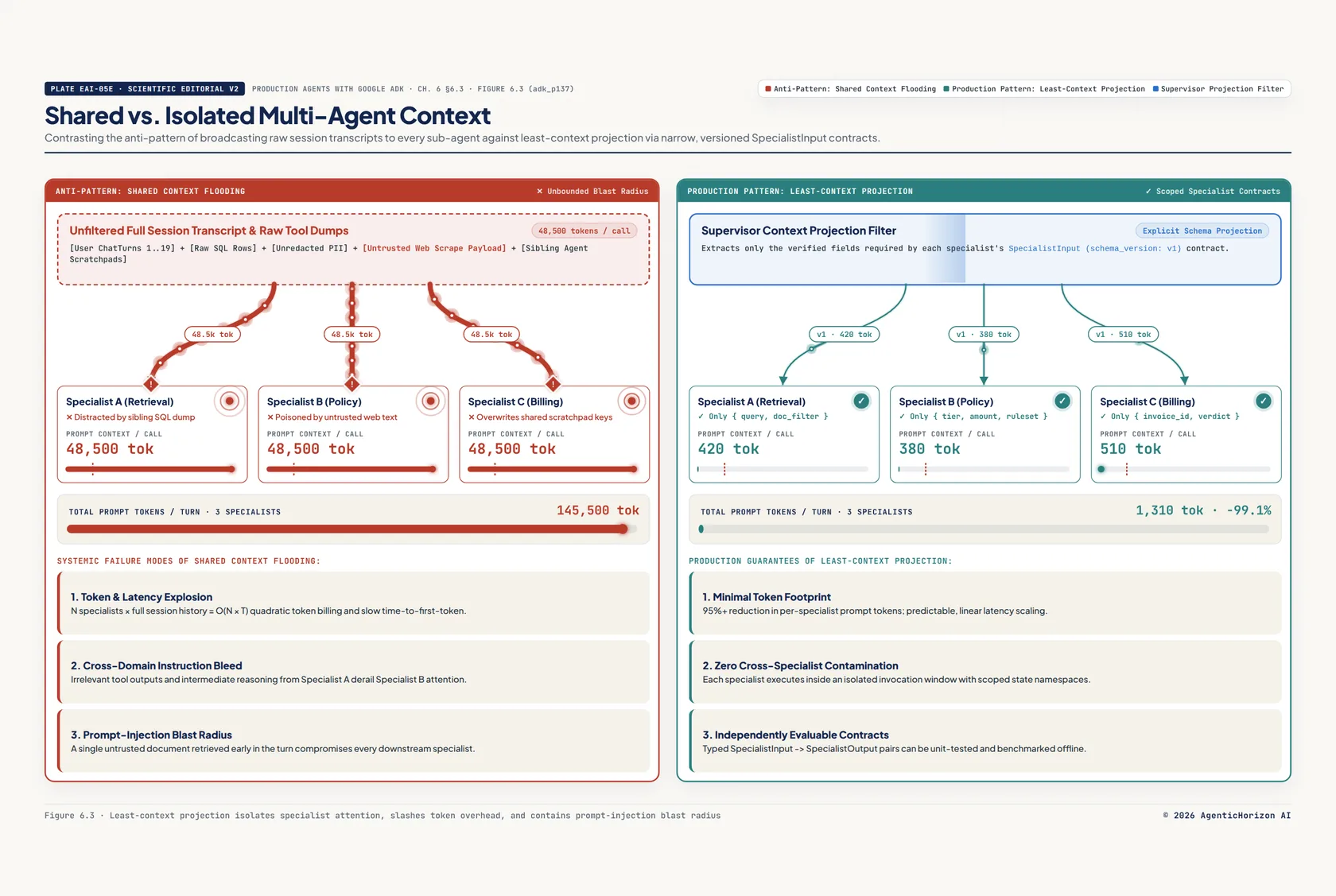
Shared Context Flooding vs. Least-Context Specialist Projection
1. The Single-Agent-First Rule and When Decomposition Actually Pays
A pervasive anti-pattern in contemporary AI engineering is splitting a straightforward workflow into five or six conversational "persona agents"—a Planner, a Researcher, a Writer, a Critic, and a Formatter—simply to mirror a human organizational chart. In an unconstrained peer-to-peer group chat, $N$ agents create $O(N^2)$ potential communication paths, multiplying token consumption, tail latency, and failure surfaces while making root-cause debugging nearly impossible.
The Coordination Tax of Premature Multi-Agent Splits
Multi-agent decomposition is never free; it is justified only when the Net Decomposition Payoff—the gain in specialization accuracy, context isolation, and parallel throughput—strictly exceeds the coordination tax of serialization, schema validation, and handoff latency. Our architecture therefore enforces the Single-Agent-First Rule: begin with a single bounded agent wrapped in a deterministic workflow shell until an explicit architectural boundary forces decomposition.
Five Structural Triggers That Earn Decomposition
Splitting a single agent into a supervisor-specialist hierarchy or parallel workflow is warranted under five measurable triggers: (T1) tool-catalog overload where >15–20 distinct tools degrade single-step selection precision, (T2) incompatible context regimes where massive raw document ingestion would drown downstream structured synthesis, (T3) independent parallelizable subtasks (such as simultaneous Buyer and Seller grounding checklists), (T4) adversarial verification separation where a critic or verifier must hold zero shared bias with the generator, and (T5) distinct security-authority compartments across organizational boundaries.
2. Why Shared Context Flooding Breaks Specialist Reasoning
Once a team adopts a multi-agent topology, the default behavior of many orchestration frameworks is Shared Context Flooding: passing the entire cumulative conversation transcript—every user message, intermediate scratchpad thought, failed tool call, and raw retrieval dump from Agents A, B, and C—directly into the prompt window of Specialist Agent D.
Cross-Turn Hallucination Amplification
Shared transcript flooding destroys the very benefit that specialist decomposition was meant to achieve. When a downstream pricing or compliance specialist receives 40,000 tokens of upstream brainstorming and discarded tool attempts, attention dilution causes the model to latch onto superseded figures or speculative hypotheses generated three hops earlier. Even worse, in automotive or retail catalog pipelines, residual attributes from a previously discussed product trim contaminate the specialist’s output for the current SKU.
Taint Contagion and Tenant Scope Leakage
From a zero-trust security standpoint, shared transcripts propagate provenance taint across the entire agent graph. If Specialist A ingests an untrusted external web page or vendor PDF and appends its raw output to a global shared transcript, every subsequent specialist that reads that transcript becomes tainted—forcing the Layer 3 policy gate to block autonomous writes across the entire workflow.
3. Least-Context Specialist Projection and the 60 / 30 / 10 Budget Compiler
Production multi-agent systems replace shared transcript concatenation with Least-Context Specialist Projection. Every model invocation is treated as a deterministic compiler pass that projects only the minimum sufficient information slice required for that specialist’s contract.
Four Orthogonal State and Memory Scopes
To prevent state conflation, the runtime maintains four strictly separated stores: (1) the ephemeral Session Transcript (human conversation history), (2) Authoritative Workflow State (mutated exclusively by deterministic FSM reducers and Layer 3 gates), (3) the Bitemporal Knowledge Graph (system-of-record entity facts with valid-time and transaction-time lineage), and (4) Evaluated Long-Term Memory (quarantine-screened cross-session profiles).
Compiling the 60 / 30 / 10 Token Allocation Slice
When invoking a specialist agent, the Deterministic Context Compiler partitions the target token window mathematically: 60% is allocated to canonical primary-entity facts extracted via parameterized SPARQL 1.1 or Cypher queries, 30% is allocated to the authoritative workflow state header, persona rules, and closed-world SHACL/policy constraints, and 10% is allocated to relevant episodic memory and live market telemetry. In production enterprise knowledge and decision intelligence deployments across 21 SPARQL resolvers, this 60/30/10 compilation budget completely eliminates cross-entity attribute contamination and context overflow.
4. Typed Delegation Envelopes and Attenuated Authority Handoffs
Communication between a coordinator and a specialist subagent must never occur through untyped natural-language prose. Every cross-agent handoff is packaged inside a nine-field DelegationEnvelope<TPayload> that enforces strict schema and authority boundaries:
interface DelegationEnvelope<TPayload> {
  readonly correlationId: string;
  readonly parentSpanId: string;
  readonly attenuatedIdentity: {
    readonly tenantId: string;
    readonly principalUri: string;
    readonly effectiveScopes: readonly string[]; // Scope(Child) ⊂ Scope(Parent)
  };
  readonly contextTaint: 'VERIFIED_INTERNAL_ONLY' | 'UNTRUSTED_EXTERNAL_INGEST';
  readonly budget: { maxIterations: number; maxTokens: number; deadlineEpochMs: number };
  readonly inputContractSchemaUri: string;
  readonly expectedOutputSchemaUri: string;
  readonly compiledPayload: TPayload;
}
When the specialist completes its bounded loop, its return payload is not merged blindly into the parent state. It must pass a three-outcome Parent Verification Gate: (1) ACCEPT_AND_MERGE if the output conforms to expectedOutputSchemaUri and domain invariants, (2) RETRY_WITH_DIAGNOSTIC if a local constraint failed and the specialist’s retry budget remains positive, or (3) ESCALATE_OR_ABSTAIN if the specialist encountered a knowledge gap or exhausted its budget.
5. The Immutable Versioned Data Bus and Checkpoint Promotion Pattern
In complex multi-stage pipelines—such as our six-stage Enterprise Evidence & Decision Engineering reference architecture built on Google ADK—allowing multiple parallel and sequential agents to mutate a shared dictionary in place creates race conditions and makes stage rollback impossible.
Instead, all inter-agent state flows through an Immutable Versioned Data Bus combined with the Checkpoint Promotion Lifecycle (draft → validated → promoted). Whenever an agent stage completes (for example, parallel 47-question requirement and capability taxonomy analysis or structured evaluation synthesis), it writes a new immutable artifact envelope (such as positioning.v1 or decision_narrative.v2) carrying cryptographic hashes of its parent inputs and explicit quantitative needed_data bindings.
Every newly emitted artifact enters the bus in draft state. Deterministic schema and fact-echo verifiers transition it to validated, and either an automated policy gate or a human reviewer promotes it to promoted. Downstream compilation stages are hard-coded to reject any upstream artifact whose lifecycle state is not promoted. In the documented reference implementation, unifying multi-agent state onto this immutable versioned bus delivered a 10× data-access speedup (reducing resolution latency from ~500ms to ~50ms), shrunk the orchestration codebase by 43%, and enabled instant point-in-time replay across every stage.