Executive Summary & Key Architectural Takeaways
- Never lecture before diagnosing: dumping unsolicited explanations wastes finite human attention on mastered concepts and masks the true root cause of errors.
- Start with brief, unassisted cold retrieval probes before working memory is primed by AI hints to measure genuine long-term schema accessibility.
- A single wrong answer is an ambiguous symptom; maintain a Bayesian diagnostic posterior across eight competing latent capability gaps.
- Select diagnostic probes via Expected Value of Information (EVI) and escalate along the Minimum Intervention Ladder (Cue → Bridge → Teach → Retest).
Minimum Diagnostic Routing Policy: Diagnose → Skip / Bridge / Teach
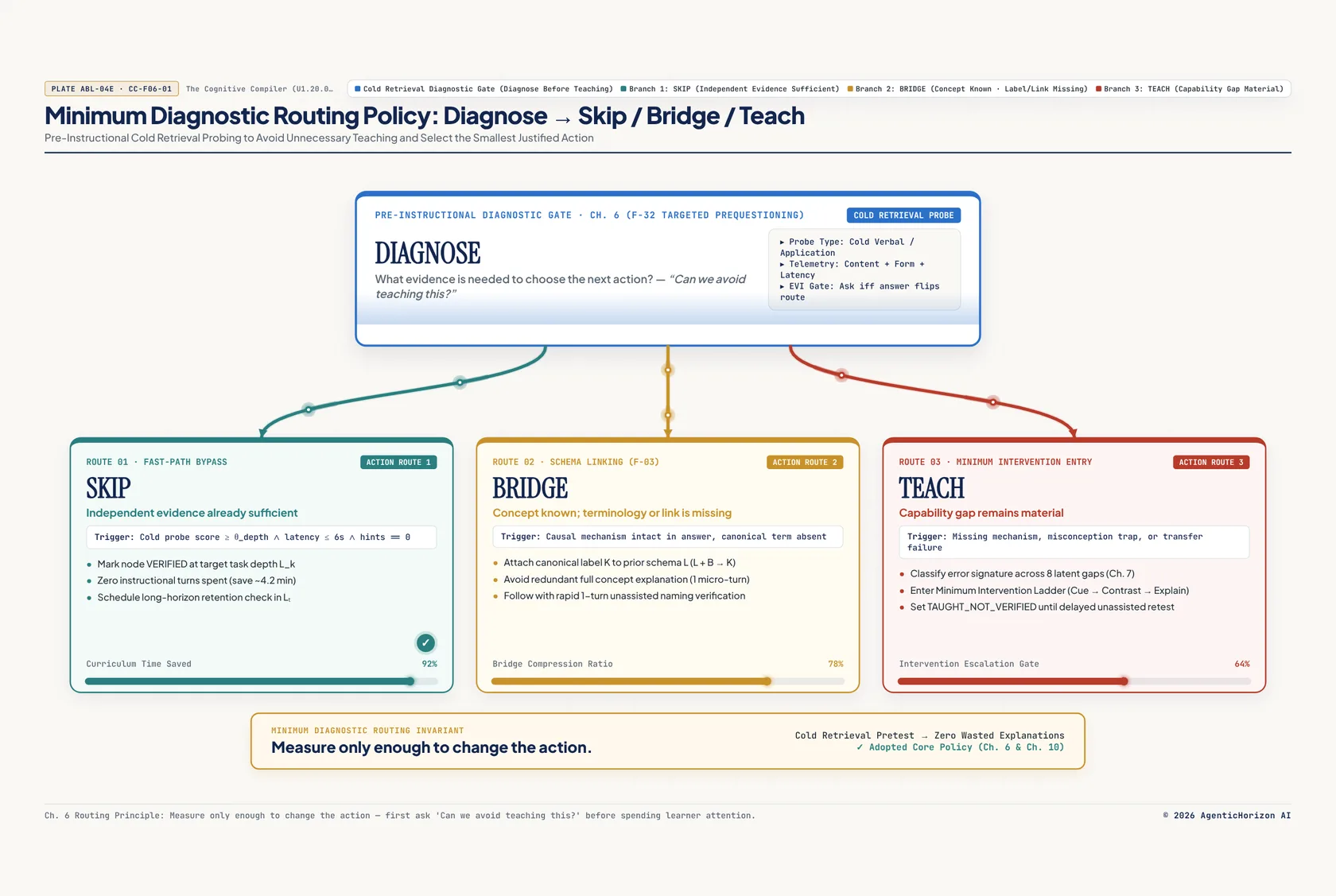
1. The Attention Scarcity Inversion: Why Lecturing Before Diagnosing Fails
In the legacy regime of cognitive scarcity, explanations were rare and expensive; a student waited for a scheduled lecture hall hour or searched through physical reference chapters. Today, generative AI has inverted that equation completely: synthetic explanations are instantaneous and infinite, while human cognitive attention and working-memory consolidation bandwidth are the hard, non-renewable bottlenecks.
Exponential Content Abundance vs. Finite Human Attention
Despite this inversion, nearly every conventional AI tutor and enterprise onboarding copilot defaults to "lecture-first" behavior. The moment a learner asks a question or misses a step, the model emits a 500-word textbook monologue covering definitions, background history, and worked examples.
Three Ways Blind Explanation Wastes Cognitive Bandwidth
Delivering an explanation before diagnosing the learner’s epistemic state fails in three distinct ways: (1) if the learner already possesses the underlying schema and merely made a momentary slip, a multi-paragraph lecture wastes valuable attention that should have been routed to Skip; (2) if the learner holds 90% of the mental model and only needs a single focusing prompt to connect two concepts, a full lecture steals the constitutive cognitive work that a lightweight Bridge would have preserved; and (3) if the learner is missing an upstream prerequisite concept two hops earlier in the knowledge graph K, explaining the advanced target concept directly bounces off without comprehension.
2. Cold Retrieval Probing: Measuring Schema Accessibility Without Priming
To measure what actually resides inside a human mind—what LiA2036 defines as Internal Sovereign Capability Residency—diagnostic assessment must begin with a Cold Retrieval Probe: a brief, unassisted retrieval, generation, or causal prediction challenge administered before any definitions, multiple-choice options, or AI hints prime the learner’s working memory.
Why Warm Recognition Masks Long-Term Memory Decay
When a system presents a concept summary or a multiple-choice list first, it tests warm recognition rather than cold retrieval. A practitioner who can recognize a valid distributed-systems invariant when it is highlighted on screen may be completely unable to summon that invariant from long-term memory under temporal decision pressure during a live production outage or clinical emergency. Furthermore, cognitive psychology demonstrates that the act of cold retrieval itself—even when partial or initially unsuccessful—potentiates subsequent encoding far more powerfully than passive reading.
The Prediction-Commit Lock in Interactive Studios
In our Interactive Causal & Counterfactual Sandbox studio archetype, cold probing is enforced structurally: when a learner manipulates system variables in a physics, economic, or distributed-architecture simulator, the "Run Simulation" button remains locked until the learner commits a falsifiable, unassisted prediction of the outcome and its causal mechanism.
3. Disambiguating the Eight Competing Latent Capability Gaps
When a learner’s cold retrieval probe or task attempt fails, treating "wrong answer on Concept X" as a single monolithic state is diagnostically blind. Behind a single incorrect response lie eight competing latent capability gaps maintained as a Bayesian posterior distribution inside Graph 2 (Lₜ):
- Missing Upstream Prerequisite Node in K: The learner understands the local rule of Concept X but lacks a foundational dependency $u \to X$ required to execute it.
- Terminological or Notation Confusion: The learner possesses the correct causal mental model in intuitive terms but misinterprets formal symbols or domain nomenclature.
- Flawed Causal Mental Model (Misconception Trap $M_k$): The learner operates under a systematic, internally consistent, but false causal theory that produces wrong predictions on boundary cases.
- Procedural Execution Slip Under High Mastery: The learner’s conceptual schema $\mu_t$ is high, but a transient arithmetic or syntax slip occurred under speed pressure.
- Precondition or Boundary Blindness: The learner applies a valid theorem or engineering pattern outside the domain constraints where its preconditions hold.
- Overgeneralized Analogy Trap: The learner imports an analogy from a familiar domain that breaks down on the target structural edge case.
- Cross-Representation Translation Failure: The learner can reason about the concept in prose or diagrams, but cannot translate that invariance into equations or executable code.
- Working-Memory Overload: The learner has mastered each component skill individually, but the simultaneous coordination load exceeds their current working-memory automation threshold.
Each of these eight root causes demands a radically different pedagogical intervention: a procedural slip (Gap 4) requires only a brief self-check cue, whereas a flawed causal mental model (Gap 3) requires a minimal falsifying counterexample, and a missing prerequisite (Gap 1) requires stepping backward along the dependency edge in K.
4. Expected Value of Information (EVI) Probe Selection Policy
If eight latent gaps compete to explain an error, why not administer a 20-question diagnostic battery before every lesson? Because endless testing is just as corrosive to human attention and motivation as endless lecturing. Diagnostic probing must be governed by decision theory.
Before issuing any diagnostic question $q$, Graph 3 (Fₜ) evaluates its Expected Value of Information (EVI) relative to the cost of learner attention:
EVI(q) = E_y [ max_a E[Utility(a | Posterior(Lₜ, q, y))] ]
         - max_a E[Utility(a | Prior(Lₜ))]

AskProbe(q) iff (EVI(q) > QueryAttentionCost(q)) AND (CanFlipOptimalAction(q) == true)
This controller invariant is decisive: never ask a diagnostic question whose outcome cannot change the next pedagogical action across Skip, Bridge, Prerequisite Remediation, or Teach. Once posterior uncertainty $\sigma_t$ narrows sufficiently that one intervention dominates, diagnostic probing stops immediately and compilation transitions to action.
5. The Pedagogical Permission Gate and Minimum Intervention Escalation Ladder
Once the diagnostic posterior identifies the active capability gap, how much help should the AI system provide? In LiA2036, every learning studio is governed by a deterministic Pedagogical Permission Gate enforcing the axiom that "Capability Does Not Imply Pedagogical Permission." Even though the language model can generate the complete solution in milliseconds, it is prohibited from doing so whenever the learner is operating in the LEARN mode of the 10-variable LASD router and remains within the productive Challenge Envelope.
Instead, the controller climbs the Minimum Intervention Escalation Ladder—selecting the smallest scaffold capable of unblocking productive struggle:
- Rung 1 · Deliberate Non-Intervention & Focus Cue: Withhold hints during initial productive struggle (<240 seconds) or point attention to the specific constraint violated without explaining how to fix it.
- Rung 2 · Minimal Falsifying Counterexample or Structural Bridge: Surface a concrete edge case where the learner’s stated hypothesis contradicts observable output, inviting the learner to revise their own schema.
- Rung 3 · Targeted Micro-Teach or Prerequisite Detour: Provide a concise explanation scoped strictly to the disambiguated gap (leaving the node in
TAUGHT_NOT_VERIFIED). - Rung 4 · Delayed Unassisted Transfer Retest: Require an unassisted transfer solution (
hints_used == 0) on an isomorphic problem variant to certify durable mastery.
By diagnosing cold before teaching and intervening minimally thereafter, educational and enterprise training systems protect the productive friction that builds sovereign human judgment.