Executive Summary & Key Architectural Takeaways
- Fluent AI explanations induce a powerful illusion of competence: reading or co-piloting a solution updates exposure state but proves zero internal mastery.
- Separate the read-only Canonical Knowledge Graph (K) from the Dynamic Learner Epistemic State (Lₜ) and the Adaptive Compilation Policy (Fₜ).
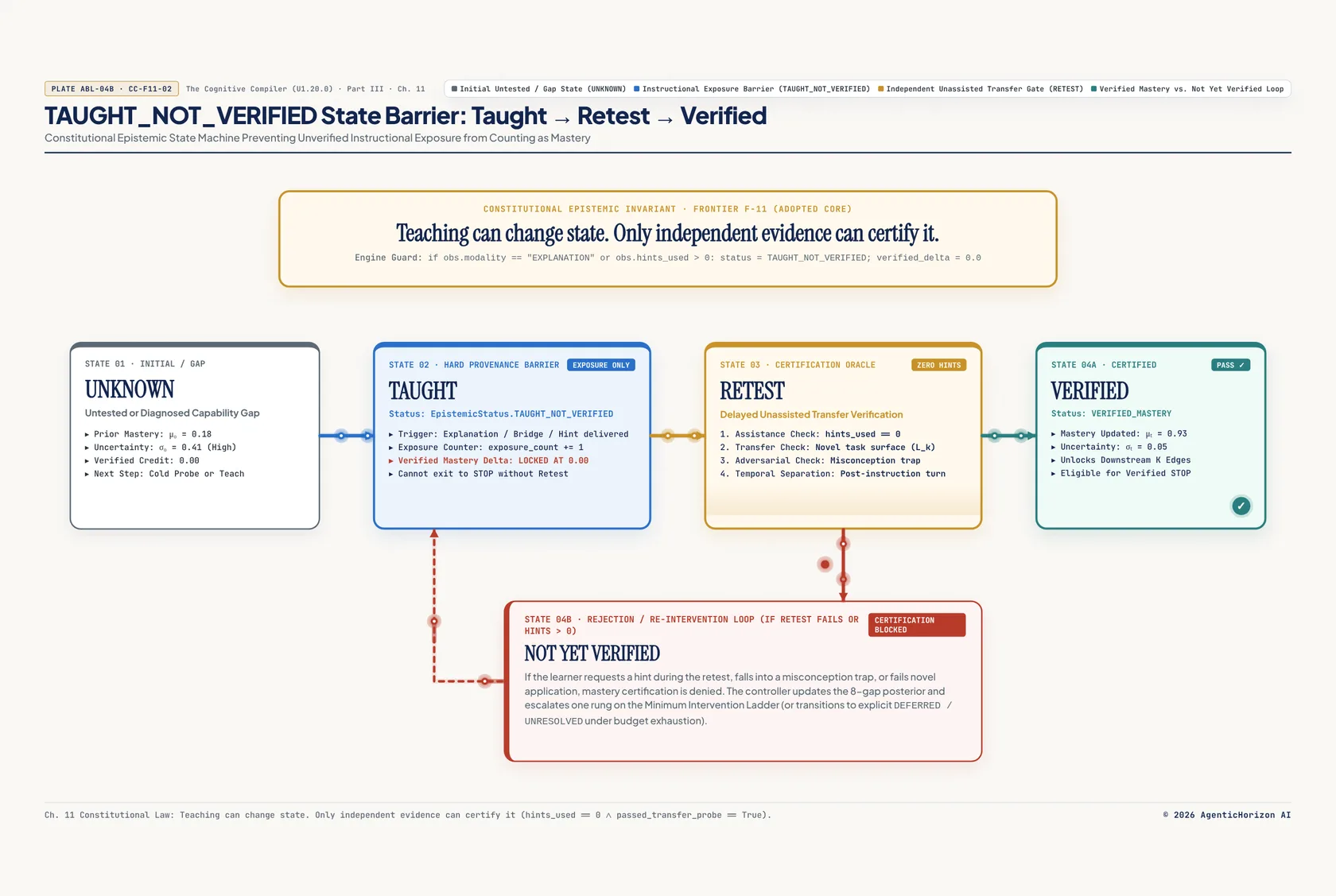
- Enforce the TAUGHT_NOT_VERIFIED state barrier: any turn involving an explanation or hints_used > 0 holds verified mastery growth at zero (verified_delta = 0.0).
- Transition a capability node to VERIFIED_MASTERY only when the learner passes an unassisted transfer probe and clears its targeted misconception trap.
TAUGHT_NOT_VERIFIED State Barrier: Taught → Retest → Verified
1. The Illusion of Competence and the Proxy Gap in AI-Saturated Learning
When a university student, medical resident, or enterprise systems engineer asks a conversational AI assistant to explain a distributed consensus protocol or walk through a differential diagnosis, the foundation model produces a clear, articulate, step-by-step explanation in seconds. The human reads the response, nods along as the logic flows effortlessly, and experiences a strong subjective feeling of understanding. Cognitive scientists call this trap the Illusion of Competence: mistaking the perceptual fluency of following someone else’s organized explanation for the ability to generate and apply that causal structure independently.
Why Conversational Helpfulness Undermines Schema Formation
Commercial chatbots are trained via reinforcement learning from human feedback (RLHF) to minimize user friction and deliver complete answers immediately. In routine administrative delegation, that helpfulness is an asset; in human capability building, it is a structural hazard. When an AI assistant supplies the crucial problem-framing step or hints at the edge case before the learner’s own working memory has wrestled with the structure, it short-circuits the constitutive cognitive effort required to wire durable schemas in long-term memory.
The Collapse of the Static Artifact Proxy
For centuries, educational institutions and professional certification boards relied on the finished artifact—the take-home essay, problem set, or code submission—as a trusted proxy for the learner’s internal cognitive work. Generative AI permanently severs that link, creating the Proxy Gap: an identical, polished submission can now result from deep independent mastery, heavily hinted AI co-piloting, or total cognitive bypass.
2. The Three-Graph Epistemic Compiler Architecture (K, Lₜ, Fₜ)
To transform cognitive abundance into verified human capability, our Adaptive Epistemic Compiler replaces unconstrained chat logs with a closed-loop control system operating over three strictly separated mathematical graphs:
Graph 1: Canonical Knowledge Graph (K)
K = (V_concepts, E_prereq, M_misconceptions, T_verification) models a domain not as flat textbook chapters, but as a read-only directed acyclic graph of typed concept nodes, hard prerequisite dependencies, explicit Misconception Trap Signatures ($M_k$), and graduated far-transfer verification tasks ($T_k$). Conversational tutor history is never allowed to mutate canonical domain structure in K.
Graph 2: Dynamic Learner Epistemic State (Lₜ)
For every concept node $v \in K$, the learner model maintains a time-varying five-element epistemic state vector: Lₜ(v) = [μₜ (mastery probability), σₜ (epistemic uncertainty), sₜ (memory stability/decay), cₜ (confidence calibration gap), hₜ (hint reliance)]. Tracking uncertainty $\sigma_t$, stability $s_t$, and hint reliance $h_t$ alongside mastery $\mu_t$ prevents the controller from confusing recent, heavily scaffolded success with durable retention.
Graph 3: Adaptive Compilation Policy (Fₜ)
At each step $t$, the compilation DAG Fₜ evaluates the active learning frontier and selects the optimal pedagogical action $a_t^*$ that maximizes expected verified mastery gain while penalizing cognitive overload and illusion-of-competence risk.
3. Enforcing the Hard TAUGHT_NOT_VERIFIED State-Machine Barrier
The foundational constitutional invariant of the Adaptive Epistemic Compiler is the TAUGHT_NOT_VERIFIED State Barrier. In naive adaptive learning platforms, watching an instructional walkthrough, reading an AI explanation, or answering a question correctly after clicking two hints increments the student’s mastery score. In our state engine, exposure and assisted completion are strictly segregated from verification:
if observation.modality == "EXPLANATION_DELIVERED" or observation.hints_used > 0:
    node_state.status = EpistemicStatus.TAUGHT_NOT_VERIFIED
    verified_mastery_delta = 0.0  # Hard invariant: exposure never certifies mastery
elif observation.is_transfer_probe and observation.passed_misconception_trap and observation.hints_used == 0:
    node_state.status = EpistemicStatus.VERIFIED_MASTERY
    verified_mastery_delta = compute_bayesian_update(node_state, observation)
Why Explanations and Hinted Completions Yield verified_delta = 0.0
Delivering a brilliant AI explanation transitions a concept node from UNKNOWN or DIAGNOSED_GAP to TAUGHT_NOT_VERIFIED. It records that instructional exposure occurred and schedules a subsequent verification task, but holds verified mastery growth at exactly zero (verified_delta = 0.0). Similarly, if a learner solves a practice problem using even a single structural hint (hints_used > 0), the engine logs the assisted progress in hₜ but refuses to transition the node to verified status.
Unassisted Transfer and Misconception Trap Clearance
A concept node can cross into VERIFIED_MASTERY if and only if the learner completes an unassisted transfer probe (hints_used == 0) on a structural problem variant they have not just seen explained, while simultaneously clearing the node’s targeted misconception trap $M_k$ and demonstrating retention across a spacing interval governed by memory stability $s_t$.
4. Empirical Provenance Defect Replay and Banned Anti-Patterns
Why must this barrier be enforced by a deterministic state engine rather than left to an LLM tutor’s judgment? In our empirical defect replay traces (PILOT-001 and PILOT-002), when assistance provenance was not enforced as a hard state-machine guard, learners who received step-by-step Socratic scaffolding produced correct final answers at the end of the dialogue turn; an unguarded evaluator recorded those turns as independent mastery, prematurely unlocking downstream dependent concepts in K for which the learner lacked the prerequisite mental schema.
To prevent such provenance corruption across all deployments, the compiler’s Frontier Decision Ledger formally classifies candidate assessment mechanisms into ADOPT, EXPERIMENT, WATCH, and REJECT dispositions. Most notably, Unverified Conversational Self-Report—the ubiquitous chatbot habit of asking "Does that make sense?" and treating the user’s "Yes, got it!" as evidence of learning—is permanently classified as REJECT (Banned Anti-Pattern). Learner self-report is a measure of conversational politeness or overconfidence calibration $c_t$, never a signal of mastery $\mu_t$.
5. Contestable Learner Models and Cryptographic Capability Evidence Passports
Enforcing rigorous verification must never turn educational software into an opaque, authoritarian black box. In our architecture, the dynamic epistemic state Lₜ is designed as an Open, Contestable Learner Model. At any moment, a student or professional trainee can inspect their exact capability graph, see why a specific node is marked TAUGHT_NOT_VERIFIED (for example, because prior success relied on hints or because memory stability $s_t$ decayed), and invoke their Right to Challenge—triggering an immediate, unassisted transfer verification probe to demonstrate mastery and override stale priors.
When a learner progresses across the Foundation–Anchor–Integration–Frontier (F-A-I-F) curriculum graph—combining unassisted Foundation transfer probes, planted-defect adversarial audit drills, and live perturbation defenses—the verification engine emits a tamper-evident W3C Verifiable Capability Evidence Passport. By recording the exact capability URI, the verification modality, and the assistance condition (ZERO_AI, AUGMENTED, or SUPERVISED), institutions replace broken take-home artifact proxies with verifiable proof of durable human mastery.